

Who Kener is for#
SaaS teams publishing status updates
Use Kener when customers need a clear public page for uptime, incidents, and maintenance windows.
Skip if:
You need advanced incident command, on-call scheduling, and vendor-managed global status infrastructure.
Open-source projects showing service health
Use Kener when a project runs public services and wants transparent status without paying for a hosted page.
Skip if:
Your project does not operate services that users depend on.
The problem it solves#
Customers need clear status updates during outages, but hosted status page tools add another vendor dependency and recurring cost. Small teams may only need a public status page, monitors, incidents, and maintenance messages without buying a larger observability platform.
The status page also has to remain trustworthy when the main product is degraded. Teams need a lightweight deployment they understand, can brand, and can keep separate from the application stack where possible.
How it solves it#
Status pages for services
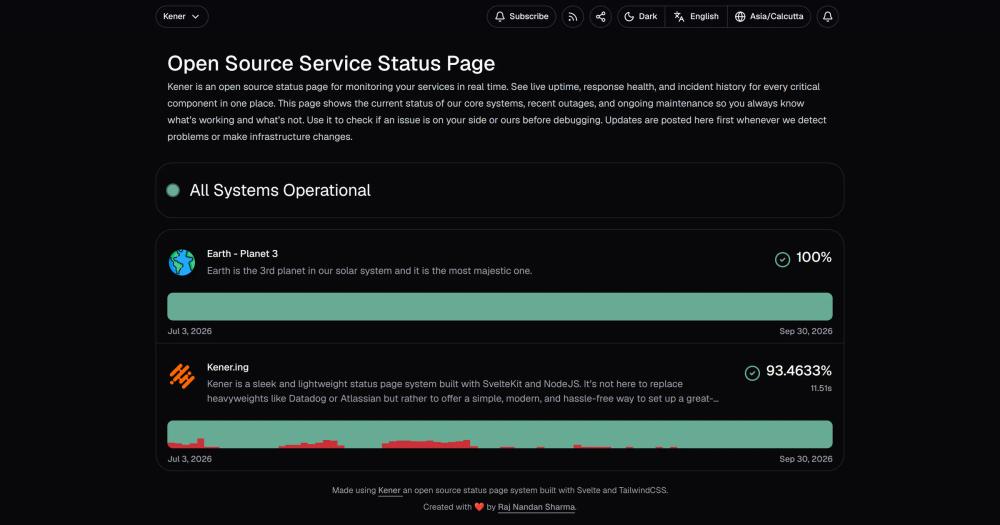
Kener lets teams publish service health, incidents, and maintenance information so users can see what is affected during outages.
Self-hosted deployment
The project supports self-hosting, giving teams control over branding, uptime checks, data, and deployment location.
Monitoring and incident communication
Kener combines status display with monitoring-oriented workflows, reducing the gap between detecting an issue and communicating it publicly.
Strengths and trade-offs#
Strengths
- Simple ownership of public status communicationKener gives teams a direct way to run their own status page instead of depending on a hosted status vendor for outage communication.
- Good fit for small services and open-source projectsThe project is lightweight enough for teams that need transparent uptime communication but not a full incident management suite.
Trade-offs
- -Not a full incident platformKener is a status page and monitoring tool, not a replacement for alert routing, on-call scheduling, retrospectives, and enterprise incident workflows.
What it's built on#
- Languages
- JavaScriptTypeScript
- Frameworks
- ExpressSvelte
- Databases
- MySQLPostgreSQL
- Runtimes
- Node.js
- Infrastructure
- Docker
- Cache
- Redis
- Tooling
- esbuild
FAQ#
What is Kener?
Kener is a self-hosted status page and monitoring tool for publishing service health, incidents, and maintenance updates.
Is Kener a Statuspage alternative?
Yes. Kener can replace hosted status page products for teams that want to run and brand their own status page.
Can Kener replace Datadog?
No. Kener is not a full observability suite. It is best used for status pages, monitoring signals, and incident communication.
Similar open-source tools#

Gatus
Check endpoints on a schedule and auto-publish a status page

Uptime Kuma
Track uptime for websites and APIs with 90+ alert integrations

Vela
OpenStreetMap and Google data, no account, no Play Services

Obtainium
Android app updates direct from GitHub and F-Droid

documenso
Open source DocuSign alternative with enterprise e-signatures

Nexion
Web3 SSH manager that replaces passwords with crypto keys