
Small teams publishing service health
Gatus fits teams that need endpoint checks plus a simple status page from a config file.
Skip if:
Use a managed status platform if external SLAs, subscribers, and incident comms are the main need.

Open source alternative to UptimeRobot, Atlassian Statuspage and Better Stack
Last verified
Gatus is a self-hosted endpoint health monitoring tool that checks services on a schedule, sends alerts via Slack or PagerDuty, and displays a public status page automatically. Apache-2.0 licensed, written in Go.
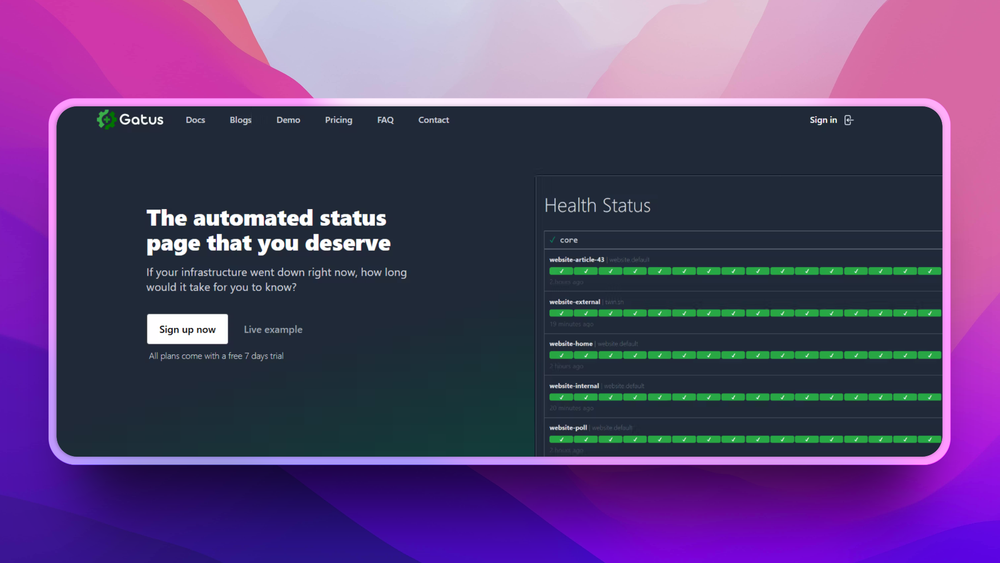
Gatus fits teams that need endpoint checks plus a simple status page from a config file.
Use a managed status platform if external SLAs, subscribers, and incident comms are the main need.
Gatus can watch APIs, ports, DNS, and other checks that a generic website monitor may not cover.
Skip it if you need deep APM, traces, or log analytics.
Hosted uptime tools are easy to start, but teams often outgrow basic ping checks. They need endpoint assertions, DNS checks, internal service visibility, and a status page that reflects what they actually monitor.
Small teams also want monitoring config in version control, not a set of hidden dashboard clicks that no one can review after an incident.
Gatus supports HTTP, TCP, ICMP, DNS, and custom-style health checks, covering more than simple website ping monitoring.
Checks live in configuration, which makes monitoring changes reviewable and repeatable across environments.
Gatus includes a public status-page view, so teams can expose service health without adding a separate status-page product.
Gatus supports HTTP, TCP, ICMP, DNS, and other health-check patterns through configuration.
Yes. Gatus includes a built-in status page for monitored endpoints.
Gatus is Apache-2.0 licensed.

Alternative to Atlassian Statuspage
Open source status page built with SvelteKit and SQLite

Alternative to UptimeRobot
Track uptime for websites and APIs with 90+ alert integrations

Alternative to Unraid
Browser desktop for your self-hosted home server

Alternative to Incident.io
Accelerate incident resolution with intelligent alert investigation

Alternative to Datadog
Open source agent that automates app deployment and monitoring

Alternative toDatadog
Instant observability with no-code setup.
Run Gatus on your own server
Hostinger sets Gatus up as a one-click app on a VPS.
Deploy on HostingerFeatured

Alternative to Grok Bot
AI teammates you own: your keys, your model, your machine.

Alternative to Superhuman
AI email assistant that drafts replies and clears your inbox

Alternative toClaude Managed Agents
Open-source agent deployment API. Self-host or use Omnara Cloud.
The projects we add and every new guide. Free, unsubscribe any time.
 Claude Code to
  OpenCode
 Jira to
  Windshift
 Notion to
  AppFlowy
 Slack to
  Mattermost
 Linear to
  GitLab
 Wispr Flow to
  Handy
Handy CapCut to
  Concat
 Grok Bot to
  rakazo
 Superhuman to
  Inbox Zero
 Airtable to
  AITable
 Muse to
  OpenClaw
 GitHub Copilot to
  Cline
Cline Datadog to
  Netdata
 Microsoft Teams to
  Rocket.ChatConfluence to
  Docmost
 Pinecone to
  Qdrant
 Zapier to
  n8n
n8n Devin AI to
  OpenHands
 Firebase to
  Supabase
 1Password to
  KeePassXC
 Contentful to
  Strapi
 Adobe Premiere Pro to
  Shotcut
 ChatGPT to
  AnythingLLM
 LangSmith to
  Langfuse


