

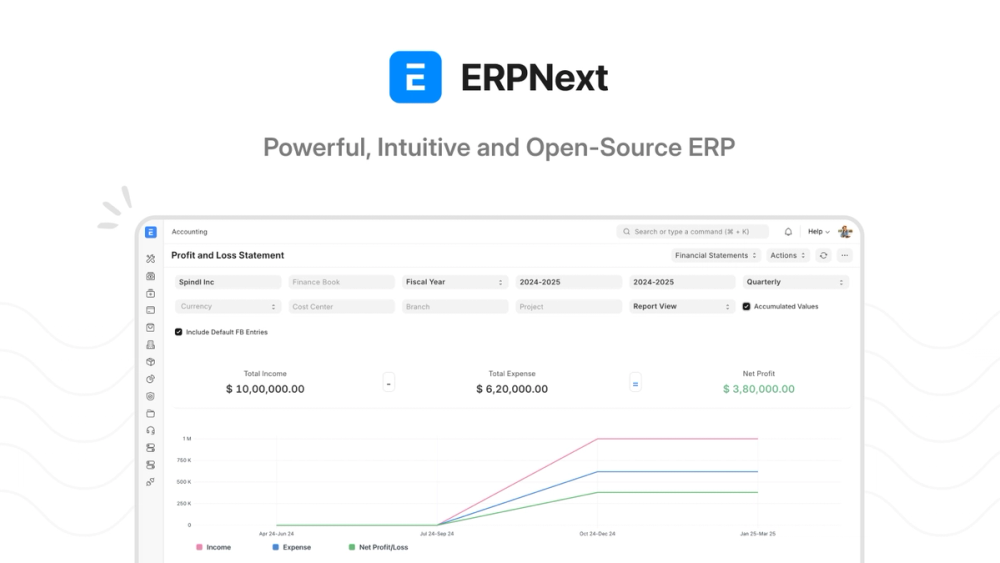
ERPNext is a free, open-source ERP platform that covers accounting, inventory, manufacturing, HR, and project management for organizations that need enterprise-grade business operations without SAP's licensing costs.
The Problem
SAP and Oracle NetSuite require implementation budgets that put them out of reach for most SMBs, nonprofits, and educational institutions. QuickBooks handles accounting but lacks manufacturing and inventory depth. Organizations with vertical-specific needs in education, healthcare, or manufacturing often cannot find a single platform that fits their workflows without expensive customization.
How ERPNext Solves It
ERPNext is built on the Frappe framework, a Python and JavaScript full-stack that lets teams build custom modules, forms, and workflows without modifying core ERP code. Standard modules cover accounting, HR, payroll, inventory, purchasing, sales, manufacturing, project management, and CRM. An education module supports school administration. A healthcare module handles patient billing and clinical workflows. GPL-3.0 licensed; deploy via Docker or frappe-bench.
Key Features
- Modules for accounting, HR, payroll, inventory, manufacturing, CRM, and projects
- Industry-specific modules for education and healthcare institutions
- Frappe framework for building custom modules without changing core ERP code
- Multi-company, multi-currency, and multi-warehouse support
- Built-in workflow engine, report builder, and form customizer
- GPL-3.0 licensed; Docker and frappe-bench deployment options
Who It's For
ERPNext is best for manufacturing companies, nonprofits, educational institutions, and mid-market businesses in cost-sensitive markets that need a complete ERP without SAP's licensing overhead.
Compared to SAP
Unlike SAP, ERPNext is fully open source, requires no per-user licensing fees, and runs on infrastructure you control. SAP offers deeper functionality for large enterprise operations and a broader partner ecosystem; ERPNext covers the ERP essentials at a fraction of the total cost of ownership for SMB and mid-market scale.


