

Who Jami is for#
Privacy-focused teams choosing open communication
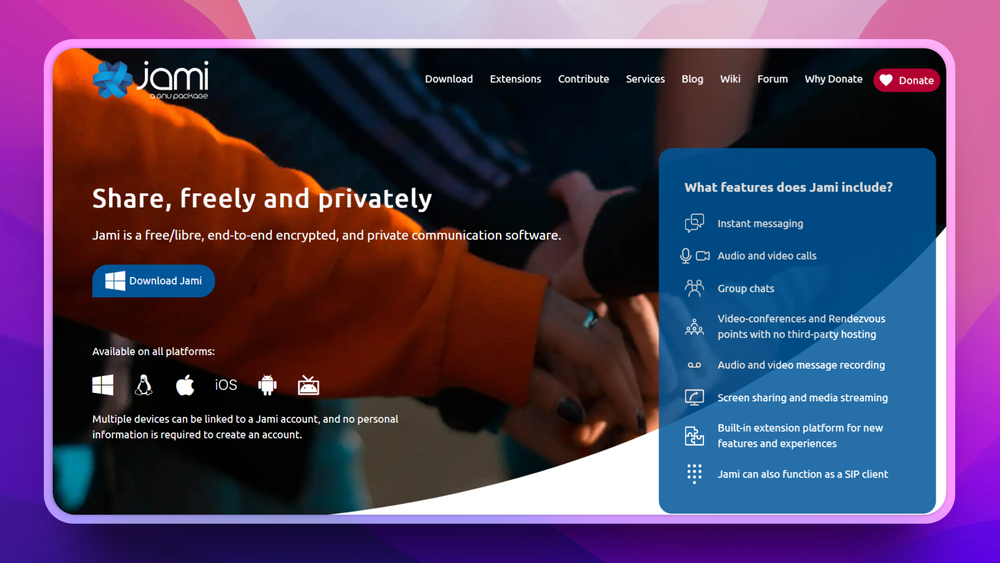
Jami fits groups that want inspectable voice, video, messaging, and file transfer with less dependency on a central provider.
Skip if:
You need the simplest managed workspace chat with broad enterprise integrations.
VoIP developers integrating open call logic
The daemon repository helps developers work with the core communication logic separately from client interfaces.
Skip if:
You only need a hosted meeting app and do not plan to run or integrate communication infrastructure.
The problem it solves#
Centralized calling and messaging services put accounts, routing, and metadata under one provider. That can be convenient, but it creates privacy concerns, outage dependency, and limited control over communication infrastructure.
Teams with stronger privacy requirements need communication tools that reduce central server reliance while still supporting practical calling, file transfer, and account workflows. They also need client and daemon boundaries developers can understand.
How it solves it#
Peer-to-peer distributed calls
The README lists P2P-DHT support, which lets Jami route calls through a distributed model instead of depending only on a central service.
SIP account compatibility
Jami can work with Asterisk through SIP accounts, which matters for organizations with existing VoIP infrastructure.
Separate daemon and interfaces
The README explains that the daemon handles business logic while user interfaces live separately, making integrations and alternate clients easier to reason about.
Strengths and trade-offs#
Strengths
- Distributed communication modelJami is strongest for users who want chat and calling without putting every interaction through a centralized platform account.
- Useful VoIP bridgeSIP and Asterisk compatibility make Jami relevant for teams that already understand VoIP systems and need open client infrastructure.
Trade-offs
- -Distributed systems can be harder to supportP2P communication can complicate troubleshooting, connectivity, and user onboarding compared with fully managed centralized services.
What it's built on#
- Languages
- CC++Objective-C++Python
FAQ#
What is Jami used for?
Jami is used for voice, video, messaging, file transfer, and VoIP-style communication.
Does Jami use peer-to-peer communication?
Yes. The README lists peer-to-peer distributed calls using P2P-DHT.
What is in the jami-daemon repository?
The README says the source tree contains the daemon that handles Jami business logic, while user interfaces live in separate repositories.
Similar open-source tools#

dcts-shipping
645 GitHub starsSelf-hosted Discord-style chat with encrypted DMs and voice
Alternative to Discord

simplex-chat
19,577 GitHub starsPrivate messaging without user IDs or servers.
Alternative toWhatsApp

Signal
10,739 GitHub starsA secure messaging app focused on privacy and user experience.
Alternative toWhatsApp

Valour
401 GitHub starsOpen source Discord alternative with flexible community tools
Alternative toDiscord

SpacebarChat
2,207 GitHub starsFree open source Discord reimplementation with full API parity
Alternative toDiscord

Revolt
3,400 GitHub starsSelf-hosted open source Discord alternative with servers
Alternative toDiscord