
Compliance-conscious organizations replacing GA4
Matomo gives teams stronger data control while retaining deep web analytics features.
Skip if:
Skip if you only need simple aggregate traffic numbers and want the smallest possible script.

Open source alternative to Google Analytics, Adobe Analytics and Mixpanel
Last verified
Track website traffic, goals, and ecommerce events with a self-hosted analytics suite. GPL-3.0 licensed, built for teams that need owned data.
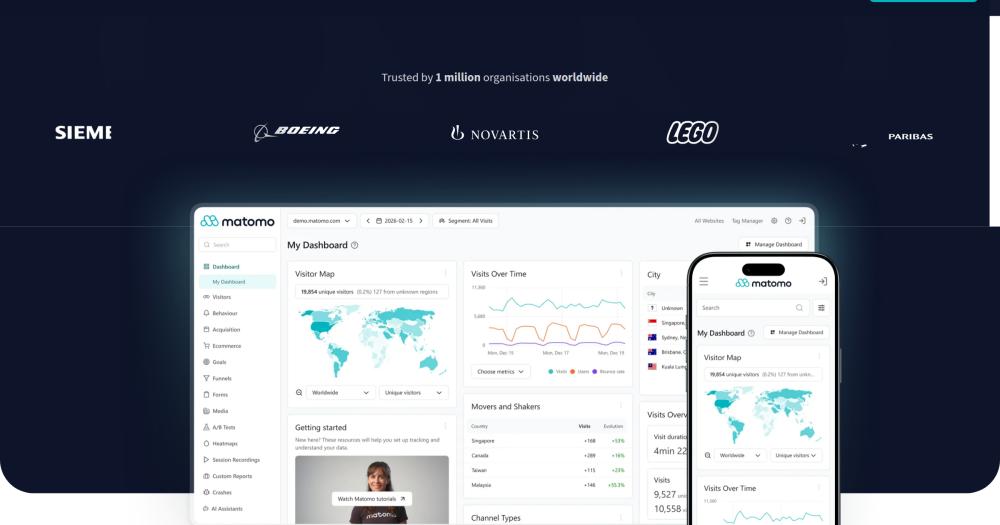
Matomo gives teams stronger data control while retaining deep web analytics features.
Skip if you only need simple aggregate traffic numbers and want the smallest possible script.
Matomo can track goals and ecommerce without sending all data to Google.
Skip if Google Ads attribution is the main reporting source.
Analytics teams often have to choose between shallow privacy tools and deep proprietary platforms. Google Analytics is feature-rich, but it sends data through Google infrastructure and can create consent, governance, and data residency work.
Organizations with compliance requirements need analytics that can run on their own servers while still covering goals, ecommerce, campaign tracking, and historical reporting. The challenge is getting enough depth without recreating a full analytics product internally.
Matomo can run on your own infrastructure so web analytics data stays under your administrative control.
The platform supports conversion and ecommerce reporting for teams that need more than page views.
Matomo includes privacy-focused configuration options for consent, anonymization, and data retention workflows.
Matomo has extensions and paid add-ons for teams that need features beyond core traffic analytics.
Matomo and Google Analytics both provide deep website analytics. Matomo differentiates through self-hosting and data ownership, while Google Analytics integrates deeply with Google’s advertising ecosystem.
| Criteria | Matomo | Google Analytics |
|---|---|---|
| License | GPL-3.0 | Proprietary |
| Self-hosting | Yes | No |
| Ecommerce analytics | Yes | Yes |
| Best fit | Owned analytics with privacy controls | Google Ads and audience attribution |
Matomo is better when data residency, consent control, and self-hosting matter. Google Analytics remains better when the organization depends on Google Ads attribution and does not want to run analytics infrastructure.
Yes. Matomo is open source under the GPL-3.0 license.
Matomo can replace Google Analytics for many traffic, goal, and ecommerce analytics workflows, especially when self-hosting matters.
Usually yes. Matomo has a broader analytics surface and can require more database and server maintenance than lightweight analytics tools.

Alternative to Google Analytics
Self-hosted analytics for product and marketing teams

Alternative toGoogle Analytics
Cookie-free web analytics for privacy-focused teams

Alternative to Plausible Analytics
Open source self-hosted analytics for total data ownership

Alternative toGoogle Analytics
Privacy-first open source web analytics with no cookies

Alternative to Mixpanel
Open-source analytics with funnels, replay, and self-hosting

Alternative toGoogle Analytics
Cookieless web analytics: GDPR compliant, 18 KB script
Run Matomo on your own server
Hostinger sets Matomo up as a one-click app on a VPS.
Deploy on HostingerFeatured

Alternative toClaude Managed Agents
Open-source agent deployment API. Self-host or use Omnara Cloud.

Alternative to Grok Bot
AI teammates you own: your keys, your model, your machine.

Alternative to Superhuman
AI email assistant that drafts replies and clears your inbox
The projects we add and every new guide. Free, unsubscribe any time.
 Claude Code to
  OpenCode
 Jira to
  Windshift
 Notion to
  AppFlowy
 Slack to
  Mattermost
 Linear to
  GitLab
 Wispr Flow to
  Handy
Handy CapCut to
  Concat
 Grok Bot to
  rakazo
 Superhuman to
  Inbox Zero
 Airtable to
  AITable
 Muse to
  OpenClaw
 GitHub Copilot to
  Cline
Cline Datadog to
  Netdata
 Microsoft Teams to
  Rocket.Chat
 Pinecone to
  Qdrant
 Zapier to
  n8n
n8n Devin AI to
  OpenHands
 Firebase to
  Supabase
 1Password to
  KeePassXCConfluence to
  Docmost
 Contentful to
  Strapi
 Adobe Premiere Pro to
  Shotcut
 ChatGPT to
  AnythingLLM
 LangSmith to
  Langfuse


