

Who Plausible is for#
SaaS founders tracking landing pages
Plausible gives founders traffic, source, and conversion data without adding a heavy analytics suite to a small marketing site.
Skip if:
Skip if your growth motion depends on Google Ads attribution and audience exports.
Publishers avoiding cookie banners
Plausible fits content sites that want useful aggregate metrics while minimizing personal data collection.
Skip if:
Skip if you need heatmaps, session replay, or deep behavioral funnels in the same product.
The problem it solves#
Website analytics often asks teams to trade simple traffic insight for consent banners, heavy scripts, and ad-tech data sharing. Google Analytics can answer advanced marketing questions, but many sites only need to know which pages, sources, and campaigns work.
Privacy-focused teams also need analytics they can explain to visitors. When a dashboard depends on cookies, cross-site identifiers, or third-party advertising infrastructure, every report creates compliance and trust work beyond the analytics task itself.
How it solves it#
Cookieless tracking
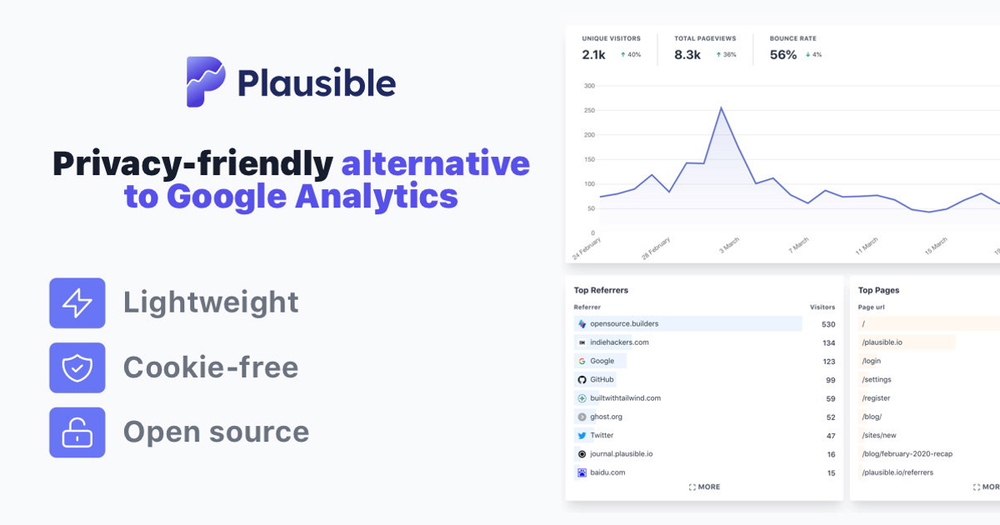
Plausible measures visits without cookies or cross-site identifiers, reducing consent-banner overhead for simple traffic analytics.
Lightweight tracking script
The project positions its script as small and privacy-focused, which fits content sites that care about page speed.
Goals and campaigns
Teams can track conversions and UTM campaigns without adopting a full product analytics suite.
Cloud or self-hosted deployment
Plausible offers a hosted service and an open source self-hosted path for teams with data-control requirements.
Strengths and trade-offs#
Strengths
- Privacy-first analytics modelPlausible avoids visitor profiles and ad-network data sharing, which makes its reports easier to defend than Google Analytics for many content sites.
- Simple dashboard for non-analystsThe product focuses on core site metrics in one interface instead of requiring users to build reports across several analytics menus.
Trade-offs
- -Less advanced attributionPlausible is not a full replacement for GA4 when a team depends on Google Ads attribution, audience segmentation, or deep product analytics.
- -Self-hosting adds database operationsRunning Plausible yourself means maintaining its supporting services, upgrades, backups, and email or proxy setup where needed.
Plausible vs alternatives#
Plausible vs Google Analytics
Plausible and Google Analytics both report website traffic, but they answer different adoption questions. Plausible optimizes for privacy, speed, and simple reporting; Google Analytics optimizes for deeper advertising and audience workflows.
| Criteria | Plausible | Google Analytics |
|---|---|---|
| License | AGPL-3.0 | Proprietary |
| Self-hosting | Yes | No |
| Cookies | No cookies by default | Uses identifiers depending on setup |
| Best fit | Privacy-friendly site analytics | Advanced ad and audience analysis |
Plausible is the better fit when a team needs aggregate analytics without sending visitor behavior into Google advertising infrastructure. Google Analytics remains the better fit when ad attribution, remarketing audiences, and deep campaign reporting are required.
What it's built on#
- Languages
- ElixirJavaScriptTypeScript
- Frameworks
- ExpressPhoenixReactTailwind CSS
- Databases
- ClickHousePostgreSQL
- Tooling
- Rollup
FAQ#
Is Plausible open source?
Yes. Plausible Analytics is open source under the AGPL-3.0 license.
Can Plausible replace Google Analytics?
Plausible can replace Google Analytics for simple privacy-friendly traffic reporting, goals, and campaigns. GA4 remains stronger for advanced advertising attribution and audience analysis.
Can I self-host Plausible?
Yes. Plausible supports self-hosting, but production operation requires maintaining its databases, upgrades, and infrastructure.
Similar open-source tools#

rybbit
Cookieless web analytics: GDPR compliant, 18 KB script

Umami
Self-hosted analytics for product and marketing teams

Matomo
Self-hosted Google Analytics alternative, 100% data ownership

openpanel
Open-source analytics with funnels, replay, and self-hosting

Traffic Source
Open source self-hosted analytics for total data ownership

PostHog
Track events, replay sessions, and run A/B tests, self-hostable