

Backend developers testing local and staging APIs
Use Yaak for day-to-day request building across HTTP, GraphQL, WebSockets, SSE, and gRPC without cloud sync.
Skip if:
Skip if your team relies on Postman enterprise workspaces and governance.
Last verified
Run local-first API tests for HTTP, GraphQL, gRPC, SSE, and WebSockets with an MIT-licensed desktop client.
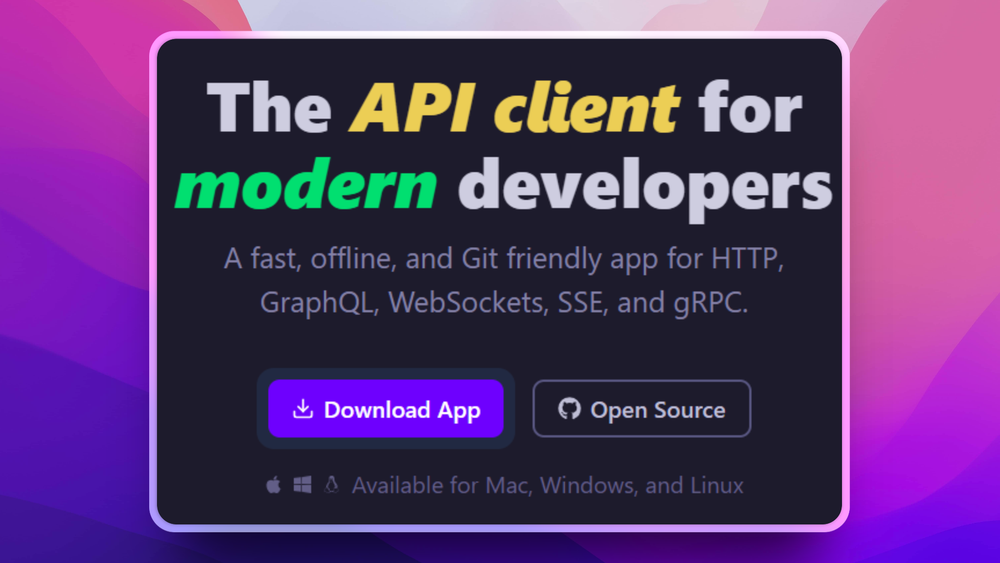
Use Yaak for day-to-day request building across HTTP, GraphQL, WebSockets, SSE, and gRPC without cloud sync.
Skip if your team relies on Postman enterprise workspaces and governance.
Yaak keeps credentials local, reducing exposure to a third-party API-client cloud.
Skip if your policy requires centralized managed sharing and audit logs for every collection.
API clients are everyday developer tools, but cloud-first workspaces can create friction for teams handling sensitive credentials. Request collections, tokens, staging URLs, and production examples often sync to a vendor account by default.
Developers need a fast request client that works offline, keeps secrets local, and still supports modern API protocols beyond simple HTTP.
Keeps workspaces, requests, environments, and secrets on the local machine instead of requiring a hosted account.
Supports HTTP, GraphQL, WebSockets, Server-Sent Events, and gRPC in one desktop application.
Runs on macOS, Windows, and Linux, which makes it practical for mixed engineering teams.
Yaak and Postman both help developers send API requests and manage environments. Yaak keeps request data local; Postman centers a cloud workspace with broad collaboration and governance features.
Yaak is better for developers who want offline API testing and local credential control. Postman is still better for large teams that need managed collaboration, mocks, documentation portals, and enterprise administration.
Yes. Yaak is open source under the MIT license.
Yaak supports HTTP, GraphQL, WebSockets, Server-Sent Events, and gRPC.
Yaak is local-first and account-free for core use. Postman has a larger managed collaboration platform and enterprise feature set.

Alternative to Postman
Local-first API client for HTTP, REST, and GraphQL

Alternative toPostman
Open source Postman alternative for REST and GraphQL testing

Alternative toPostman
AI-powered CLI for automated API testing with natural language

Alternative toPostman
AI-powered tool that converts API traffic into test cases

Alternative to AWS API Gateway
High-performance Python API framework with auto OpenAPI documentation

Alternative to Composio
Open reference servers for connecting AI to external tools and data
Featured

Alternative to Grok Bot
AI teammates you own: your keys, your model, your machine.

Alternative toClaude Managed Agents
Open-source agent deployment API. Self-host or use Omnara Cloud.

Alternative to Superhuman
AI email assistant that drafts replies and clears your inbox
The projects we add and every new guide. Free, unsubscribe any time.
 Claude Code to
  OpenCode
 Jira to
  Windshift
 Notion to
  AppFlowy
 Slack to
  Mattermost
 Linear to
  GitLab
 Wispr Flow to
  Handy
Handy CapCut to
  Concat
 Grok Bot to
  rakazo
 Superhuman to
  Inbox Zero
 Airtable to
  AITable
 Muse to
  OpenClaw
 GitHub Copilot to
  Cline
Cline Datadog to
  Netdata
 Microsoft Teams to
  Rocket.ChatConfluence to
  Docmost
 Pinecone to
  Qdrant
 Zapier to
  n8n
n8n Devin AI to
  OpenHands
 Firebase to
  Supabase
 1Password to
  KeePassXC
 Contentful to
  Strapi
 Adobe Premiere Pro to
  Shotcut
 ChatGPT to
  AnythingLLM
 LangSmith to
  Langfuse


