
Open Source Alternatives LogoOpen Source Alternatives
AlternativesBlogAdvertise
Open Source Alternatives LogoOpen Source Alternatives

Stay Updated

Subscribe to our newsletter for the latest news and updates about Alternatives

Open Source Alternatives LogoOpen Source Alternatives

Handpicked Open Source Alternatives to Paid Softwares

Product
  • Search
  • Categories
  • Tag
  • Sign In
Resources
  • Blog
  • Collection
  • Submit
  • Advertise your tool
Company
  • Privacy Policy
  • Terms of Service
  • Refund Policy
  • Sitemap
Copyright © 2026 All Rights Reserved.
Home/Categories/AI & Machine Learning/Octrafic
icon of Octrafic

Octrafic

Open source alternative to Postman, Testsigma and Katalon Studio

AI-powered CLI tool for automated API testing using natural language commands.

Repository

Stars
33
Forks
5
License
MIT
Latest
v0.6.0
Last commit
67 days ago
Last verified
May 21, 2026
Repo
octrafic/octrafic-cli ↗
33 starsGoMITActive recently
Visit websiteGitHub repo
image of Octrafic
Contents
  1. 01What Octrafic does
  2. 02Who Octrafic is for
  3. 03The problem it solves
  4. 04How it solves it
  5. 05Strengths and trade-offs
  6. 06Install and self-host
  7. 07Tech stack
  8. 08FAQ
  9. 09Similar open-source tools
TL;DR

Octrafic is an MIT-licensed CLI for testing APIs from natural language prompts and existing API specs. It replaces manual Postman collections and one-off curl scripts with generated test plans, exports, reports, and CI-friendly headless runs.MIT · Go · 33 stars · Active recently

what it does

What Octrafic does#

who it's for

Who Octrafic is for#

Backend developers exploring unfamiliar APIs

Octrafic helps developers turn docs and prompts into testable requests when they need quick coverage for an API they did not write.

Skip if

You already maintain strict contract tests in code and do not need interactive exploration.

QA teams creating repeatable API checks

The export and headless modes help QA teams move from exploratory prompts to repeatable test assets.

Skip if

Your team cannot use LLM providers in the test workflow.

the problem
tech stack · detected from GitHub

What it's built on#

Languages
GoPython
frequently asked

FAQ#

What does Octrafic test?
Can Octrafic run in CI?
Which API formats does Octrafic support?
also worth a look

Similar open-source tools#

Echolon

Echolon

Local-first API client for HTTP, REST, and GraphQL

49TypeScriptMIT

Additional details

Language
Go
Open issues
13
Contributors
3
First release
2026

Categories

AI & Machine LearningDeveloper ToolsDevOps & CI/CD

Tags

AI Coding AssistantAPI Development ToolsCLITestingLLMWorkflow AutomationDevOps Tools

The problem it solves#

how Octrafic solves it

How it solves it#

Natural language test planning

Octrafic lets users describe what they want to test in plain English, then generates and executes an API test plan.

Broad spec input support

The README lists OpenAPI 3.x, Swagger 2.0, Postman Collections, GraphQL, and Markdown documentation as supported sources.

Multiple export targets

Test sessions can export to Postman collections, Python pytest files, or Bash curl scripts for reuse outside the interactive CLI.

Headless CI mode

Octrafic includes a non-interactive octrafic test command so API checks can run in pipelines.

strengths · trade-offs

Strengths and trade-offs#

Strengths

  • Bridges docs and executable checksSupport for multiple spec formats helps teams turn existing API documentation into runnable tests without starting from a blank collection.
  • Useful beyond the CLI sessionExports to Postman, pytest, curl, and PDF reports make Octrafic output portable for teams that need reviewable artifacts.

Trade-offs

  • -AI-dependent test qualityNatural language generation still needs review. Teams should inspect generated tests, especially for auth behavior, destructive endpoints, and edge cases.
install · self-host

Install and self-host#

bash
```bash
curl -fsSL https://octrafic.com/install.sh | bash

brew install octrafic/tap/octrafic
```
Maestro

Maestro

Simple end-to-end testing for iOS, Android, and web apps

14.1KKotlinApache-2.0
Hoppscotch

Hoppscotch

Open source Postman alternative for REST and GraphQL testing

79.2KTypeScriptMIT
Yaak

Yaak

Local-first API client for HTTP, GraphQL, and WebSocket

18.6KTypeScriptMIT
Keploy

Keploy

AI-powered tool that converts API traffic into test cases

17.2KGoApache-2.0
DeepSeek TUI

DeepSeek TUI

A coding agent that lives in your terminal.

27.6KRustMIT

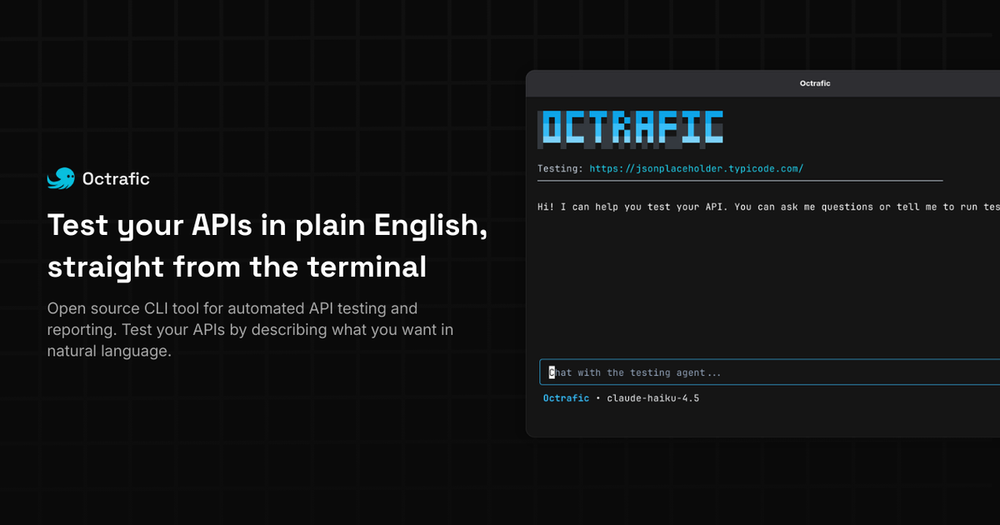
Octrafic is an open-source command-line interface (CLI) tool designed for automated API testing. It leverages AI to allow users to test APIs by simply describing what they want to test in natural language, making it accessible for both technical and non-technical users.

Key Features:

  • Natural Language API Testing: Users can describe tests in plain English, and the AI agent generates and executes the necessary API requests.
  • Real API Requests: Tests are run against actual APIs, providing real status codes and errors without the need for mocks.
  • PDF Report Generation: Easily export test results to a styled PDF for sharing with teams or stakeholders.
  • Multiple LLM Provider Support: Compatible with various LLM providers like OpenAI and Anthropic, allowing flexibility in testing.
  • OpenAPI Spec Generation: Automatically generate OpenAPI specifications from your codebase, simplifying the testing process.

Use Cases:

  • For Developers: Test REST APIs without writing code, streamlining the development process.
  • For DevOps: Integrate into CI/CD pipelines to automate API testing on every commit, catching regressions early.
  • For QA Engineers: Non-technical teams can perform API tests using natural language commands, enhancing collaboration and efficiency.
  • For API Validation: Validate OpenAPI specifications to ensure APIs behave as documented, improving reliability and user experience.

Octrafic tests APIs by reading specs or docs, generating requests, executing them, and reporting the result.

Yes. The README lists a headless CI mode through octrafic test for non-interactive pipeline runs.

API testing often starts as a pile of curl commands, Postman collections, and documentation pages that drift from the actual service. Teams know what behavior they want to verify, but turning that intent into repeatable tests takes time.

The gap grows when APIs use mixed documentation formats or multiple authentication methods. A developer may need to read OpenAPI, Swagger, Postman, GraphQL, and Markdown docs before they can create even basic coverage.

The README lists OpenAPI 3.x, Swagger 2.0, Postman Collections, GraphQL, and Markdown documentation.