

Who Altorank is for#
Content teams running a regular publication schedule
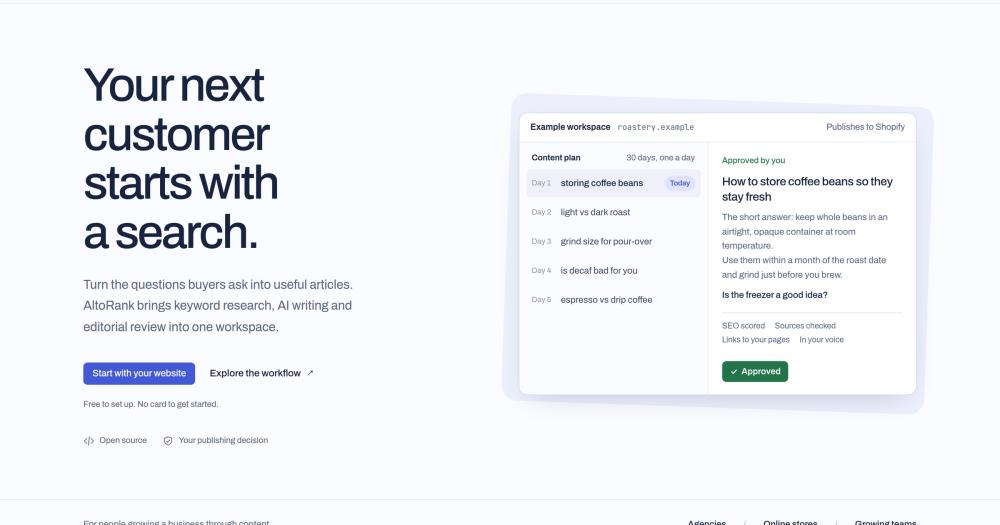
AltoRank holds a content plan (for example, 30 articles per month), drafts each article when it is due, and queues it for reviewer approval. The editorial gate keeps the team's name on every article without requiring a reviewer to be present during generation.
Skip if:
Your publish cadence is fewer than a few articles per week. The setup overhead is higher than drafting manually for occasional content needs.
Agencies managing content for multiple clients
Each workspace keeps a client's voice profile, keyword plan, content history, and analytics connections separate. The Agency hosted plan includes unlimited workspaces; self-hosting removes per-workspace cost entirely.
Skip if:
Your clients require direct CMS publishing today. The CMS adapters are built but not yet verified end to end; Markdown and HTML export is the current reliable path.
Developers building AI-assisted editorial workflows
The MCP server and agent API let you drive keyword research, draft generation, and content plan management from an AI coding agent or custom automation. The AltoRank skill installs via npx skills add AltoRank/altorank and works with Claude Code, Cursor, Codex, and other supported agents.
Skip if:
You need the agent to approve and publish drafts autonomously. The API has no such calls, and adding one would violate the project's stated contribution policy.
Self-hosters who need full data ownership
Running AltoRank on your own Supabase instance keeps keyword data, drafts, voice profiles, and analytics connections on infrastructure you control. The AGPL-3.0 license permits commercial use, including internal client work, without a subscription fee.
Skip if:
You are not comfortable running a Node application with Supabase. The hosted app at app.altorank.co removes that operational overhead at €69 per month.
The problem it solves#
Scaling SEO content production means maintaining research quality, editorial consistency, and publishing control across many articles. Most teams solve this by stringing together separate paid tools, using one for keyword research, another for AI drafting, and a third for optimization scoring. The workflow breaks at each handoff, and the approvals and publishing steps remain outside those tools.
The accountability gap is the harder pain. AI-generated content can reach a live site before anyone has reviewed it for accuracy or verified the sources behind its claims. For teams that put their name on the articles they publish, the absence of a reliable approval gate is a real operational risk.
How it solves it#
Keyword research via DataForSEO
Queries DataForSEO for keyword volume, difficulty, and SERP competition data to populate the content plan. Without DataForSEO credentials, the research step is skipped rather than failed, so the drafting pipeline still runs on the remaining inputs.
Scored and fact-checked article generation
Generates a structured draft from a keyword brief, then runs an SEO score pass and a fact-check pass. Any figure citing a source is looked up on that source page; figures with no source are flagged. The Approve button refuses a draft with unresolved unsourced figures.
Human-approval gate enforced at database level
No article can reach a CMS or be marked live without approval recorded under a named person. A site member can enable an auto-approve rule that approves drafts after a configurable hold window, but the rule is set by a named person and runs stricter checks than the manual Approve button.
MCP server and agent API
Exposes research, drafting, and content-plan operations as MCP tools at /api/mcp (Streamable HTTP, OAuth). AI agents can queue drafts for human review and manage the content plan; the API has no approve, delete, or publish call by design.
Markdown, HTML, and CMS export
Every draft exports as Markdown (front matter included), HTML, or a .md file download. Thirteen adapters cover ten CMS platforms including WordPress, Shopify, Webflow, Ghost, and Framer; direct CMS publishing is built but awaiting end-to-end verification against live sites.
Strengths and trade-offs#
Strengths
- Approval gate enforced below the application layerThe approval constraint is written into the database schema (migration 109). Only the server can mark an article as approved, and a signed-in user's own database client cannot bypass it. An edit to approved text sends the article back to review. The restriction is not a UI toggle.
- Full self-hosting with no feature tier held backThe self-hosted version is the complete product, AGPL-3.0 licensed, with no separate paid tier held behind an ee/ directory. The same codebase powers app.altorank.co, so keyword research, AI drafting, scoring, fact-checking, rank tracking, and the MCP server are all available to self-hosters.
- Agent API with enforced authority limitsThe MCP server and agent API can research keywords, suggest topics, generate drafts, and manage the content plan, but have no approve, delete, or publish calls. The restriction is at the API level, not configuration, so it cannot be worked around by an agent.
- 35-locale keyword research and article generationKeyword research, SEO scoring, and article generation span 35 locales (apps/web/lib/seo/locales.ts), covering regional search intent across European, North American, and Asia-Pacific markets without requiring separate workspace configurations per region.
Trade-offs
- -CMS publishing unverified end to endThirteen CMS adapters are built and the connection form covers all platforms, but none has been tested against a live site. Every published draft is available as Markdown or HTML export today; direct CMS publishing requires requesting integration assistance until the adapters are verified.
- -Early-stage project with limited community validationAltoRank was created in August 2026 and has 3 GitHub stars and 13 open issues as of October 2026. The hosted app runs from main, but the codebase has not been validated by a broader contributor community. Teams with low tolerance for early-stage software should evaluate the project timeline before committing.
- -Self-hosting requires multiple external servicesA complete self-hosted install needs Node 22+, a Supabase project, an Anthropic API key for article generation, a Resend account for transactional email, and optionally DataForSEO credentials for keyword data. Setup involves more moving parts than a single Docker image.
Altorank vs alternatives#
AltoRank vs Surfer SEO
Surfer SEO is an on-page optimization tool. Bring a draft or URL and it scores the content against competing pages, suggesting terms to add. AltoRank covers the same scoring step but extends the workflow in both directions, adding keyword research and AI drafting before the score and an approval gate after it.
| Feature | AltoRank | Surfer SEO |
|---|---|---|
| License | AGPL-3.0 | Proprietary |
| Self-hosting | Yes, free under AGPL-3.0 | No |
| AI article drafting | Yes | No (optimization-focused) |
| Human-approval gate | Yes, enforced at database level | No |
| Hosted pricing | From €69 per month | Paid subscription |
Surfer SEO is the better fit when you want to optimize individual pages or run competitive audits and your team already handles drafting separately. AltoRank is the stronger choice when you are building the full production pipeline from keyword research through to approved publish and want one tool to own the chain.
AltoRank vs Frase
Frase focuses on research-driven content briefs and AI-assisted writing. It pulls SERP data to suggest topics and outlines, then helps you write against them. AltoRank covers similar ground and adds the editorial gate and post-publish rank tracking that Frase leaves to separate tools.
| Feature | AltoRank | Frase |
|---|---|---|
| License | AGPL-3.0 | Proprietary |
| Self-hosting | Yes, free under AGPL-3.0 | No |
| Content brief generation | Yes | Yes |
| Human-approval gate | Yes | No |
| Search Console integration | Built in | No |
| Hosted pricing | From €69 per month | Paid subscription |
Frase has a lower-friction onboarding path and a more mature editor for teams already comfortable with the brief-to-draft workflow. AltoRank is the better fit when data ownership, self-hosting, or an auditable approval record matter alongside the writing interface.
AltoRank vs Clearscope
Clearscope specializes in content grading. It scores a draft against the SERP and surfaces terms the content is missing, without drafting articles. AltoRank's scoring pass covers similar ground but is part of a full drafting and approval workflow. Teams that want only a content grading signal for articles they write themselves will find Clearscope more focused; teams that want the full workflow in one place will find AltoRank a better fit.
Quick start#
Self-hosting setup requires Node 22+, a Supabase project, and API keys for Anthropic and email; full environment variables are documented in docker/.env.example.
```bash
git clone https://github.com/AltoRank/altorank
cd altorank
npm install
cp docker/.env.example apps/web/.env.local
npm run dev
```What it's built on#
- Languages
- PHPTypeScript
- Frameworks
- Next.jsReact
- Tooling
- esbuild
FAQ#
Is AltoRank free to self-host?
Yes. The self-hosted version is AGPL-3.0 licensed and carries no subscription fee. You cover your own hosting costs (a Node 22+ server and Supabase) and API usage costs for Anthropic (article generation) and, optionally, DataForSEO (keyword data). The hosted app at app.altorank.co starts at €69 per month with model and data costs included.
Can an AI agent publish articles without human review?
No. The agent API and MCP server have no approve or publish call; the only publish-side call retries a failed CMS publish of an article a person already approved. The restriction is enforced at the API level, not by configuration, so it cannot be toggled off.
What CMS platforms does AltoRank connect to?
Thirteen adapters cover WordPress (two paths), Shopify, Webflow, Ghost, Notion, Framer, HubSpot, Magento, Wix, WooCommerce, and git and webhook targets. As of October 2026, the adapters are built but awaiting end-to-end verification against live sites. Every draft exports as Markdown (with front matter) or HTML today.
What is the AGPL-3.0 license and does it affect commercial use?
AGPL-3.0 is an OSI-approved copyleft license. You can self-host AltoRank commercially, run it for client work, and modify it freely. The one obligation applies when you modify the source and offer that modified version to others as a network service: you must share your changes back under the same license. Running an account or using AltoRank for clients has no such obligation.
How does the fact-checking step work?
After generating a draft, AltoRank checks each cited figure against its linked source page. A figure with a source is looked for on that page; if it is absent, it is flagged for the reviewer. Figures with no source at all are also flagged. The Approve button refuses a draft with an unresolved unsourced figure, requiring the reviewer to add a source or remove the claim before publication.
Similar open-source tools#

newsjack
Open-source PR skills for AI agents. No agency required.

hypit
Clone viral video formats with AI agents, batch 100+ variants

MiroFish
Multi-agent simulation engine that predicts real-world outcomes

DeskcommCRM
AI agents for WhatsApp sales, fully audited, no per-user pricing

marketingskills
50 MIT-licensed marketing skills for AI coding agents

FckSignups
Open-source tools that work instantly, no signup required