
Who Claude-Red is for#
Authorized red team operators on multi-surface engagements
Operators load the relevant skill at the start of a technique phase and work through escalation paths with a methodology-aware Claude. Switching from web exploitation to Active Directory to cloud pivots is as simple as shifting the conversational topic.
Skip if:
If you need an automated exploit framework, Claude-Red is not a replacement for Metasploit or Cobalt Strike. It provides methodology guidance, not execution.
Bug bounty hunters triaging unfamiliar attack surfaces
When scope includes an unfamiliar technique (GraphQL APIs, CI/CD pipelines, supply chain vectors), the relevant skill provides structured methodology without the hunter needing to research from scratch. The offensive-graphql skill covers introspection abuse, batching attacks, and alias-based IDOR.
Skip if:
Bug bounty platforms with automated scanners cover basic enumeration. Claude-Red adds value on complex logic and methodology gaps, not automated vulnerability detection.
Security researchers preparing for CTF competitions
Covers forensics tradecraft, cryptographic implementation attacks (padding oracle, ECB manipulation, hash extension), binary exploitation from beginner to advanced, and TOCTOU race conditions across binary, kernel, web, and container contexts.
Skip if:
CTF writeup communities and challenge-specific resources are better for finding exact solutions. Claude-Red teaches methodology; it is not a hint system for specific challenges.
Operator trainers building internal security curricula
The structured exploit development course and fuzzing curriculum provide learning paths with methodology already documented. Skills serve as briefing documents before live exercises without trainers needing to write their own methodology materials.
Skip if:
Paid training platforms (SANS, Offensive Security) provide formal certification, lab environments, and instructor feedback that SKILL.md files cannot replicate.
The problem it solves#
Security professionals using Claude for offensive work hit a consistent ceiling. The model has surface-level familiarity with attack techniques but lacks the deep, structured methodology needed during a live engagement. Getting useful guidance for an Active Directory Kerberoasting assessment or a WPA3-SAE wireless attack requires extensive prompting to establish the baseline, and context degrades over long sessions as the conversation grows.
The operational pain compounds during authorized engagements and bug bounty triage. Operators either carry their own methodology notes and paste them at the start of each session, or they accept generic output that misses edge cases and escalation paths. Neither approach scales across 23 distinct attack surfaces. Commercial AI security copilots address this problem but add subscription costs and infrastructure dependencies on top of existing Claude usage.
How it solves it#
78 skills across 23 attack categories
Full coverage from OWASP Top 10 web techniques through Active Directory abuse, wireless (802.11 through LoRaWAN), exploit development, cloud multi-account pivots, and post-exploitation. Each skill is an independent SKILL.md file, so teams can install the full library or cherry-pick a single category.
Demand-loaded context
Skills load automatically based on conversational triggers. Mentioning SQL injection loads the offensive-sqli skill; mentioning shellcode loads the shellcode skill. Claude only carries context for the active technique, keeping the context window clean during multi-surface engagements.
Multiple install paths
Install the full library with one git clone, cherry-pick a category with sparse checkout, pipe a skill directly into Claude Code via the --system-file flag, or paste a SKILL.md into a Claude.ai Project prompt. An interactive install script handles category selection for less manual workflows.
Expert methodology per attack surface
Each skill covers techniques, tooling, edge cases, and escalation paths. The Active Directory skill includes Kerberoasting, ASREProast, ACL abuse, and ADCS ESC1-15 delegation and hybrid Azure AD attacks rather than a generic overview.
MIT licensed with no extra subscription
The full library is MIT licensed, so teams can fork it, add custom skills for proprietary environments, and use it commercially without restriction. No additional subscription beyond existing Claude access is required.
Strengths and trade-offs#
Strengths
- No context overhead when not in useSkills load on demand rather than being pre-loaded into every conversation. A 78-skill library pre-loaded permanently would consume substantial context; the trigger-based loading means context is only used for the technique currently in scope.
- 14 wireless attack categories in one libraryThe wireless section covers 802.11, WPA2/3, EAP, WPS, evil-twin, BLE, Zigbee, Z-Wave, and LoRaWAN across 14 distinct skills. This depth across sub-GHz and modern wireless protocols is rare in freely available methodology resources.
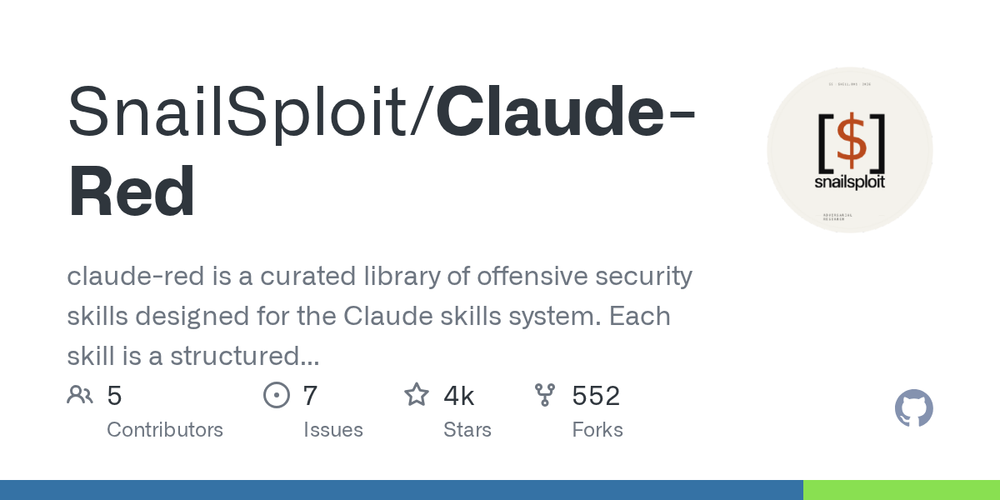
- Active maintenance and strong community adoptionThe project has 3,602 GitHub stars, 552 forks, and was last pushed in August 2026. The active fork count and recent maintenance indicate the skill methodology has been used and iterated on in real engagements.
- Fits existing Claude workflows without added toolingWorks inside Claude.ai Projects, Claude Code, and the Claude skills system with no additional tooling or infrastructure. Operators who already use Claude can add Claude-Red without changing their existing workflow.
Trade-offs
- -Claude-platform dependencyClaude-Red works exclusively inside Claude. It does not work with other AI models, and changing AI providers means the entire methodology library becomes unusable. Operators whose organizations use GPT-4 or Gemini get no value from this repository.
- -Methodology guidance, not automated executionSkills provide technique guidance and expert methodology, not automated execution. Claude cannot directly run a Kerberoasting attack or capture a WPA2 handshake; it explains how. Operators still need their own toolchains (Impacket, aircrack-ng, Metasploit) to act on the guidance.
- -No lab or practice environment includedClaude-Red provides no practice targets or sandboxed environment. Methodology without authorized targets requires operators to supply their own lab or engagement context. Unlike paid training platforms, there is no built-in way to practice the techniques against safe targets.
Claude-Red vs alternatives#
Claude-Red vs Commercial AI Security Copilots
Commercial AI security copilots charge monthly subscriptions for guided offensive methodology, often bundling managed infrastructure, integrations, and vendor support. For teams that want everything packaged together, the managed approach has clear advantages.
| Feature | Claude-Red | Commercial Copilots |
|---|---|---|
| License | MIT | Proprietary |
| Cost | Free (Claude subscription required) | Additional $50-500+/month |
| Attack categories | 23 categories, 78 skills | Varies by vendor |
| Lab environment | No | Often included |
| Installation | git clone to ~/.claude/skills | Vendor-managed |
| Model | Claude only | Varies |
Claude-Red is the better choice for teams already paying for Claude who want expert-level methodology without a second subscription. The MIT license lets teams fork skills and add custom techniques for internal tooling or proprietary environments. Commercial copilots are worth considering when teams need a lab environment, formal reporting templates, integrations with existing security tooling stacks, or vendor support agreements.
Claude-Red vs Paid Red Team Training Platforms
Platforms such as HackTheBox Pro and SANS offensive security courses provide structured methodology, guided exercises, and certifications. They serve skill development and assessment, not methodology on demand during active engagements.
| Feature | Claude-Red | Training Platforms |
|---|---|---|
| License | MIT | Subscription |
| Primary use | Active engagements and triage | Skill development |
| Lab environment | No | Core feature |
| Certification | No | Available |
| Attack coverage | 23 categories, 78 skills | Varies by course |
Operators who need certification (OSCP, GPEN, or employer-required credentials) should use a training platform with labs and formal assessment. Claude-Red serves operators who already have their methodology foundation and need structured expert-level guidance inside their AI workflow during active work. Many practitioners use both.
Quick start#
Install the full skill library into your local Claude skills directory with git clone.
```bash
git clone https://github.com/SnailSploit/Claude-Red ~/.claude/skills/claude-red
```What it's built on#
- Languages
- Python
FAQ#
Does Claude-Red work with Claude.ai or only Claude Code?
It works with both, plus Claude's native skills system. For Claude Code, pipe a SKILL.md via the --system-file flag. For Claude.ai, paste the SKILL.md content into a Project's system prompt. The Claude skills system auto-loads matching skills based on conversational triggers, so no manual loading is needed once installed.
Is Claude-Red legal to use?
The library is MIT licensed and documented for authorized use: red team engagements with explicit scope, bug bounty programs, CTF competitions, and security research. Using the methodology against systems without authorization is illegal regardless of tool licensing. The README scopes every skill to authorized work contexts.
Can I install just one category instead of all 78 skills?
Yes. The README documents sparse checkout for selective category installation. The install.sh script supports a --category flag to install a single category. For one-off use in Claude Code, pipe the specific SKILL.md file directly without cloning the full library.
What attack surfaces does Claude-Red cover?
23 categories: web application (16 skills, OWASP Top 10 and beyond), Active Directory, wireless (802.11 through LoRaWAN), cloud (AWS/Azure/GCP), mobile (Android and iOS), IoT and embedded systems, exploit development, fuzzing, privilege escalation, post-exploitation, container and Kubernetes, CI/CD pipelines, cryptography, network attacks, AI security, and more.
Does using Claude-Red give Claude the ability to run attacks autonomously?
No. Skills provide methodology, technique guidance, tooling recommendations, and escalation paths. Claude cannot execute commands, make network connections, or control external systems. Operators use the guidance to direct their own authorized toolchains and workflows.
Similar open-source tools#

God's Eye View
Real-time global intelligence on a 3D globe

pentagi
Autonomous AI agents for hands-free penetration testing

DeskcommCRM
AI agents for WhatsApp sales, fully audited, no per-user pricing

CloddsBot
AI trading agent for crypto, DeFi, and prediction markets

camofox-browser
Stealth headless browser for AI agents; bypasses bot detection

JellyBoxPlayer
Native Jellyfin and Emby music player for every platform