
B2B brand visibility tracking
OneGlanse fits teams that need to know whether AI answer engines recommend them, ignore them, or frame them incorrectly.
Skip if:
You only need classic keyword-rank tracking.

Open source alternative to Semrush, Ahrefs and BrightEdge
Last verified
Track how your brand appears in AI-generated responses. Compare LLM outputs, analyze sources, and self-host for full data ownership.
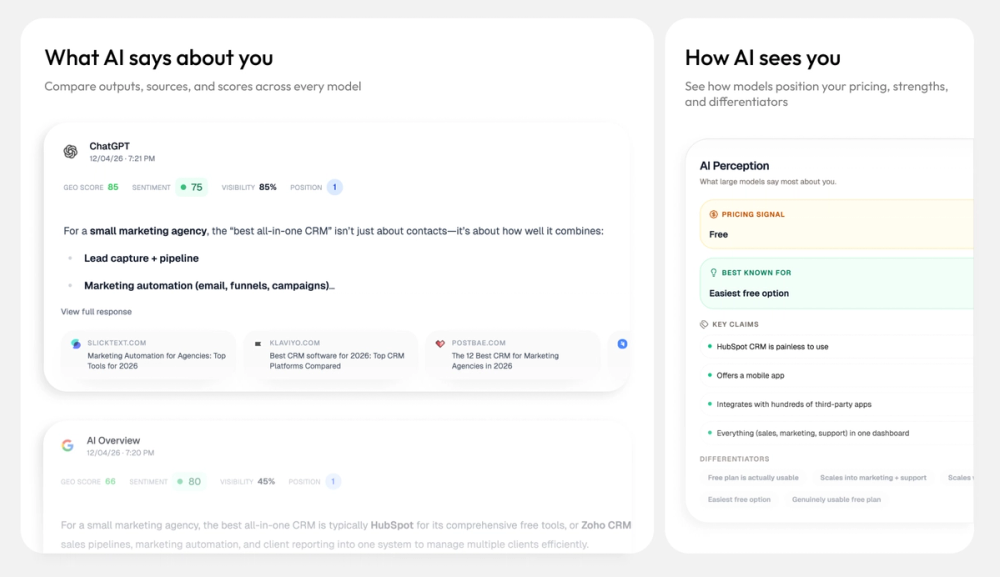
OneGlanse fits teams that need to know whether AI answer engines recommend them, ignore them, or frame them incorrectly.
You only need classic keyword-rank tracking.
Marketing teams can compare model responses across competitors and sources.
You cannot act on content, positioning, or source improvements.
Search visibility is no longer limited to blue links. Prospects ask ChatGPT, Gemini, Claude, Perplexity, and AI Overviews for recommendations, and brands often have no record of what those systems said.
Traditional SEO tools report rankings and backlinks, but they may not show the actual generated answer, source citations, or sentiment around a brand. OneGlanse focuses on that AI visibility gap so teams can monitor how model answers present them against competitors.
OneGlanse tracks how multiple AI systems respond to prompts about a brand, product, or market.
The product focuses on generative engine optimization signals such as mentions, position, sentiment, and source usage.
Teams can inspect and self-host the tracking logic rather than relying only on a proprietary marketing dashboard.
OneGlanse is an open-source tool for tracking how AI answer engines mention, rank, and describe a brand.
GEO means generative engine optimization, the work of improving how AI answer systems cite and describe a brand.
OneGlanse is best for marketing and growth teams that care about AI search visibility.

Alternative to Semrush
Open source alternative to Semrush and Ahrefs

Alternative to Outscraper
Google Maps lead extractor with batch keywords and CSV export

Alternative to Unstructured.io
Convert documents to clean markdown and JSON with open source AI.

Alternative to LlamaParse
Document parsing and ETL for LLMs, RAG pipelines, and AI agents.

Alternative toLlamaParse
Document parsing for LLM workflows, OCR, and agent reading.

Alternative to Mixpanel
Open-source analytics with funnels, replay, and self-hosting
Run OneGlanse on your own server
Self-host OneGlanse on a Hostinger VPS.
Deploy on HostingerFeatured

Alternative to Grok Bot
AI teammates you own: your keys, your model, your machine.

Alternative toClaude Managed Agents
Open-source agent deployment API. Self-host or use Omnara Cloud.

Alternative to Superhuman
AI email assistant that drafts replies and clears your inbox
The projects we add and every new guide. Free, unsubscribe any time.
 Claude Code to
  OpenCode
 Jira to
  Windshift
 Notion to
  AppFlowy
 Slack to
  Mattermost
 Linear to
  GitLab
 Wispr Flow to
  Handy
Handy CapCut to
  Concat
 Grok Bot to
  rakazo
 Superhuman to
  Inbox Zero
 Airtable to
  AITable
 Muse to
  OpenClaw
 GitHub Copilot to
  Cline
Cline Datadog to
  Netdata
 Microsoft Teams to
  Rocket.ChatConfluence to
  Docmost
 Pinecone to
  Qdrant
 Zapier to
  n8n
n8n Devin AI to
  OpenHands
 Firebase to
  Supabase
 1Password to
  KeePassXC
 Contentful to
  Strapi
 Adobe Premiere Pro to
  Shotcut
 ChatGPT to
  AnythingLLM
 LangSmith to
  Langfuse


