

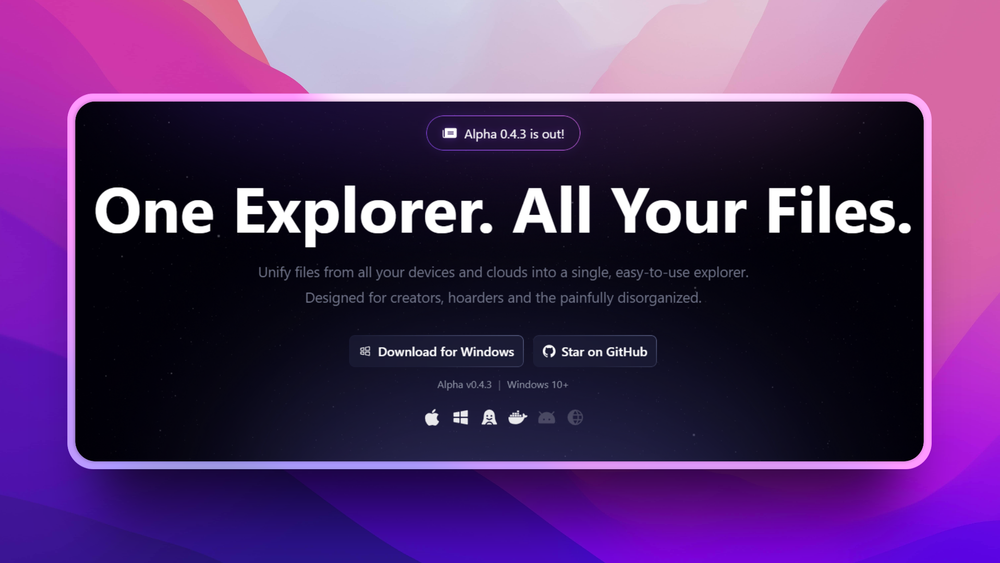
Who Spacedrive is for#
Creators with many storage locations
Use Spacedrive to search and browse projects spread across laptops, external drives, cloud buckets, and archives.
Skip if:
Skip if all files already live cleanly in one managed cloud drive.
Self-hosters organizing home storage
Use content hashing and device indexing to understand redundant files across NAS, desktops, and portable drives.
Skip if:
Skip if you need enterprise records management, retention policy, or legal hold workflows.
The problem it solves#
Files scatter across laptops, external drives, NAS boxes, cloud buckets, and SaaS exports. The operating system file manager only sees the current machine, while cloud drives force you into separate vendor folders and sync rules.
How it solves it#
Virtual distributed file system
Spacedrive builds a cross-device index so files from local drives, offline devices, and cloud volumes appear in one interface.
Content identity with BLAKE3
The README describes BLAKE3 content hashes for file identity, which helps track duplicates and file redundancy across devices.
P2P metadata sync
Devices sync metadata through direct Iroh and QUIC connections, reducing dependence on a central file server for cross-device awareness.
Strengths and trade-offs#
Strengths
- Broader than a cloud driveSpacedrive indexes local storage, cloud volumes, archives, and external data sources instead of treating one vendor folder as the center of your files.
- Local-first operating modelThe README emphasizes local operation and user-controlled sync, which fits privacy-conscious file management better than default cloud-first tools.
Trade-offs
- -Not a low-level file manager replacementThe README says Spacedrive sits above Finder and Explorer. You still use your OS for low-level file operations while Spacedrive adds search, indexing, and cross-device awareness.
Spacedrive vs alternatives#
What it's built on#
- Languages
- PythonRustSwiftTypeScript
- Frameworks
- Next.jsReact
FAQ#
Does Spacedrive replace Finder or Explorer?
No. The README says Spacedrive sits above the OS file manager and adds cross-device, cloud-aware, and automation-friendly capabilities.
What license does Spacedrive use?
Spacedrive references the Functional Source License 1.1 with Apache-2.0 future licensing. Teams should review the FSL terms before using it in commercial products or managed services.
Can Spacedrive index cloud storage?
Yes. The README lists S3, Google Drive, Dropbox, OneDrive, Azure, and GCS as cloud volumes.
Similar open-source tools#

Duckle
Self-hosted ETL on DuckDB with 385 connectors and no per-row billing.

libredb-studio
One browser tab for 18 database engines, deployed beside your data

MiroFish
Multi-agent simulation engine that predicts real-world outcomes

FckSignups
Open-source tools that work instantly, no signup required

Twake Drive
Twake file management for Cozy-backed Drive workflows

DBeaver
Free open-source database management tool for SQL databases.