

Who Hume AI is for#
Voice AI product teams
Hume AI fits teams building conversational voice experiences that need more than transcription and text replies.
Skip if:
You need a fully offline voice stack.
Researchers prototyping emotion-aware interfaces
The SDK can help teams test how expression and speech signals affect user experience.
Skip if:
Your application only needs basic speech-to-text.
The problem it solves#
Most voice AI systems optimize for transcription or command execution, not how a person sounds or feels. That limits products where tone, expression, timing, and emotional context shape the user experience.
Developers also need client libraries that make these APIs practical to use in real applications. Hume AI's SDK gives teams a typed integration path for adding empathic voice and expression analysis to JavaScript and TypeScript projects.
How it solves it#
TypeScript API access
The SDK gives JavaScript and TypeScript teams a maintained client for interacting with Hume AI services.
Voice and expression workflows
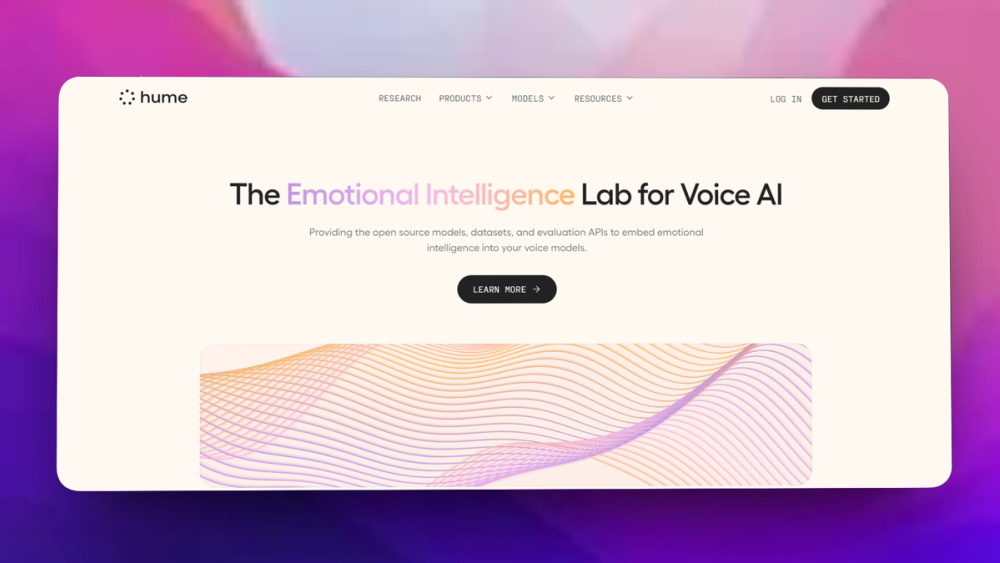
Hume's product focus centers on speech, expression, and emotion-aware AI rather than plain text generation alone.
Developer integration surface
The SDK helps teams add Hume capabilities to apps without hand-writing every API request.
Strengths and trade-offs#
Strengths
- Strong fit for voice productsHume AI is most relevant when emotional context and voice interaction quality matter to the product.
- Typed SDK for app teamsTypeScript support lowers integration friction for web and Node.js developers building production prototypes.
Trade-offs
- -Service dependency remainsThe SDK is open source, but teams still depend on Hume's hosted APIs and should evaluate pricing, privacy, and latency requirements.
Hume AI vs alternatives#
Hume AI vs ElevenLabs
Both platforms help developers add voice generation and conversational audio to applications, but they make different tradeoffs. Hume publishes an MIT-licensed TypeScript SDK and positions its product around emotion, expression, and empathic interaction. ElevenLabs sells a managed proprietary API with published subscription tiers, while its on-prem deployments are custom-priced.
| Feature | Hume AI | ElevenLabs |
|---|---|---|
| SDK license | MIT TypeScript SDK | Proprietary platform |
| Deployment model | Open source client SDK for hosted Hume APIs | Managed API, with custom on-prem deployments |
| Product focus | Emotion-aware voice, expression measurement, empathic interaction | Broad voice generation, dubbing, speech, and agent tooling |
Hume is the better choice when your team wants open source client code, typed SDK ergonomics, and a product designed around emotional expression rather than generic text to speech alone. ElevenLabs is still worth considering when you need its broader managed voice product surface, large voice catalog, or enterprise purchasing path for a proprietary platform.
What it's built on#
- Languages
- TypeScript
- Tooling
- Webpack
FAQ#
What is the Hume AI TypeScript SDK?
It is a TypeScript client for using Hume AI APIs from JavaScript and TypeScript applications.
Is Hume AI fully self-hosted?
No. The SDK is open source, but it connects to Hume AI services.
What is Hume AI best for?
Hume AI is best for voice and interaction products where emotion, expression, or tone analysis matters.
Similar open-source tools#

VoiceStudio
Voice cloning, dubbing, and transcription that runs fully offline

supertonic
Instantly convert text to speech with customizable options

VoxCPM
Tokenizer-free multilingual text-to-speech with voice cloning

Voicebox
Open source voice synthesis studio for generating audio

FckSignups
Open-source tools that work instantly, no signup required

vexa
Self-hosted meeting bot API for Meet, Teams, Zoom, and Jitsi