
Who magnitude is for#
Developers using AI coding agents to cut cloud API costs
Engineers running Claude Code, Cline, or OpenCode on agentic tasks pay token costs that accumulate across a full workday of multi-step coding sessions. Magnitude routes those calls to a local model, removing the per-token cost entirely while keeping the existing agent workflow intact.
Skip if:
Your machine has under 4GB of free RAM, or your work requires frontier model quality (complex reasoning, advanced math) that small local models cannot match. For those workloads, cloud APIs remain the better fit.
Engineers working with proprietary or compliance-sensitive code
Developers who want AI agent assistance on private codebases, unreleased products, or compliance-sensitive data without sending prompts to a third-party API. Magnitude keeps all prompts and context local with no cloud relay at any point in the inference path.
Skip if:
Your work environment restricts installation of local server software on work machines. In that case, a managed cloud deployment would be needed, which Magnitude does not provide as a hosted option.
Developers building or debugging in offline or restricted-network environments
Once a model is downloaded, Magnitude runs with no internet connection. Developers working without reliable internet, while traveling, or in restricted-network facilities can continue using agent-assisted coding without cloud access.
Skip if:
You need to download new models or update the catalog during the offline period. The initial CLI install and model download both require an internet connection.
Open source contributors building without cloud API budgets
Solo developers and open source maintainers who want AI agent assistance but cannot justify ongoing cloud API costs. Magnitude provides a free-to-run local inference path with Apache 2.0 licensing and no ongoing fees after the initial setup.
Skip if:
You need frontier model quality for daily work. Local models on consumer hardware will not match the output quality of GPT-4 or Claude Opus on complex tasks; if that bar is required, cloud APIs remain the practical choice.
The problem it solves#
Running local models for AI agent workloads is harder than it should be. Your agent does not know your hardware: it cannot tell which model quantization fits your RAM, what inference speed to expect, or how to configure the runtime for concurrent agent calls. Setting up a local inference stack manually means guessing at quant levels, tuning concurrency by trial and error, and writing harness configuration by hand.
The result is that most developers default to cloud LLM APIs and accept the costs. Token fees accumulate fast on agentic tasks that make dozens of LLM calls per session. Cloud APIs also mean prompts, context windows, and files leave your machine, which is a privacy concern for developers working with proprietary or sensitive code.
How it solves it#
Hardware profiling and model recommendations
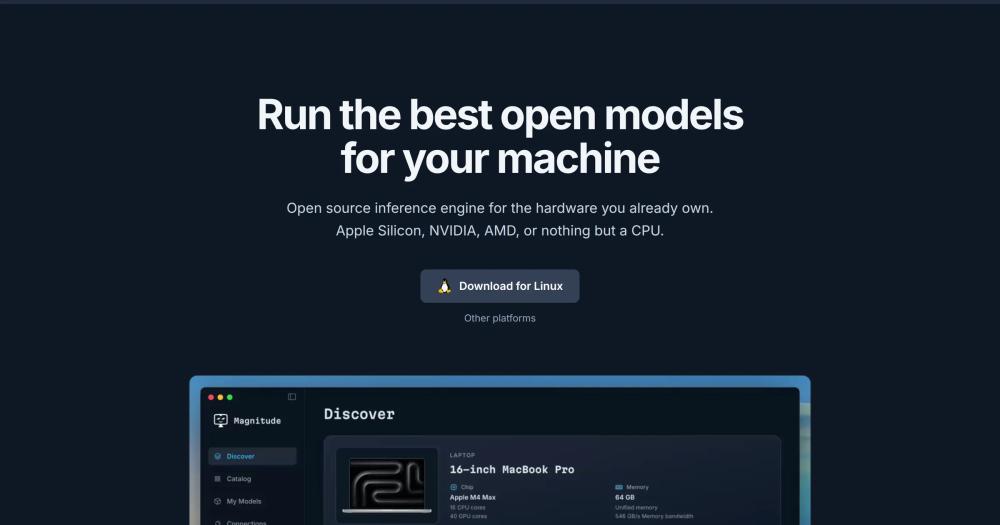
Magnitude profiles your chip, memory, and bandwidth, then computes the best-fit models from its curated catalog with estimated tokens per second for your specific hardware. You pick from a ranked list built for what will actually run fast on your machine, rather than guessing at quantization levels manually.
Agent-first onboarding via a single prompt
Send one prompt to your agent and it walks through the full setup: installs the Magnitude CLI, profiles your hardware, downloads the chosen model, and writes the harness configuration automatically. Compatible with Pi, OpenCode, Hermes, OpenClaw, Codex, Claude Code, Oh My Pi, and Cline, or use the built-in harness.
Just-in-time model loading and memory management
Models load when your agent needs them and unload automatically when idle or when memory gets tight. This keeps RAM available on machines where you run other workloads alongside the inference server, without requiring you to manage model lifecycle manually.
End-to-end inference tuning
Speculative decoding and concurrency are configured automatically for your hardware and selected model. Magnitude sets these based on the hardware profile it collects, removing the need to tune inference parameters by hand before agent workloads perform reliably.
Fully offline after initial setup
Once Magnitude and your chosen model are downloaded, no internet connection is required for inference. Prompts, context windows, and files stay on your machine and never reach any external server, making it suitable for air-gapped or network-restricted environments.
Custom GGUF model support
You can import compatible GGUF models from Hugging Face outside the built-in catalog. This lets you use specialized or fine-tuned models not included in the default recommendations, while still benefiting from Magnitude's runtime management and agent harness integration.
Strengths and trade-offs#
Strengths
- Zero token costs for agent workloadsAgentic tasks typically make dozens of LLM calls per session. Routing those calls through Magnitude eliminates per-token API fees entirely. There are no API keys to manage, no rate limits to hit, and no cloud billing to monitor once the initial setup is complete.
- Hardware-aware inference, not guessworkSetting up a local inference stack manually requires guessing at quant levels, which risks OOM errors or poor throughput. Magnitude measures your machine first and produces a catalog with concrete tok/s estimates, making model selection a data-driven step rather than trial and error.
- Full data privacy with no cloud relayPrompts, files, and model weights stay on your machine throughout the inference path. For developers working with proprietary code, private documents, or compliance-sensitive data, this is the data-privacy guarantee that cloud APIs cannot offer.
- Works with major agent harnesses out of the boxMagnitude integrates directly with Claude Code, Cline, OpenCode, Hermes, Pi, OpenClaw, Codex, and Oh My Pi. The onboarding flow configures the harness connection automatically, so switching a running agent from a cloud API to local inference is a setup step, not a code change.
Trade-offs
- -Model quality is bounded by available RAMThe models Magnitude can run are constrained by your hardware. On machines with limited RAM, only smaller quantized models fit, which produce noticeably weaker output than frontier cloud models on complex reasoning tasks. More available memory is the prerequisite for larger, more capable models.
- -macOS and Linux only; Windows requires WSLNative Windows support is not available. Windows users must have WSL installed and configured before running Magnitude. This adds a prerequisite step for developers on Windows who have not already set up WSL, and WSL carries some performance overhead compared to native Linux.
- -Young project with a growing model catalogMagnitude was created in June 2026 and its curated catalog is still expanding. Models not yet in the catalog must be imported manually as GGUF files from Hugging Face. Users who need a specific model outside the catalog will need to handle that import themselves.
magnitude vs alternatives#
Cloud LLM APIs
Most AI agents default to cloud LLM APIs because setup is straightforward: add an API key and start calling. Providers like OpenAI and Anthropic offer capable models through managed APIs with no infrastructure to run. Magnitude takes the opposite approach: local inference, on your hardware, with models selected and tuned for your machine. It is an open source alternative to paid API services for developers who want zero token costs and full data privacy.
| Magnitude | Cloud LLM APIs | |
|---|---|---|
| License | Apache 2.0 | Proprietary (API access) |
| Inference cost | Free (hardware you already own) | Per-token billing |
| Data privacy | Fully local, no cloud relay | Prompts sent to third-party servers |
| Model quality ceiling | Bounded by local hardware | Frontier models available |
| Rate limits | None | Tier-dependent |
| Works offline | Yes (after model download) | No |
| Setup effort | CLI install plus hardware profile | API key only |
| Agent harness support | Pi, OpenCode, Hermes, Cline, Claude Code, and more | Any API-compatible agent |
Magnitude is the better choice when cost and privacy are the primary constraints. Agentic tasks make many LLM calls per session; billing those through a cloud API accumulates fast across a workday, while local inference costs only the hardware you already own. For teams handling proprietary code or compliance-sensitive data who cannot send prompts to a third-party server, Magnitude is the practical path to agent-assisted development without cloud exposure.
When Cloud APIs Fit Better
Cloud APIs remain the stronger choice when you need frontier model quality that local hardware cannot deliver, when you need managed uptime without infrastructure to operate, or when your hardware is too constrained to load a useful model. On machines with limited RAM, the quality gap between local and frontier models is substantial enough that cloud APIs are still worth the per-token cost for complex reasoning tasks.
Quick start#
Install the Magnitude CLI via npm on macOS or Linux (Windows requires WSL), then run the guided setup to profile your hardware and select a local model.
```bash
npm install -g @magnitudedev/cli
magnitude setup
```What it's built on#
- Languages
- CC++PythonRustTypeScript
FAQ#
Does Magnitude require specific hardware or a minimum spec?
No minimum specification is required. Magnitude profiles your actual hardware and recommends the best-fit models for what you have. Machines with more RAM can run larger and more capable models, but Magnitude finds something workable for most modern hardware. More available memory is the primary lever for improving model quality.
Does Magnitude send any data to the cloud?
No. Prompts, files, and model weights stay on your machine. Once Magnitude and a model are downloaded, inference runs entirely offline with no external network calls during operation.
Which AI agent harnesses work with Magnitude?
Pi, OpenCode, Hermes, OpenClaw, Codex, Claude Code, Oh My Pi, and Cline. During onboarding, Magnitude writes the harness configuration automatically, connecting your agent to the local model you select. A built-in harness is also available if you are not using one of those tools.
Can I use models not in the Magnitude catalog?
Yes. You can download compatible GGUF models from Hugging Face and use them with Magnitude. The catalog provides curated recommendations tuned to your hardware, but it is not a closed list. Custom models are loaded and managed the same way as catalog models.
Does Magnitude work on Windows?
Not natively. Magnitude supports macOS and Linux. Windows users can run it through WSL (Windows Subsystem for Linux). WSL must be installed and configured before running Magnitude on Windows.
Similar open-source tools#

llama-swap
5,977 GitHub starsHot-swap AI models on your local inference server
Alternative to LM Studio

omlx
22,887 GitHub starsFast LLM inference for Apple Silicon with persistent SSD KV caching
Alternative toLM Studio

Ollama
183,634 GitHub starsRun large language models locally on Mac, Linux, or Windows
Alternative toLM Studio

Hermes Agent
254,611 GitHub starsSelf-hosted AI agent: persistent memory, multi-channel chat, model choice.
Alternative to Grok Bot
Orgtree
146 GitHub starsDesktop canvas for persistent multi-agent AI teams, Windows-only
Alternative to Conductor
Agent Cache Web
11 GitHub starsConvert docs URLs into Markdown bundles for AI coding agents
Alternative to Context7