

Who Zulip is for#
Remote engineering teams coordinating decisions
Zulip keeps architecture, incident, release, and support conversations separated by topic while still living in shared team streams.
Skip if:
Your team mainly uses chat for quick social coordination and does not want to enforce topic naming.
Open source communities with public support channels
Maintainers can point contributors to focused topics and keep answers discoverable across time zones.
Skip if:
Your community depends heavily on voice rooms, live events, or broad consumer familiarity with Discord.
The problem it solves#
Fast chat tools work well for live coordination, but they turn messy when a team discusses several decisions in the same channel. Important answers get buried between status updates, newcomers have to read long scrollback, and remote teams repeat the same questions because no one can find the thread that settled the issue.
The pain gets sharper for open source communities, research groups, and engineering teams with members across time zones. They need asynchronous discussion that stays organized by topic, not just a searchable stream of every message ever sent.
How it solves it#
Topic-based conversations
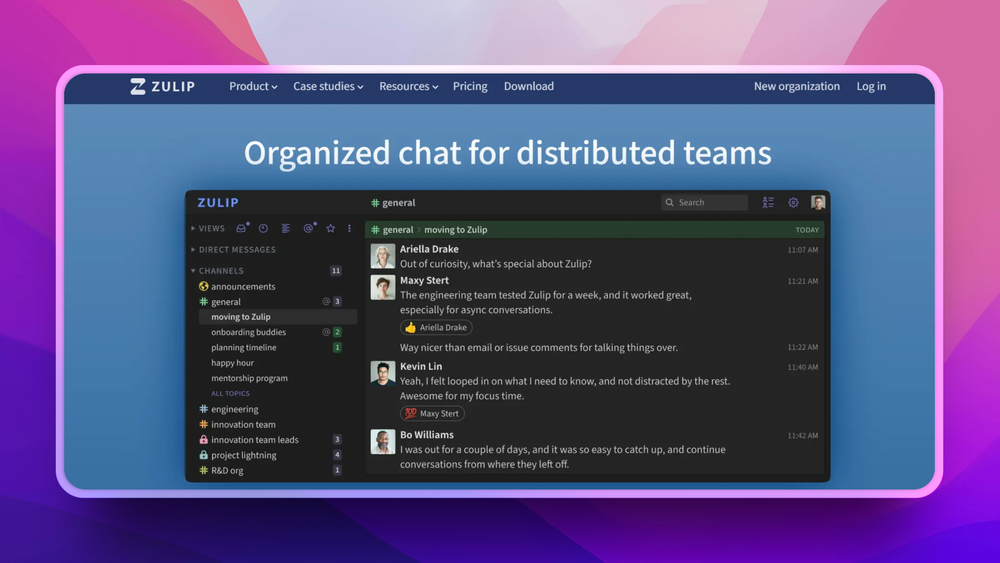
Every stream message belongs to a topic, so multiple discussions can happen in the same team space without mixing decisions, questions, and status updates.
Self-hosted server option
Zulip publishes its server code under Apache-2.0, giving teams a path to run chat on their own infrastructure instead of keeping all history in a proprietary SaaS account.
Developer-focused integrations
The project documents integrations, bots, webhooks, and an API so engineering teams can connect deployments, CI alerts, issue trackers, and custom workflows to chat.
Cross-platform clients
Official web, desktop, and mobile clients let teams keep the same threaded conversation model across laptops and phones.
Strengths and trade-offs#
Strengths
- Better async structure than channel-only chatTopic threads make Zulip easier to scan after time away than Slack-style channels where unrelated conversations interleave chronologically.
- Apache-2.0 licensingThe permissive license supports internal modification and commercial use without the network-copyleft obligations that some team chat platforms carry.
Trade-offs
- -Different mental modelTeams used to casual channel chat need to adopt topic hygiene. Without that habit, Zulip loses much of its advantage over Slack or Discord.
- -Self-hosting is an operations commitmentRunning the server means maintaining databases, email delivery, backups, upgrades, and push notification configuration instead of delegating that work to Zulip Cloud.
Zulip vs alternatives#
Zulip vs Slack
Zulip and Slack both handle team chat, integrations, mentions, and searchable history. The main difference is conversation structure: Zulip requires topics inside streams, while Slack centers channels and optional threads.
| Criteria | Zulip | Slack |
|---|---|---|
| License | Apache-2.0 server | Proprietary |
| Self-hosting | Yes | No |
| Conversation model | Topic-first streams | Channel-first messages |
| Best fit | Async teams and communities | Teams that want the largest SaaS chat ecosystem |
Zulip is the better choice when async discussion quality matters more than SaaS familiarity. Slack is still the better fit when your organization depends on Slack-native apps, enterprise administration, or users who will resist a topic-first workflow.
What it's built on#
- Languages
- JavaScriptPythonTypeScript
- Frameworks
- React Native
- Tooling
- Webpack
FAQ#
Is Zulip open source?
Yes. Zulip Server is open source under the Apache-2.0 license, with official clients and integrations available through the Zulip project.
Can Zulip replace Slack?
Zulip can replace Slack for teams that value threaded async discussion, searchable history, and self-hosting. Slack remains stronger for teams that rely on a large app marketplace and familiar channel-first workflows.
Can I self-host Zulip?
Yes. Zulip provides a self-hosted server path, but production operation requires normal chat infrastructure work such as email, backups, upgrades, and push notification setup.
Similar open-source tools#

dcts-shipping
645 GitHub starsSelf-hosted Discord-style chat with encrypted DMs and voice
Alternative to Slack
Slack

Prose
59 GitHub starsDecentralized open source workplace with chat and docs
Alternative toSlack

Adapt
13 GitHub starsLightweight self-hosted messaging platform for teams
Alternative toSlack

SpacebarChat
2,207 GitHub starsFree open source Discord reimplementation with full API parity
Alternative toSlack

Rocket.Chat
46,281 GitHub starsSelf-hosted team chat with voice, video, and omnichannel support
Alternative to Microsoft Teams

Converse.js
3,299 GitHub starsSelf-hosted web-based XMPP chat client for any server
Alternative toSlack