

Who dcts-shipping is for#
Privacy-focused teams moving off Slack
Teams that need message data on their own servers will find DCTS covers the core Slack use case: organized text channels, encrypted direct messages, and voice communication. The AGPL-3.0 license and self-hosted model mean no vendor access to message history and no recurring per-seat cost.
Skip if:
Your team relies heavily on Slack integrations or automated workflows via Slack bots and connectors. DCTS does not replicate the Slack integration ecosystem, so integration-heavy workflows will lose significant tooling.
Gaming and hobby communities leaving Discord
Communities currently on Discord for voice channels, text rooms, and community management can host a comparable experience with DCTS. Voice chat with screensharing and camera support covers the main Discord voice use cases, and Android and desktop clients give members a native app experience.
Skip if:
Your community depends on the Discord bot ecosystem, game status integrations, or Discord's frictionless onboarding. DCTS requires members to create an account on your instance, which adds friction for casual joiners.
JavaScript developers customizing their communication stack
DCTS is built in JavaScript and uses sockets, making the source readable and modifiable for developers who want to customize their communication setup. The project's commitment to building its own libraries means the codebase follows consistent internal patterns.
Skip if:
Skip if you need a production-grade system with a vendor-backed SLA, enterprise compliance certifications, or guaranteed uptime. DCTS is an independently maintained project without commercial support.
The problem it solves#
Slack and Microsoft Teams dominate team communication, but both host your messages on vendor-controlled servers with no self-hosting option. For teams handling sensitive conversations, working under data residency requirements, or simply unwilling to pay per-seat pricing for a chat tool, this is a real problem: message data leaves your control the moment it is sent, and the vendor sets the terms for retention, access, and pricing.
Voice-first communities face the same challenge with Discord: the server is centralized, accounts are tied to Discord's infrastructure, and any policy or pricing change affects your community immediately. Running your own communication server eliminates this dependency but historically required assembling separate tools for text chat, voice, and mobile access.
How it solves it#
End-to-end encrypted server DMs
DCTS encrypts server direct messages between users, a feature explicitly listed in the README and reflected in the project's e2ee and encrypted GitHub topics. For teams with sensitive conversations, this ensures DM content stays private at the application layer.
Voice chat with screensharing and camera support
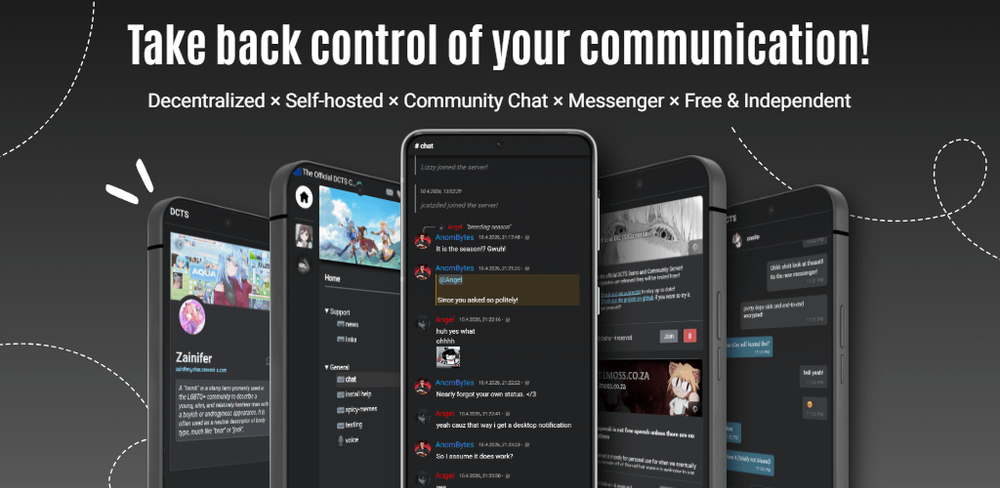
DCTS ships a working voice layer that includes screensharing and camera support, matching the voice channel experience Discord users are familiar with. Voice communication runs through the server you control, with no third-party relay required.
Desktop and Android clients
A dedicated desktop client and a full Android app are available alongside the web interface. Both clients include an integrated decentralized messenger, giving your team a native app experience separate from the main web chat server.
Docker and Pterodactyl deployment
DCTS ships a Pterodactyl egg for panel-based automated deployment alongside Docker support, giving server operators two installation paths. The Pterodactyl egg covers hosting environments that already use panel-based server management, while Docker covers standard VPS and container setups.
Node.js and Bun runtime support
DCTS runs on both Node.js (tested on v16 through v24) and Bun (tested on 1.3.x), giving operators a choice of JavaScript runtime. This covers current long-term support Node.js releases and the faster Bun runtime for performance-oriented setups.
Independent custom library ecosystem
The DCTS project builds its own libraries rather than depending on third-party packages, aiming for long-term stability and independence from external dependency changes. This lets the codebase adopt new features without waiting on upstream library updates.
Strengths and trade-offs#
Strengths
- AGPL-3.0 license with full self-hostingDCTS is licensed under AGPL-3.0 and runs on your own server, so there are no per-seat fees and no vendor access to your messages. Unlike Slack or Microsoft Teams (proprietary, no self-hosting), you own the infrastructure and can audit the source code.
- Voice, text, and encrypted DMs in one installMany self-hosted chat tools handle text only and require a separate voice tool. DCTS ships encrypted direct messages, text channels, and voice chat with screensharing and camera support in a single server deployment.
- Actively maintained with multi-platform clientsThe repository last pushed on August 16, 2026, and the project ships clients for web, desktop, and Android. Maintaining multiple client platforms alongside the server signals continued active investment, not a maintenance-only project.
- Multiple deployment pathsOperators can deploy via Docker or through a Pterodactyl egg, covering standard container environments and panel-based hosting setups. Tutorial videos and documentation at docs.dcts.community lower the barrier for first-time server operators.
Trade-offs
- -AGPL-3.0 restricts SaaS distributionThe AGPL-3.0 license requires distributing source changes to users if you run a modified version of DCTS as a network service. For commercial managed hosting or SaaS deployments, this is a meaningful legal constraint. Internal team use and private community hosting are not affected.
- -Requires server administrationUnlike Slack or Microsoft Teams, DCTS requires a server, a domain, and enough technical knowledge to configure and maintain the software. The README directs setup questions to external documentation rather than including a one-command quick-start. Teams without a server administrator will face setup friction.
- -Early-stage ecosystemWith 634 GitHub stars and 14 open issues, DCTS is an actively developed but emerging project. The third-party integration ecosystem (bots, workflow connectors, plugins) is limited compared to Slack's app directory or Discord's bot ecosystem. Teams that depend heavily on integrations will need to build their own.
dcts-shipping vs alternatives#
DCTS vs Slack
Slack is the dominant commercial team chat tool, hosted entirely on Slack's servers with per-seat pricing and no self-hosting option. DCTS runs on your own infrastructure under the AGPL-3.0 license, with no vendor access to your messages and no recurring per-seat fee.
| Feature | DCTS | Slack |
|---|---|---|
| License | AGPL-3.0 | Proprietary |
| Self-hosting | Yes | No |
| Voice chat | Yes, with screensharing and camera | Yes (Huddles) |
| DM encryption | End-to-end encrypted | Not end-to-end encrypted |
| Mobile app | Android | iOS and Android |
DCTS is the better choice for teams that need message data on their own servers, encrypted DMs, and no recurring licensing costs. Slack remains the stronger pick for teams that depend on its integration ecosystem, search at scale across large message archives, or enterprise compliance features like data retention policies and e-discovery.
DCTS vs Microsoft Teams
Microsoft Teams is a proprietary communication tool included with Microsoft 365 subscriptions, tightly integrated with Office apps and hosted on Microsoft's servers. DCTS offers a self-hosted path for teams that want to operate outside the Microsoft ecosystem.
| Feature | DCTS | Microsoft Teams |
|---|---|---|
| License | AGPL-3.0 | Proprietary |
| Self-hosting | Yes | No |
| Voice and screensharing | Yes | Yes (full video conferencing) |
| Office 365 integration | None | Deep integration |
| Mobile app | Android | iOS and Android |
DCTS is the right fit for teams outside the Microsoft 365 ecosystem who want full control of their communication stack and no Microsoft data residency. Microsoft Teams is still the better choice for organizations where Outlook, SharePoint, and Office 365 integration is a daily workflow dependency, or where enterprise IT governance requires Microsoft-managed infrastructure.
Quick start#
Self-hosting DCTS starts with cloning the repository; Docker deployment and manual server setup guides are available in the project docs at docs.dcts.community.
```bash
git clone https://github.com/hackthedev/dcts-shipping
```What it's built on#
- Languages
- JavaScript
- Frameworks
- Express
- Databases
- MySQL
- Infrastructure
- Docker
FAQ#
Is DCTS free to use?
Yes. DCTS is licensed under AGPL-3.0 and free to self-host on your own server with no licensing fees. The project accepts donations via PayPal and Ko-fi to fund independent development, but donations are not required to use or run the software.
Does DCTS have a mobile app?
Yes. A full Android app is available at android.dcts.community and a desktop client is available at desktop.dcts.community. Both clients include the standard chat features plus an integrated decentralized messenger that operates separately from the main server chat.
How does DCTS compare to Rocket.Chat for self-hosted team chat?
Both are self-hosted chat projects with open source codebases, but they target different audiences. Rocket.Chat is a mature project with enterprise features and a large plugin ecosystem. DCTS is a newer, lighter project focused on encrypted DMs, voice chat with screensharing, and a Discord-style community experience. Choose DCTS if voice and data sovereignty are the priority; choose Rocket.Chat if you need enterprise integrations or a larger support community.
Can DCTS replace Slack for a business team?
DCTS covers the core Slack use cases: text channels, encrypted direct messages, and voice communication. What it does not replicate is Slack's integration ecosystem, search at scale across large message archives, or enterprise compliance features like e-discovery and data retention policies. For small teams prioritizing data ownership over integrations, DCTS is a capable alternative; for teams with integration-heavy workflows, the switch involves losing significant tooling.
What server runtime does DCTS require?
DCTS runs on Node.js (tested on v16 through v24) and Bun (tested on 1.3.x). Beyond the JavaScript runtime, you need a server with enough capacity for your expected concurrent users. Docker deployment is supported and a Pterodactyl egg is available for panel-based hosting environments. Full setup requirements are documented at docs.dcts.community.
Similar open-source tools#

Prose
Decentralized open source workplace with chat and docs

Adapt
Lightweight self-hosted messaging platform for teams

SpacebarChat
Free open source Discord reimplementation with full API parity

Zulip
Organized team chat with threaded conversations, self-hostable

Rocket.Chat
Self-hosted team chat with voice, video, and omnichannel support

Converse.js
Self-hosted web-based XMPP chat client for any server