

Who treg is for#
AI coding agents running SEO audits
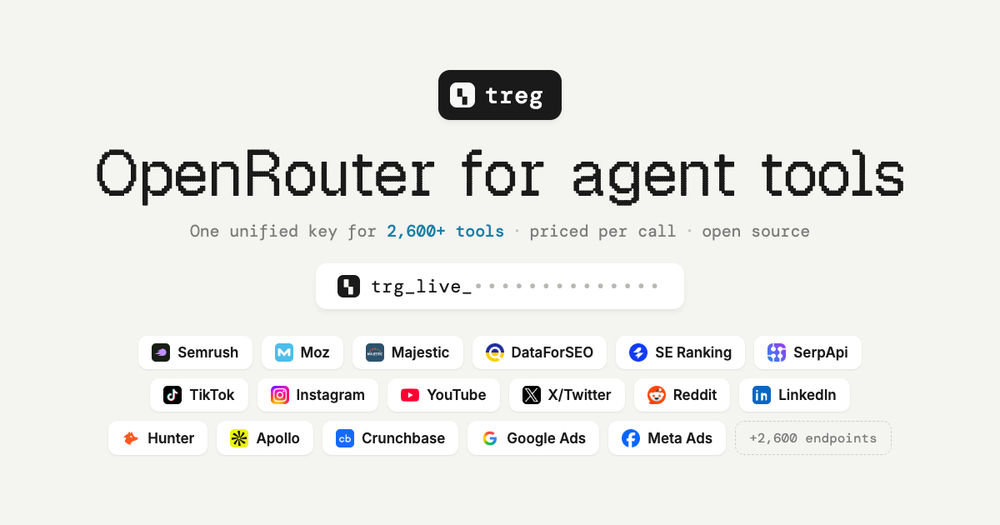
An agent configured with treg can query keyword volume from Semrush, pull backlink data from Moz, run live SERP results from SerpApi, and check Search Console in a single run. All seven providers in the SEO toolbelt answer to one treg token, billed per call at fractions of the monthly seat price.
Skip if:
Your SEO workflow already has a data pipeline feeding a warehouse. treg's value is replacing missing subscriptions and per-provider signup overhead; if the data is already structured and queryable, a direct warehouse query is simpler.
SDR teams enriching contact lists across multiple providers
treg exposes Hunter for email verification, Lusha for person enrichment, PDL for profile history, and Apollo for contact search under one token. An agent can run multiple enrichment providers on the same input and compare results without the team holding four separate seats.
Skip if:
Your enrichment volume is high enough that owning direct vendor seats is cheaper than per-call billing. Calculate the breakeven against each vendor's monthly cost before relying entirely on the catalog path.
Developer teams managing shared agent credentials
Teams with multiple agents or developers register their provider keys once and every agent reaches them via the treg token, without distributing raw keys. Admin-configurable per-member access controls which tools each agent or teammate can call, and every call writes to an audit log.
Skip if:
Your team is one or two people with a single agent. Single-operator workflows do not need the team coordination overhead; a local .env is simpler until you have multiple agents or teammates needing shared access.
Developers publishing skills to a shared team library
A SKILL.md recipe registered through treg upload becomes callable by any teammate's agent using just their treg token. The skill's API credentials live server-side; the skill author never has to redistribute keys when a teammate wants to run the same capability.
Skip if:
Your skills call only public APIs with no credentials. treg's skill registry is most valuable when the skill wraps a credentialed endpoint. For credential-free skills, a public GitHub skill directory is simpler.
The problem it solves#
The tools an AI coding agent needs for real work sit behind separate subscriptions: Semrush at $139/mo, Moz at $99/mo, Crunchbase at $99/mo, Apollo at $59/seat. Most of these exist because a human logs in regularly; buying them for a single automated agent run is economically irrational. Beyond cost, each provider requires its own signup flow, credential management, and key rotation.
The credential problem compounds when a team shares agents. Every teammate needs the same set of API keys available in their environment, which means keys scattered across config files and machines, or stored in a secret manager most agents cannot query natively. One compromised machine exposes all those keys at once.
How it solves it#
Unified credential proxy
One treg token replaces credentials for every provider in the catalog. The proxy injects the correct API key server-side before relaying the request, so provider credentials never reach the agent's machine. Token revocation in one place cuts off access to all 47 providers simultaneously.
2,630-endpoint catalog with live pricing and success rates
Every catalogued endpoint shows its price before the call, the success rate treg has measured, and average latency. Where multiple providers serve the same capability (nine vendors offer email lookup, for example), the catalog lists them side by side so the agent picks on evidence. The agent always chooses; treg does not silently pick a provider.
Pay-per-result billing at provider cost
Semrush keyword data (normally $139/mo) costs $0.006 per call through the catalog. Moz backlinks ($99/mo) bill at $0.012 per call. Each team starts with $1.00 free credit. Teams that already hold a provider subscription connect their own key, and those calls route through unmetered with no treg markup.
Team-scoped skill and secret registry
Teammates register their own API keys, CLIs (stripe, gh, vercel), and SKILL.md recipe files once. Every agent in the org can then call them using just the treg token. Tool access is per-member configurable by admins, and every call writes an audit log entry.
Claude Code plugin and MCP surface
treg ships as a Claude Code plugin installable with one slash command and exposes an MCP endpoint at treg.to/mcp/v2/ for the Claude.ai Connectors Directory. The plugin walks the agent through sign-in on first run, then registers the CLI and MCP tools automatically.
Self-hosted with SQLite or Postgres
The registry server runs locally with uv run python -m treg using SQLite by default. Production deployment points at Postgres and sets a Fernet key for secrets at rest. No treg-owned infrastructure is required; self-hosters run the complete stack on any machine with Python.
Strengths and trade-offs#
Strengths
- No per-provider signup requiredThe catalog covers 47 providers. Using any of them requires only a treg account and a prepaid balance: no Hunter account, no Semrush trial, no Apollo seat. For agents that need data from several providers in a single run, this removes hours of account setup and ongoing credential-maintenance overhead.
- Bring your own key, pay nothing on topAny provider key a team already pays for routes through treg unmetered. The team pays nothing additional, treg charges no markup on those calls, and credentials are still injected server-side so the key never sits on the agent's machine. Existing subscriptions become more useful, not redundant.
- Credentials never leave the serverThe proxy relays requests faithfully to upstreams and injects credentials server-side. The agent holds only the treg token. Revoking that token immediately cuts off access to every provider. Losing a single agent's environment does not expose the underlying provider keys.
- Fully self-hostable open source stackThe registry server is open source and deployable on any machine with Python and a database. There is no treg-owned infrastructure required: a self-hosted instance can run its own catalog, credential store, and team management with no dependency on the hosted treg.to service.
Trade-offs
- -Source-available license: SaaS use requires authorizationtreg's LICENSE file is Apache-2.0 with Additional Terms that take precedence. Self-hosting for your own organization is expressly permitted, including commercial internal use. Offering treg as a hosted, managed, or embedded service to third parties, such as a SaaS product or managed registry sold to customers, requires the licensor's written authorization. This fair-code model resembles n8n's Sustainable Use License; strict OSI-only policies should review the terms first.
- -Self-hosting requires careful Fernet key managementStored credentials are encrypted with a Fernet key (TREG_SECRET_KEY). If that key is lost on redeployment, every stored credential becomes unrecoverable and must be re-registered. Production deployments need a persistent, backed-up key management strategy; the README explicitly flags this risk.
- -Catalog calls fail hard when balance is emptyAn empty prepaid balance returns HTTP 402, failing any agent call that depends on a catalog-tier endpoint. Teams relying on catalog endpoints for core workflows need either a funded balance with automatic top-ups, or their own provider keys registered as the primary path.
- -Project is less than two months oldCreated in July 2026, treg has 1,011 stars and 29 open issues. The core proxy and catalog are functional, but the project is under active development. API surfaces and configuration details may change. Production deployments should pin a tested version and monitor the changelog.
treg vs alternatives#
treg vs Composio
Both treg and Composio let AI agents call third-party APIs through a unified interface without managing per-provider credentials. The key difference is deployment model: Composio is a managed cloud service; treg is source-available and self-hostable, with a fair-code license that permits internal commercial use but restricts reselling it as a managed service.
| Feature | treg | Composio |
|---|---|---|
| License | Source-available (fair-code) | Proprietary |
| Self-hosting | Yes | No |
| Billing model | Per-call, at provider cost | Managed subscription |
| Catalog size | 2,630+ endpoints | 250+ apps |
| Bring your own key | Yes, unmetered | Limited |
treg is the better choice when you need full data residency, want to run the credential store on your own infrastructure, or need to bring existing provider accounts without paying on top of them. Composio is the more mature managed service with a larger ecosystem of pre-built agent actions and broader platform integrations. Teams that want zero infrastructure overhead and a polished UI for non-technical stakeholders will find Composio easier to adopt.
treg vs Toolhouse
Toolhouse is a managed tool-hosting service that stores and runs tools for AI agents. treg's model is different: it is a credential proxy and registry rather than a tool-execution environment. In treg, the upstream provider runs the computation; treg injects auth and relays the request. In Toolhouse, Toolhouse runs the tool on your behalf in its own infrastructure.
| Feature | treg | Toolhouse |
|---|---|---|
| License | Source-available (fair-code) | Proprietary |
| Self-hosting | Yes | No |
| Execution model | Proxy to upstream | Managed execution |
| Billing | Per-call at cost | Managed |
Toolhouse suits teams that want a fully managed tool execution environment with no infrastructure concern. treg suits teams that want transparent per-call pricing against upstream providers, the ability to bring their own provider accounts, and the option to self-host the entire registry stack.
Quick start#
Install the CLI via the hosted setup script, or deploy the server locally using the Python server extra.

```bash
curl -fsSL https://treg.to/install.sh | sh
treg login
```

```bash
pip install "tools-registry[server]"
uv run python -m treg
```What it's built on#
- Languages
- JavaScriptPythonTypeScript
- Frameworks
- FastAPIVue
- Cache
- Redis
FAQ#
How does treg differ from Composio and Toolhouse?
Composio and Toolhouse are managed cloud services that connect agents to third-party APIs. treg is open source and self-hostable: you run the full registry on your own infrastructure with your own database and credential store. The billing model also differs: treg charges per call at provider cost with no markup, earning on volume pricing with vendors rather than on user margin. Teams needing data residency or wanting to avoid managed infrastructure have a path that Composio and Toolhouse do not offer.
Can I use my existing API subscriptions with treg?
Yes. Register a provider secret with treg secret add or run treg upload env from a project directory with a .env file. Those calls route through the proxy with your credential injected server-side and are completely unmetered. You pay the provider directly on your existing contract; treg charges nothing for calls that use your own key.
Is treg free to self-host?
The registry server is free to self-host and run. You can run it locally with uv run python -m treg with no paid account needed. Catalog-tier calls, where treg holds the provider account and bills against your balance, require a funded prepaid account; every new team starts with $1.00 free credit.
What happens when a catalog call runs out of balance mid-run?
The proxy returns HTTP 402 with balance_micro, estimated_cost_micro, and a topup_url in the response body. An agent can parse this structured response and act on it without reading prose. Teams can configure automatic top-ups to prevent mid-run failures on high-volume workflows.
How does treg handle credential security?
Stored credentials are encrypted at rest using a Fernet key set in TREG_SECRET_KEY. The proxy injects credentials server-side before the request reaches the upstream provider. The agent's machine holds only the treg token, not the underlying API keys. Revoking the treg token immediately cuts off access to every provider. The README warns that losing the Fernet key makes stored credentials unrecoverable, so production deployments should back up the key separately from the database.
Similar open-source tools#

servers
Open reference servers for connecting AI to external tools and data

jentic-one
Self-hosted API broker that routes agent calls without exposing keys

Jentic Mini
Self-host API execution for AI agents

GenericAgent
Autonomous agent that evolves skills over time

FckSignups
Open-source tools that work instantly, no signup required

openpanel
Open-source analytics with funnels, replay, and self-hosting