

Who Paymenter is for#
Hosting providers migrating from WHMCS
The built-in WHMCS importer transfers clients, invoices, and service data without manual CSV exports. Providers who have hit WHMCS's annual license cost ceiling and want to eliminate the per-client fee will find a direct migration path.
Skip if:
If your operation relies on WHMCS modules with no Paymenter equivalent, migrating will require replacing those integrations first. Check the Paymenter extension marketplace before committing to the switch.
New hosting businesses building their billing stack
Starting fresh, a hosting company avoids WHMCS license fees from day one. Paymenter covers the core billing needs: subscription management, payment gateways, client portal, and support ticketing, all from a single self-hosted install.
Skip if:
If you need enterprise-grade SLA, dedicated support contracts, or a large pre-built extension ecosystem from day one, a commercial billing tool may be faster to deploy initially.
Pterodactyl panel operators adding billing
Hosting providers already running Pterodactyl get native integration between billing events and panel deployments. When a client subscribes, Pterodactyl can provision the server automatically through Paymenter's extension hooks.
Skip if:
If you run a hosting operation without Pterodactyl, Paymenter still works but you lose the tightest native integration. The REST API and extension system still connect to other panels.
The problem it solves#
Billing for hosting businesses gets expensive when every invoice flows through a commercial tool. WHMCS, the most widely used option, requires annual license fees that increase with client volume; Blesta, HostBill, ClientExec, and WISECP follow the same proprietary pricing model, so the more your hosting business grows, the more you pay just to run the billing layer.
For hosting providers on tight margins, those recurring costs chip away at profitability. Switching away from established billing tools is also hard because client data, invoices, and service configurations are tied to the vendor's database schema. Most operators end up locked in, paying more each year, without the ability to customize billing workflows without paying for add-ons.
How it solves it#
WHMCS Migration Importer
An automated migration tool transfers clients, services, and invoices from WHMCS via a built-in artisan command. The importer connects directly to the WHMCS database and runs in minutes. Support for Blesta imports is in active development.
Extensions Marketplace
A growing library of first- and third-party extensions covers payment gateways (including Stripe), server panel integrations, and service modules. Extensions are installable directly from the Paymenter marketplace without modifying core files.
REST API with OpenAPI Spec
A full REST API, with a published OpenAPI spec, gives programmatic control over invoices, service provisioning, and client management. You can automate billing workflows, integrate with external tools, and build custom client-facing portals without modifying Paymenter's core.
Multi-Currency and Multi-Language
Built-in currency conversion with automatic rate updates lets you accept payments in multiple currencies without third-party plugins. Translation support lets you serve clients in their preferred language through the client portal.
Integrated Support and Announcements
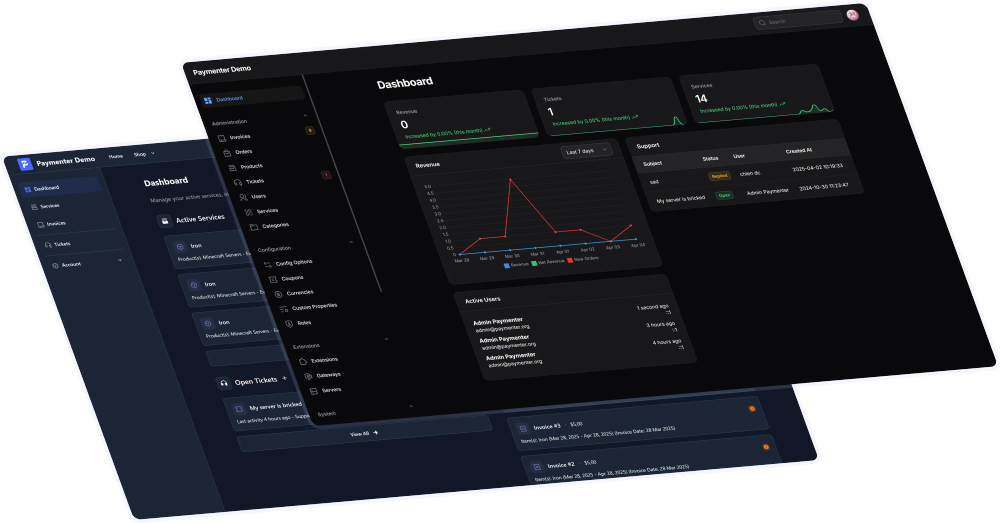
A built-in ticketing system handles support requests without requiring a separate helpdesk tool. A blog and announcements module lets you notify clients about maintenance windows or new services from the same admin panel.
Strengths and trade-offs#
Strengths
- MIT License with No Recurring FeesMIT licensing means you pay nothing for the software itself, regardless of how many clients you bill or invoices you process. WHMCS and competing commercial billing tools charge annual licenses that scale with client volume. A self-hosted Paymenter install has no vendor-imposed cost ceiling.
- Built for Pterodactyl IntegrationPaymenter was built with Pterodactyl in mind: the GitHub topics list pterodactyl as a first-class integration, and the extension system supports native service deployments through the panel. Hosting providers running Pterodactyl get a tighter fit here than with generic billing tools.
- Active Development and CommunityThe repository received regular pushes through October 2026, indicating active maintenance. Over 2,600 stars and 530 forks reflect community adoption. The project is not archived or in maintenance mode, with continuous development since the October 2022 launch.
- Automated WHMCS Migration PathMany billing alternatives require manual data migration. Paymenter ships a built-in artisan-based WHMCS importer that transfers clients, services, and invoices automatically, lowering the barrier to switching for existing WHMCS operators.
Trade-offs
- -PHP Stack Requires Server SetupInstalling Paymenter requires PHP 8.3, Composer, a MariaDB database, and a web server. There is no official one-click installer or Docker image documented in the README, so operators unfamiliar with PHP server management face a meaningful setup step before billing is live.
- -Younger Extension EcosystemWHMCS has a large third-party extension library built over many years. Paymenter launched in 2022 and its marketplace is still growing. Teams that rely on specialized WHMCS modules may not find direct equivalents in Paymenter's current extension library.
- -75 Open Issues at Review TimeThe GitHub repository had 75 open issues when this was written. For a billing tool, unresolved issues in payment flow or invoice logic can directly affect revenue. Checking the issue tracker before deploying to production is advisable.
Paymenter vs alternatives#
Paymenter vs WHMCS
WHMCS is the most widely used billing tool in the web hosting industry and the primary paid competitor Paymenter targets. Both cover the same core needs: subscription billing, client management, payment processing, and service provisioning for hosting businesses.
| Feature | Paymenter | WHMCS |
|---|---|---|
| License | MIT | Proprietary |
| Pricing | Free (server costs only) | Commercial license required |
| WHMCS migration tool | Included | N/A |
| Extension marketplace | Growing | Established |
Paymenter is the better choice when your primary concern is eliminating recurring license costs. WHMCS charges an annual fee that increases as your client base grows; Paymenter's MIT license imposes no vendor-side cost ceiling. Paymenter also includes a built-in migration tool for WHMCS operators, which reduces the friction of switching.
WHMCS has a longer track record, a larger extension ecosystem, and commercial support options. If your operation depends on WHMCS-specific add-ons or you need guaranteed support contracts, WHMCS remains the lower-risk choice despite the ongoing license cost.
Paymenter vs Blesta
Blesta is another commercial hosting billing tool and a direct target of Paymenter's migration efforts. The Paymenter team is developing a Blesta importer, listed as upcoming on the product website, alongside the existing WHMCS migration tool.
The cost picture mirrors the WHMCS comparison: Blesta requires a commercial license with annual fees, while Paymenter is MIT licensed with no ongoing vendor fees. For Blesta operators who want to move to a self-hosted, zero-licensing-cost billing stack, the planned importer will reduce migration friction once it ships.
What it's built on#
- Languages
- PHP
- Frameworks
- Laravel
FAQ#
Is Paymenter free to use?
Yes. Paymenter is MIT licensed, which means you can self-host it, use it commercially, and modify the code at no cost. The only expenses are your own server costs. A managed hosting option from CloudHassle is available at $5/month if you prefer not to manage the server yourself.
Does Paymenter integrate with Pterodactyl?
Yes. Pterodactyl integration is a first-class use case for Paymenter, with pterodactyl listed as an official GitHub topic. Extensions handle the service provisioning link between Paymenter billing events and Pterodactyl panel operations.
How do I migrate from WHMCS to Paymenter?
Paymenter ships a built-in artisan migration command that connects directly to your WHMCS database and transfers clients, services, and invoices automatically. The migration tool is documented on the Paymenter website. Blesta migration support is in development but not yet available.
What payment gateways does Paymenter support?
Stripe is a first-party supported gateway, listed as an official GitHub topic. Additional payment gateways are available through the Paymenter extensions marketplace. The current full list of supported gateways is on the marketplace page at paymenter.org/marketplace.
What server requirements does Paymenter have?
Paymenter requires PHP 8.3 or higher, Composer, a web server (Apache or Nginx), and a MariaDB database. There is no official Docker image documented in the README; deployment requires a server with the PHP stack configured. The full installation guide is at paymenter.org/docs.
Similar open-source tools#

FckSignups
Open-source tools that work instantly, no signup required

fmt
Fast, type-safe C++ formatting that replaces printf and iostreams

3x Ui
Web panel for Xray-core with per-client and multi-node controls

Vela
OpenStreetMap and Google data, no account, no Play Services

Obtainium
Android app updates direct from GitHub and F-Droid

Cloudflare Os
Open source AI workspace with sandboxed apps and Gatekeeper security