

Who Plunk is for#
Product teams replacing two email vendors
Teams currently running a transactional provider alongside Mailchimp, Customer.io, or a similar marketing tool can consolidate on Plunk. One API, one contact list, one billing line, with transactional reliability and full campaign and automation features built in.
Skip if:
If your transactional volume is very high and SLA guarantees with premium support are a firm requirement, the commercial incumbents have more mature infrastructure and dedicated support tiers.
Developers building SaaS products with system email
Password resets, signup confirmations, receipts, and onboarding sequences are all handled through one API call. The Node.js SDK and SMTP relay mean no extra tooling for frameworks with existing email support. The MCP server lets agent-driven workflows send emails without additional integration code.
Skip if:
If you only need transactional sends with no marketing or automation requirements, Resend or Postmark offer simpler APIs with no self-hosting overhead.
Teams with EU data-residency or privacy requirements
The managed cloud offers EU hosting. Teams needing full data control can self-host via Docker on any region or provider, with the same feature set as the cloud version. Contact data, send history, and workflow state stay on infrastructure you control.
Skip if:
If your requirements specify a compliance-certified vendor (SOC 2, ISO 27001), verify Plunk's current certifications before adoption; the project is younger than established commercial vendors in this space.
AI developers integrating agent-driven email
The 23-tool MCP server covers the full email stack: listing contacts, creating segments, drafting campaigns, and triggering sends. A read-only mode with six tools is available for inspection-only workflows. Claude Code, Cursor, and any MCP-compatible client connect without custom integration code.
Skip if:
If your agent stack does not support MCP, the REST API and Node.js SDK provide the same access but without the native MCP discovery and tool-call interface.
The problem it solves#
Most teams running email at scale end up managing two products, a transactional provider for system-generated messages and a separate marketing tool for campaigns and automation. That split means double the vendor relationships, double the domain setup, and a contact list that lives in two places. When a user clicks a campaign, replies to a transactional message, and triggers an onboarding workflow, that activity is fragmented across multiple vendors with no shared view.
Pricing compounds the challenge. SendGrid, Mailgun, and Mailchimp all charge on contact storage, not just sends. A list of 100,000 contacts you email three times a year still costs as much as a list you mail weekly, because the fee is for holding the contact, not reaching them. Switching platforms means migrating domain verification, DKIM/SPF records, templates, and contact history, a genuine undertaking at any meaningful scale.
How it solves it#
Single unified contact list
Every transactional send, campaign click, inbound reply, and workflow step writes to the same contact record. A contact who received a receipt last week, opened a campaign yesterday, and replied inbound today has one feed showing all four events, which means segments and triggers can react to the full history rather than a fragment.
Visual workflow canvas
Workflows trigger on any event your API sends: a signup, a purchase, a custom attribute update. The canvas shows the full definition including delays, conditional branches, and send steps as a visual graph. What you see on the canvas is the whole definition; there is no hidden logic outside the view.
Live-query audience segments
A segment is a query re-evaluated each time you use it, not a static list snapshot. A segment filtering for pro users inactive for 30 days returns tomorrow's audience when you send tomorrow. No manual list syncs or imports are needed between sends.
Inbound email routing
Add one MX record and every address at your domain starts receiving email. Inbound messages become contacts and can trigger workflows just like any outbound event. Replies to campaigns surface in the contact feed alongside the original sends, giving a complete conversation view per contact.
MCP server for agent-driven sends
Plunk ships 23 Model Context Protocol tools covering contacts, segments, templates, campaigns, and sends. Claude, Cursor, and any MCP-compatible client can draft campaigns, list segments, and send to filtered audiences through the same interface the dashboard uses. A read-only mode registers six tools only, for agents that should inspect but not modify.
SMTP relay and REST API
Point any existing email client or framework at Plunk over SMTP without changing code. A REST API and an official Node.js SDK cover cases where HTTP is more natural. Any runtime that can make an HTTP request is supported, so no migration is required for frameworks with existing email handling.
Strengths and trade-offs#
Strengths
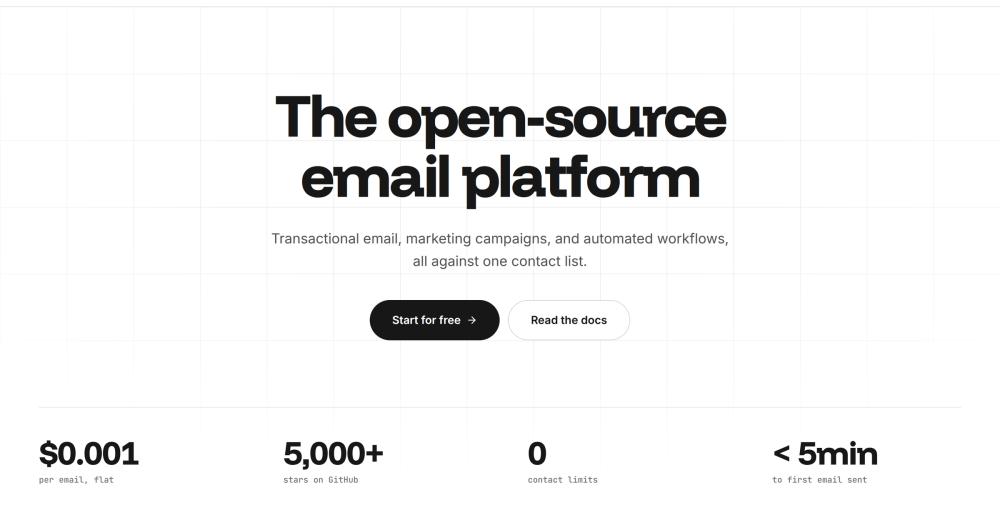
- Flat per-email pricing with no contact-tier feesPlunk charges $0.001 per email sent and stores unlimited contacts at no extra cost. At 10,000 emails per month, the site's own comparison shows Plunk at half SendGrid's price and one-third of Mailgun's. Teams with large lists they email infrequently pay only for what they send, not for what they store.
- Full-stack self-hosting via DockerThe AGPL-3.0 license allows running Plunk on your own infrastructure without licensing fees. The official Docker image is the same one the managed cloud runs, so your self-hosted deployment mirrors production exactly. Teams needing on-prem or custom-region hosting can replicate the full stack from the public image.
- All email types on one contact recordTransactional sends, campaign broadcasts, inbound processing, and automation triggers all write to the same contact record. Segmenting or triggering off the combined activity history is native; there is no ETL or sync required between email types, and no second vendor to keep in sync.
- Under five-minute setup to first sendThe website and README both report a first send in under five minutes covering domain verification, DKIM setup, and first send. The Node.js SDK and SMTP relay mean no code changes for frameworks that already support either protocol.
- Active development with 5,500+ GitHub starsThe repository has 5,511 stars and 415 forks as of October 2026, with the last push on the current date. The project was created in July 2024 and has maintained consistent development activity. A Discord community and documentation site at docs.useplunk.com support self-hosted teams.
Trade-offs
- -AGPL-3.0 restricts resale as a managed serviceAGPL-3.0 allows self-hosting for internal use, including commercial teams running it for their own products, with no restrictions. The restriction is SaaS redistribution: if you modify Plunk and offer the modified version as a hosted service to third parties, you must release your source changes. Teams running it for their own product's users are not affected by this clause.
- -Newer project with 55 open issuesPlunk was created in July 2024 and has 55 open issues as of October 2026. It is a younger project than the commercial incumbents it replaces. Edge-case bugs and missing features are more likely than on a service with years of production traffic at scale. Check the GitHub issue tracker for known limitations before adoption.
- -Self-hosting requires Postgres and DNS setupThe Docker self-hosting path needs an external Postgres database and DNS control for DKIM/SPF domain verification. It is not a zero-dependency single-command deploy. The documentation at docs.useplunk.com covers the setup, but teams without server management experience should expect some configuration time before the first send.
Plunk vs alternatives#
Plunk vs SendGrid
Both Plunk and SendGrid handle transactional and marketing email, but they target different scales and deployment models. SendGrid is a mature commercial service with enterprise support tiers, compliance certifications, and dedicated IP options. Plunk is open source, self-hostable, and charges per send rather than per contact tier.
| Feature | Plunk | SendGrid |
|---|---|---|
| License | AGPL-3.0 | Proprietary |
| Self-hosting | Yes | No |
| Pricing (10k emails/mo) | $0.001/email | $0.002/email |
| Contact limits | Unlimited (free) | Tier-based |
| Workflow automation | Yes | Yes |
| Inbound email | Yes | No |
Plunk is the better choice for teams consolidating transactional and marketing email on one contact list, especially when self-hosting is a requirement or contact pricing is a concern. SendGrid is worth considering when you need enterprise SLAs, dedicated IPs, or compliance certifications such as SOC 2 or HIPAA.
Plunk vs Mailgun
Mailgun is primarily a transactional email API with limited marketing capabilities added on. Plunk covers the same transactional ground and adds a full marketing and automation stack at a lower per-email price.
| Feature | Plunk | Mailgun |
|---|---|---|
| License | AGPL-3.0 | Proprietary |
| Self-hosting | Yes | No |
| Pricing (10k emails/mo) | $0.001/email | $0.003/email |
| Contact limits | Unlimited (free) | Tier-based |
| Visual workflow builder | Yes | No |
| Inbound email | Yes | Yes |
Plunk costs approximately one-third of Mailgun at 10,000 emails per month by the site's own comparison, and adds marketing and automation depth that Mailgun does not match. Mailgun is worth keeping when your team already has it deeply integrated and migration cost outweighs the savings.
Plunk vs Resend
Resend is a developer-first transactional email API known for React Email integration and a clean REST interface. Plunk covers transactional sending and adds campaigns, automation, contacts, segments, and inbound email in one product.
| Feature | Plunk | Resend |
|---|---|---|
| License | AGPL-3.0 | Proprietary |
| Self-hosting | Yes | No |
| Marketing campaigns | Yes | No |
| Workflow automation | Yes | No |
| Audience segments | Yes | No |
| Inbound email | Yes | No |
Resend is a better fit when you need a minimal transactional-only API with excellent developer ergonomics and no self-hosting overhead. Plunk is the better choice when transactional email is one input into a larger automation or contact lifecycle, and you want all of it in one product rather than multiple vendors.
Quick start#
Self-hosting Plunk deploys via the official Docker image with a Postgres database and DNS setup for domain verification.

```bash
docker pull ghcr.io/useplunk/plunk:latest
```What it's built on#
- Languages
- TypeScript
- Frameworks
- ExpressNext.jsReact
- Infrastructure
- AWS
- Cache
- Redis
FAQ#
Can I self-host Plunk for free?
Yes. Plunk is AGPL-3.0 licensed and the Docker image is publicly available on GitHub Container Registry. Self-hosting for internal use, including commercial teams running it for their own products, carries no licensing fees. You pay only for the infrastructure you run it on. The AGPL license requires releasing source changes only if you offer Plunk itself as a managed service to others.
How does Plunk pricing compare to SendGrid or Mailgun?
Plunk charges $0.001 per email sent with no contact-tier fees. At 10,000 emails per month, the site's own comparison shows Plunk at $0.001, SendGrid at $0.002, Mailgun at $0.003, and Mailchimp at $0.004 per email. Contacts are free to store regardless of how many you have. The free plan covers 1,000 emails per month.
Does Plunk handle both transactional and marketing email?
Yes. Transactional sends (password resets, receipts, confirmations), marketing campaigns (broadcasts to segments), automated workflow sequences, and inbound email processing are all built into the same product against one contact list. You do not need a second vendor for any of these email types.
What does AGPL-3.0 mean for a team self-hosting Plunk?
AGPL-3.0 allows any team to run Plunk on their own infrastructure, including for commercial internal use, without restriction. The one obligation is that if you modify Plunk and offer the modified version as a hosted service to third parties, you must release your changes. Running it for your own product's users is not covered by that restriction.
What is the Plunk MCP server?
Plunk ships a Model Context Protocol server with 23 tools covering contacts, segments, templates, campaigns, and sends. Claude Code, Cursor, and any MCP-compatible AI client can draft and send campaigns, list audience segments, and manage contacts through those tools. A read-only mode registers six tools only, for agent workflows that should inspect without modifying data.
Similar open-source tools#

listmonk
High-performance newsletter and mailing list manager

Keila
Send newsletters and track analytics from your own email server

FckSignups
Open-source tools that work instantly, no signup required

Vela
OpenStreetMap and Google data, no account, no Play Services

Mailcheap
Self-hosted newsletters on Amazon SES. MIT licensed, no pricing tiers.

LinkBreeze
Self-hosted Linktree alternative with one-command Docker deploy