Who Superlearn is for#
Developers preparing for technical interviews
Interview mode builds boards around probable questions, strong answers, red flags, and live-coding katas for a specific topic. The SM-2 flashcard deck covers all boards in one cross-board review session, making spaced review practical during active prep.
Skip if:
You are preparing for a behavioral or soft-skills interview. Superlearn's research is oriented toward technical depth and produces little useful output for non-technical interview preparation.
Engineers learning an unfamiliar technology or domain
Type /superlearn rust ownership for someone who knows C++ and the agent tailors the research to that background. Drop relevant PDFs or docs into .superlearn/sources/ and the agent reads them first before searching the web.
Skip if:
You need a guided, sequenced course with assignments and instructor feedback. Superlearn produces self-directed research boards, not structured curriculum evaluated by a human instructor.
Research engineers building literature maps
Research mode generates a map of the field: seminal papers with why-each-matters, recent papers, state of the field, open problems, and a suggested reading order. It pulls abstracts and PDF links from arXiv via the official API and embeds them directly in the board.
Skip if:
Your literature review requires journals behind paywalls that arXiv does not index. Coverage is strong for machine learning, physics, and computer science; weaker for biomedical, social science, and humanities domains.
Teams understanding an unfamiliar dependency before adopting it
Documentation mode produces a code-first reference board: usage patterns, configuration tables, exact terminology, and gotchas for a library or framework. Useful before a team adopts a new tool and wants shared understanding before writing the integration.
Skip if:
You need a publishable, externally-maintained documentation site. Superlearn boards are local study tools, not publishable docs sites. Use Superlearn to understand the subject, then write the documentation separately.
The problem it solves#
Learning a technical topic deeply while working in a development environment means switching context: leave the editor, open a browser, bounce between YouTube tabs, documentation pages, and scattered articles, then return to code without having fully absorbed what you read. Paid learning platforms offer structured courses, but they are fixed curricula you cannot steer mid-session. Search engines surface pages, not synthesized understanding.
The problem is sharper for self-directed topics with no existing course: niche database internals, a specific research area, interview prep on a precise algorithm, or a new framework your team just adopted. There is no course for 'Postgres MVCC in depth' or 'transformer attention mechanics for my specific background'. The developer either spends hours assembling scattered material or settles for surface-level understanding.
How it solves it#
Live web research with YouTube and arXiv integration
The agent searches and reads the live web for source material, then pulls real YouTube video IDs (title, channel, duration) and arXiv paper abstracts with PDF links using dedicated scrapers. Boards include actual watchable videos and citable papers, not placeholder links.
Six interactive view layouts
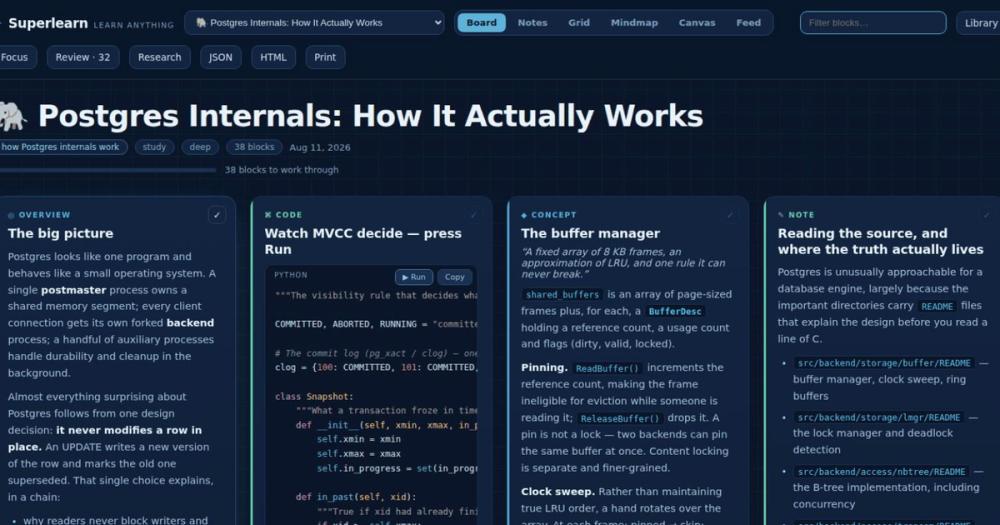
Each board can be viewed as a masonry card grid, a single-column notes document, a uniform grid, an auto-generated mindmap, a feed, or a Canvas whiteboard. Canvas lays every section out spatially with draggable frames and connector paths between sections, similar to a Miro wall. Switching views is live with no reload.
Runnable code with in-browser execution
JavaScript, Python, and HTML code blocks get a Run button. Python executes on a real CPython instance via Pyodide, with NumPy, pandas, matplotlib, and SymPy available. Output streams into a console pane below the code. Code runs inside a sandboxed iframe without access to the app's DOM or storage.
SM-2 spaced repetition across all boards
Flashcard decks generated from board content are scheduled with the SM-2 algorithm (Again, Hard, Good, Easy intervals). The Review button runs all due cards across every board in one session. Decks export as TSV for Anki.
Four research modes
`study` produces balanced conceptual mastery. `interview` focuses on probable questions, strong answers, and live-coding katas. `research` generates a literature map with seminal and recent papers in reading order. `documentation` creates a code-first reference with configuration tables and gotchas. Mode is set in plain words or with `--mode`.
Annotations, highlights, and reading progress
Any card can be annotated in your own words. Notes save into the board JSON and the agent reads them on the next iteration. Highlight any passage using the CSS Custom Highlight API, which never modifies the card DOM. A reading progress bar and Focus mode track what you have read across sessions.
Strengths and trade-offs#
Strengths
- No new subscription requiredSuperlearn runs on the Claude Code, OpenAI Codex, or Kilo Code subscription you already have. No new API key, no new monthly plan. The Python scripts use only the standard library, so there is nothing to install beyond cloning the repository.
- All data stays on your machineBoards are plain JSON files saved to .superlearn/boards/ on your disk. Research trails, annotations, highlights, and canvas arrangements persist locally. Nothing leaves your machine except the research queries the agent makes to the web. Boards are diff-able, version-controllable, and shareable with anyone who has the plugin.
- Topic-specific visual design per boardSuperlearn picks a visual identity for each board from six complete themes: midnight, blueprint, terminal, paper, sepia, arctic. Engineering topics arrive on a blueprint grid; systems programming in a terminal theme. The theme is authored per subject by the agent, not set as a global preference.
- Iterative deepening from the same sessionAfter the initial board loads, continue prompting the same agent to go deeper on any part. The board updates in place within seconds and badges any changed cards with an Updated marker. Boards accumulate across topics and connect via a library graph showing cross-board related links as edges.
Trade-offs
- -Requires an active coding agent subscriptionSuperlearn is not a standalone tool. It runs as a plugin or agent skill inside Claude Code, OpenAI Codex, or Kilo Code. Without an existing subscription to one of those agents, you cannot run it.
- -Web access requires manual configuration on CodexOpenAI Codex sandboxes network access by default. To use Superlearn with Codex, you must add network_access = true to the [sandbox_workspace_write] block in ~/.codex/config.toml. Kilo Code users on providers without built-in web search must enable it in Settings or set web_search to true in kilo.jsonc.
- -Young project with limited communityThe repository was created in August 2026. There are no community forums, no cloud-hosted version, and no managed support tier. Documentation is the README. GitHub topics are not set and discoverability is limited.
Superlearn vs alternatives#
Superlearn vs Guidde
Guidde is a paid commercial platform that auto-generates step-by-step video guides from screen recordings. It targets teams building product documentation, user onboarding flows, and internal how-to videos. Guidde's output is sharable, embeddable documentation for other people.
Superlearn serves a different purpose: personal subject mastery. Where Guidde produces video walkthroughs for an audience, Superlearn builds interactive study boards for the learner. Boards include concept cards, Mermaid diagrams, typeset math, runnable code, arXiv papers, and SM-2 spaced repetition flashcards. There is no screen recording, no publishing flow, and no audience.
If your goal is understanding a technical topic in depth for yourself, Superlearn fits better. If you need polished video documentation for a product or onboarding flow, Guidde covers that and Superlearn does not.
Superlearn vs DocuWriter
DocuWriter is a paid AI tool that generates documentation from source code: READMEs, API references, and code comments. It is designed to reduce the manual work of writing technical documentation as a codebase evolves.
Superlearn's documentation mode (--mode documentation) generates a local reference board for a library or framework you want to understand, not a publishable documentation site. The output includes usage patterns, configuration tables, exact terminology, and gotchas, organized as interactive cards you can annotate. It does not write or maintain your project's documentation files.
Choose DocuWriter when you need publishable, code-synchronized documentation for your project. Choose Superlearn when you want to deeply understand an unfamiliar dependency before using it.
Superlearn vs GitHub Copilot
GitHub Copilot answers questions and generates code in the editor. Ask it to explain a concept and you get an answer in the chat panel that disappears when the session ends. There are no persistent learning artifacts.
Superlearn builds durable boards you can return to, update, and study across sessions. The SM-2 flashcard system tracks what you have reviewed and when. Annotations and highlights save into the board JSON. The full research trail is browsable in the app.
Superlearn runs inside Claude Code, OpenAI Codex, or Kilo Code, not inside GitHub Copilot directly. It is not a replacement for Copilot's code completion features. For the specific task of learning a technical topic in depth and retaining it over time, Superlearn's board-and-review format offers persistence, structure, and spaced repetition that a chat session does not.
Quick start#
Clone the repository to install Superlearn into Claude Code, or run the installer script for OpenAI Codex or Kilo Code.

```bash
git clone https://github.com/raiyanyahya/superlearn
python3 superlearn/scripts/install.py --codex
```What it's built on#
- Languages
- Python
FAQ#
Do I need to pay for a separate subscription to use Superlearn?
No. Superlearn runs as a plugin or agent skill inside Claude Code, OpenAI Codex, or Kilo Code. If you already subscribe to one of those agents, you can install Superlearn with a git clone and a one-time setup script at no additional cost.
Does Superlearn send my data to external servers?
Your boards, annotations, highlights, and research trails save locally to the .superlearn/ directory. Nothing leaves your machine except the research queries the agent makes to the live web. There is no Superlearn account, no cloud sync, and no telemetry.
How does Superlearn compare to Guidde or DocuWriter?
Guidde and DocuWriter are paid commercial platforms focused on documentation workflows: Guidde for step-by-step video guides, DocuWriter for generating documentation from source code. Superlearn is a personal learning tool, not a documentation publisher. It builds interactive study boards with spaced repetition, runnable code, and research trails for the learner's own understanding, not for publishing to others.
What topics work best with Superlearn?
Any technical topic with reasonable coverage on the web and arXiv. The README examples include Postgres internals, transformer neural networks, Rust ownership, React hooks, and diffusion models. Research mode has the strongest arXiv coverage for machine learning, physics, and computer science. Coverage is weaker for topics primarily behind paywalls or with little open-web presence.
Can I keep refining a board after it is generated?
Yes. While the local server is running, keep prompting the same agent session. Ask to go deeper on a specific section, add the original papers, or shift the tone. The board updates in place within seconds and marks changed cards with Updated badges. You can also ask for a second board on a related topic; boards accumulate and connect in a library graph.
Similar open-source tools#

monocode
One desktop UI for all your AI coding agents.

garden-skills
Production-ready agent skills for Claude Code, Cursor, and Codex

fx
Native Zig CLI coding agent, 7.8 MiB, any AI model.

codex
OpenAI's terminal coding agent, Apache-2.0 licensed

kilocode
Open source AI coding agent. 500+ models at zero markup.
prime-agent
Automate coding workflows with a self-improving agent