
Who TDengine is for#
Industrial teams storing sensor telemetry
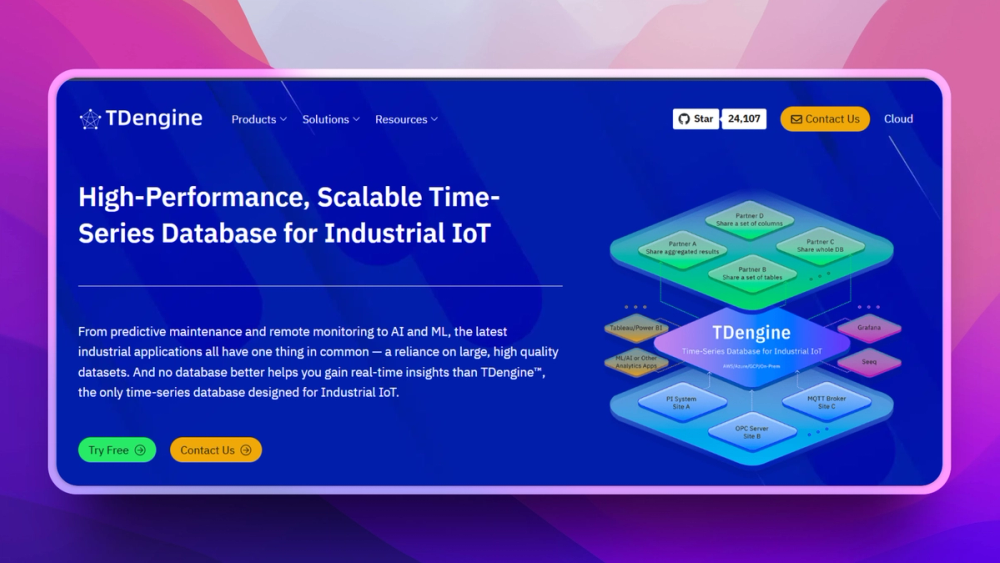
TDengine fits plants, device fleets, and monitoring systems that ingest large volumes of time-stamped measurements.
Skip if:
Your data is mostly business transactions or document records; PostgreSQL or another general database is a better default.
Edge operators with data residency constraints
Self-managed deployments help keep operational metrics close to machines and local networks.
Skip if:
You prefer a fully managed SaaS time-series database and do not have local data-control requirements.
The problem it solves#
Industrial telemetry creates data patterns that general databases handle poorly: millions of time-stamped points, many devices, retention rules, downsampling, and queries over recent windows. Teams often end up stitching together brokers, ETL jobs, and analytics databases before they can answer basic operational questions.
Managed time-series services reduce operations work, but they can introduce data residency concerns and recurring cost surprises when sensor volume grows. Plants, utilities, and edge deployments often need time-series storage close to the equipment, not only in a cloud account.
How it solves it#
Time-series database engine
TDengine centers ingestion, storage, and query behavior around timestamped metrics rather than treating telemetry as ordinary relational rows.
Industrial IoT positioning
The project documents use cases around sensors, connected devices, and operational monitoring, which makes it more specialized than a generic analytics database.
SQL-oriented access
Teams can query time-series data through SQL-style interfaces instead of forcing every analyst into a custom telemetry query language.
Edge and cloud deployment paths
TDengine supports self-managed deployments for teams that need data close to devices, with commercial cloud options available separately.
Strengths and trade-offs#
Strengths
- Purpose-built for telemetry volumeTDengine focuses on high-ingest time-series workloads, which is a clearer fit for sensor fleets than bolting telemetry tables onto a general OLTP database.
- Open source core for data controlThe AGPL-3.0 repository gives infrastructure teams a self-managed path when operational data cannot leave a site or region.
Trade-offs
- -Specialized operational surfaceTDengine is not a general PostgreSQL replacement. Teams need time-series expertise and must validate connector support, retention design, and backup procedures for their environment.
- -AGPL-3.0 obligationsOrganizations modifying and offering the software over a network should review AGPL requirements before embedding TDengine into a commercial service.
TDengine vs alternatives#
TDengine vs InfluxDB Cloud
TDengine and InfluxDB both target time-series data, but TDengine is especially positioned around industrial IoT and self-managed operational deployments.
| Criteria | TDengine | InfluxDB Cloud |
|---|---|---|
| License | AGPL-3.0 repository | Proprietary managed service plus open source components |
| Self-hosting | Yes | Managed cloud focus |
| Primary fit | Industrial telemetry and device data | Broad metrics, monitoring, and time-series analytics |
TDengine is stronger when industrial deployment control, edge placement, and SQL-style telemetry access matter. InfluxDB Cloud is still worth considering when the team wants a managed service and broad ecosystem support over running database infrastructure.
What it's built on#
- Languages
- CC++Go
- Frameworks
- Vue
- Databases
- MySQLPostgreSQL
FAQ#
What is TDengine used for?
TDengine is used for time-series data, especially industrial IoT telemetry, sensor measurements, device monitoring, and operational analytics.
Is TDengine open source?
Yes. TDengine is available under the AGPL-3.0 license, with commercial offerings available from TDengine's vendor.
Is TDengine a PostgreSQL alternative?
TDengine is not a general relational database replacement. It is a specialized time-series database for timestamped telemetry workloads.
Similar open-source tools#

QuestDB
Ingest high-frequency data and query it in real time with SQL

Prometheus

RuView
Intelligent AI agents for real-world applications

Sentry
Real-time error tracking with performance monitoring and traces

ClawTrace
Visualize agent execution trees and track token costs per step

Uptime Kuma
Track uptime for websites and APIs with 90+ alert integrations