

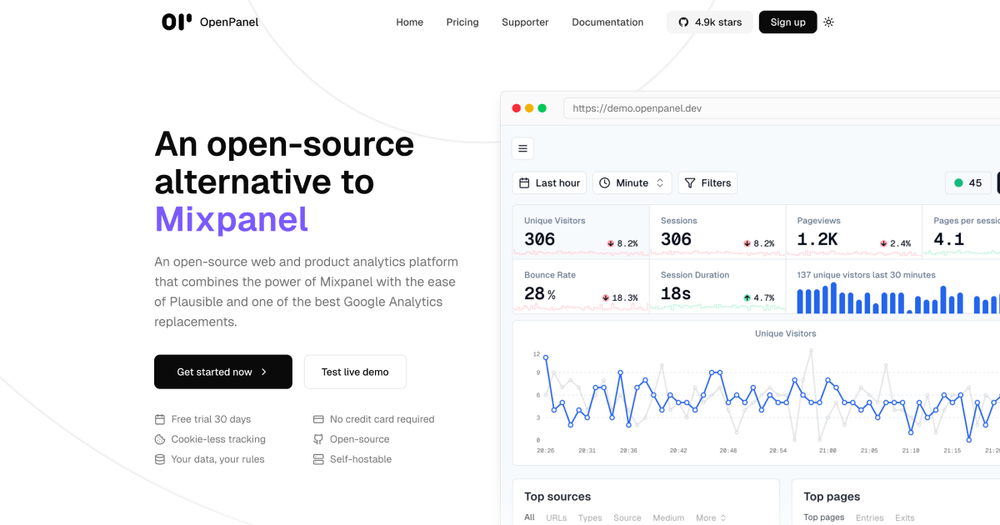
Who openpanel is for#
SaaS product teams tracking user behavior and conversion funnels
OpenPanel covers the core product analytics workflow: custom event tracking, funnels, cohort retention, user profiles, and session replay in one platform. Teams building SaaS products can track signups, activation events, and revenue from payment integrations without switching between tools.
Skip if:
If your team has no server administration capacity and needs enterprise SLAs, managed plans from Mixpanel or Amplitude provide stronger compliance and support guarantees out of the box.
Privacy-first teams serving EU users
Cookieless tracking and EU-hosted data mean visitor analytics require no cookie consent banners for the metrics OpenPanel collects by default. GDPR compliance is built in, and a Data Processing Agreement is available for teams that need it.
Skip if:
If your primary analytics need is deep mobile-native app tracking where Amplitude's mobile SDK ecosystem depth matters more than web privacy controls, Amplitude may be the better fit.
Indie developers replacing Mixpanel or Plausible
Teams currently on Plausible who want user profiles, funnels, and product analytics depth can move to OpenPanel without adopting enterprise pricing. The self-hosted path removes the per-event cost model entirely for teams with basic DevOps capability.
Skip if:
If you need only simple page-view metrics with no event tracking, Plausible or a lighter web analytics tool is simpler to operate and does not require the four-service infrastructure stack.
Developers building AI-powered analytics workflows
The MCP server exposes funnel queries, retention cohorts, referrer breakdowns, and GSC data to any MCP-compatible AI agent. Teams using Claude or Cursor for analysis can query analytics directly from their AI tools without manually exporting data or building chart queries in the dashboard.
Skip if:
If your AI stack does not use MCP-compatible clients, this feature provides no benefit and the standard dashboard is the primary interface.
The problem it solves#
Product analytics at scale is expensive. Mixpanel pricing scales with event volume, often reaching several hundred dollars per month for growing products, while Amplitude targets larger teams with pricing that starts even higher. Both platforms store your data on their servers, with no self-hosting option.
The secondary pain is privacy. Cookie-based tracking is increasingly blocked by browsers and opt-out rules, forcing teams to either lose visibility into their users or negotiate data processing agreements with vendors who control the pipeline. Teams building GDPR-compliant products serving EU users face additional scrutiny around where data is processed. OpenPanel addresses both challenges by running on infrastructure you control with cookieless tracking on by default.
How it solves it#
Funnel and cohort analytics
Tracks user flows from first page view through conversion, with configurable funnel steps tied to any custom event. Cohort retention charts show what percentage of users return on day 1, 7, 14, and 30, and which behaviors predict long-term retention.
Session replay with no monthly cap
Records real user sessions to show clicks, scrolls, and rage clicks, with privacy controls built in. Unlike Mixpanel, which caps replay sessions at 5,000 per month on its free tier and 20,000 on paid plans, OpenPanel imposes no replay session limit.
MCP server with 38 analytics tools
An MCP server connects Claude, Cursor, Windsurf, or any MCP-compatible AI agent directly to your OpenPanel data. Includes tools for funnel queries, retention series, top pages, referrers, country breakdowns, and Google Search Console metrics, with no tab-switching or manual chart-building.
Revenue and conversion tracking
Connects payment events to track MRR and which referrers drive the most revenue. A/B testing support breaks conversion results down by experiment variant, country, or device. Funnel notifications alert your team on Slack when a conversion flow completes.
Multi-platform SDKs and Google Search Console integration
Ships SDKs for React, Next.js, Vue, Remix, Astro, React Native, iOS (Swift), Android (Kotlin), Node, Express, Laravel, Rust, and Ruby. Google Search Console integration brings organic traffic and query data into the same dashboard as product events.
Cookieless, GDPR-compliant tracking
Tracks visitors without cookies by hashing IP addresses and user agents daily. EU data hosting is included by default on the cloud plan, and a Data Processing Agreement is available to sign. Analytics data does not touch third-party servers when self-hosted.
Strengths and trade-offs#
Strengths
- Self-hosted tier with unlimited events and no per-seat feesSelf-hosted OpenPanel imposes no event volume limits, no per-seat pricing, and no feature restrictions tied to usage. The cloud plan bills only for event volume, with unlimited websites, users, dashboards, charts, and tracked profiles included. The website notes that Mixpanel's pricing scales to hundreds or thousands of dollars per month as event volume grows.
- Session replay without monthly capsOpenPanel session replay has no monthly session limit. Mixpanel caps replay sessions at 5,000 per month on its free tier and 20,000 on paid plans. Teams with high traffic can record and review all sessions without hitting replay quotas or upgrading tiers.
- AI-native analytics via built-in MCP serverThe built-in MCP server lets Claude, Cursor, or any MCP-compatible AI agent query your analytics using 38 available tools. No separate integration setup or data export is needed; funnel results, retention cohorts, referrer breakdowns, and GSC data are all accessible from the AI client.
- Actively maintained with broad SDK coverageThe repository saw its last push in September 2026 and has nearly 7,000 GitHub stars and 480 forks accumulated since launching in February 2024. SDKs ship for 14-plus platforms including React, Vue, iOS (Swift), Android (Kotlin), and server-side runtimes including Rust and Laravel.
Trade-offs
- -Self-hosting requires a multi-service stackThe self-hosted path requires running Postgres, ClickHouse, Redis, and the Node application together. Platforms like Coolify simplify this to near-one-click deployment, but a generic cloud or bare-metal setup needs familiarity with container orchestration and basic database administration. This is not a single-binary install.
- -AGPL-3.0 restricts offering it as a managed service to othersOpenPanel is licensed under AGPL-3.0. You can run it on your own infrastructure for any internal commercial or team purpose at no cost. What the license restricts is offering a managed or hosted version of OpenPanel as a commercial service to third parties without releasing your modifications under the same license.
- -Relatively new platform with 56 open issuesLaunched in February 2024, OpenPanel is a younger platform than Mixpanel or Amplitude. With 56 open issues, the project is actively triaged, but some edge cases and integrations may lack the polish of more established tools. Early users described frequent updates, which also means the API surface can shift between releases.
openpanel vs alternatives#
OpenPanel vs Mixpanel
OpenPanel and Mixpanel overlap almost entirely on product analytics features: custom event tracking, funnels, cohort retention, user profiles, A/B testing, and session replay. The practical differences are data ownership, self-hosting availability, and cost at scale.
| Feature | OpenPanel | Mixpanel |
|---|---|---|
| License | AGPL-3.0 | Proprietary |
| Self-hosting | Yes | No |
| Cookieless tracking | Yes | No |
| Session replay cap | None | 5,000/month (free), 20,000/month (paid) |
| GDPR compliance | Yes (EU hosted by default) | Yes (with configuration) |
| MCP server | Yes (38 tools) | No |
OpenPanel is the better choice when data ownership matters, when self-hosting avoids per-event costs at scale, or when the team needs cookieless tracking without a cookie consent setup. Mixpanel is the better choice when you need a platform with years of production hardening, established enterprise compliance certifications, or a larger ecosystem of third-party integrations. OpenPanel launched in 2024 and is actively maintained; Mixpanel has a decade-plus track record. Teams migrating from Mixpanel will find OpenPanel covers the same core workflows, but should expect some rough edges from a younger platform.
OpenPanel vs Amplitude
Both OpenPanel and Amplitude target product analytics: events, funnels, cohort retention, and user profiles. OpenPanel is open-source under AGPL-3.0 and includes a self-hosted path with no event limits; Amplitude is a proprietary commercial platform. For teams that want product analytics depth without paying commercial analytics pricing, OpenPanel covers the core use case. Amplitude's advantage is a more mature platform with stronger enterprise support and a longer track record. OpenPanel is the better starting point for product teams that need analytics depth without committing to enterprise pricing.
Quick start#
Self-hosting OpenPanel requires cloning the repository and configuring Docker for the backing services (Postgres, ClickHouse, Redis).
```bash
git clone https://github.com/Openpanel-dev/openpanel.git
pnpm install
cp .env.example .env
pnpm dock:up
pnpm migrate:deploy
pnpm dev
```What it's built on#
- Languages
- JavaScriptTypeScript
- Infrastructure
- AWS
FAQ#
Is OpenPanel free to use?
Self-hosting is free with no event volume limits, no per-seat fees, and no feature restrictions. The managed cloud plan starts at $20 per month and bills only for event volume; everything else (users, dashboards, charts, tracked profiles) is unlimited. A 30-day free trial is available for cloud plans with no credit card required.
How does OpenPanel compare to Mixpanel?
OpenPanel covers the same core product analytics features: events, funnels, cohort retention, user profiles, session replay, and A/B testing. Key differences are self-hosting availability (OpenPanel supports it; Mixpanel does not), session replay limits (OpenPanel has none; Mixpanel caps at 5,000 to 20,000 per month), and an MCP server for AI agent queries that Mixpanel lacks. Mixpanel is a more mature platform with a longer track record and broader third-party integrations.
Can I self-host OpenPanel?
Yes. Self-hosting requires running four services together: the OpenPanel application, Postgres, ClickHouse, and Redis. The documentation covers the full setup at openpanel.dev/docs/self-hosting/self-hosting. Platforms like Coolify support near-one-click deployment. Self-hosted instances have no event volume limits and are completely free.
Is OpenPanel GDPR compliant?
OpenPanel tracks visitors without cookies by hashing IP addresses and user agents daily, which eliminates most cookie consent requirements for the data it collects. Data is EU-hosted by default on the cloud plan, and a Data Processing Agreement is available for teams that need one. Self-hosted deployments store data on your own infrastructure with no third-party data transfer.
What is OpenPanel's license?
OpenPanel is licensed under AGPL-3.0. You can run it on your own infrastructure for any internal commercial or team purpose at no cost. The AGPL requires that if you offer it as a hosted service to third parties or distribute a modified version, you release your modifications under the same license. Self-hosters using it internally are not affected by this requirement.
Similar open-source tools#

Umami
Self-hosted analytics for product and marketing teams

PostHog
Track events, replay sessions, and run A/B tests, self-hostable

Trench
Open source analytics infrastructure powered by ClickHouse

Plausible
Cookie-free web analytics for privacy-focused teams

Traffic Source
Open source self-hosted analytics for total data ownership

Matomo
Self-hosted Google Analytics alternative, 100% data ownership