

Who Cap is for#
Founders sending product walkthroughs
Record quick demos for customers or teammates while keeping the option to store sensitive videos in your own cloud account.
Skip if:
Skip if your sales process depends on advanced viewer analytics and CRM integrations.
Product teams reviewing UI changes asynchronously
Cap can replace quick sync meetings with narrated screen recordings and comment threads.
Skip if:
Skip if your team already has a full video review and asset-management system.
The problem it solves#
Async video is useful for product walkthroughs, support replies, and internal updates, but hosted tools make recordings part of a vendor-controlled library. That creates cost, retention, and privacy concerns when videos include customer data, unreleased features, contracts, or internal dashboards.
Teams need the speed of Loom-style sharing without accepting that every recording must live on a third-party video platform.
How it solves it#
Screen and camera recording
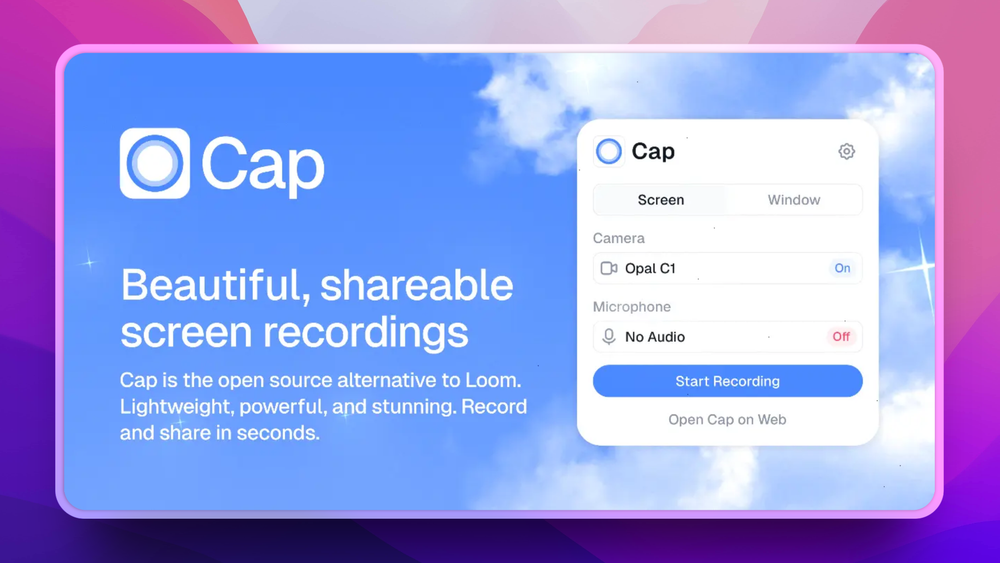
Records product demos, walkthroughs, and async updates with desktop apps and shareable playback.
Custom S3 storage option
Lets teams store recordings in their own S3 bucket, reducing dependence on vendor-controlled video storage.
Comment and sharing workflow
Supports async review around shared videos so teams can discuss specific recordings without a live meeting.
Strengths and trade-offs#
Strengths
- Storage control is the key differentiatorCustom S3 support gives small teams a path to keep recordings under their own access controls while preserving the link-sharing workflow.
- Open source codebaseThe public repository lets technical teams inspect how the recorder and web app work before trusting it with sensitive video.
Trade-offs
- -Hosted polish may differ from LoomTeams that need mature enterprise video administration, broad integrations, and viewer analytics may find Loom more complete.
Cap vs alternatives#
Cap vs Loom
Cap and Loom both support quick screen recording and async video sharing. Cap differentiates on open source code and custom S3 storage, while Loom offers a mature proprietary video workspace.
Cap is better when storage control and lower operating cost matter. Loom is still better when the organization needs polished enterprise administration, analytics, and integrations with no self-hosting work.
What it's built on#
- Languages
- JavaScriptPythonRustTypeScript
- Frameworks
- Next.jsReactSolidJS
- Databases
- MySQL
FAQ#
Is Cap open source?
Cap publishes its source code on GitHub. The repository currently reports no SPDX license assertion in the synced GitHub metadata, so teams should verify license terms before commercial self-hosting.
Can Cap replace Loom?
Cap can replace Loom for screen recording, async sharing, and teams that want storage control. Loom remains stronger for mature hosted video workflows and enterprise integrations.
Does Cap support custom storage?
Yes. Cap documents custom S3 storage, which lets teams keep recordings in their own cloud bucket.
Similar open-source tools#

Kap
Open source screen recorder for macOS with web tech

Capso
Free open-source screenshot and recorder for macOS

OBS Studio
Record and stream with multi-source scenes and hardware encoding

Excalidraw
Open source whiteboard for hand-drawn style diagrams

Kdenlive
Free non-linear video editor for Linux, Mac, and Windows

Inbox Zero
AI email assistant that drafts replies and clears your inbox