Freehire vs Simplify.jobs
Simplify.jobs is a commercial job search and application tracking platform for tech job seekers. Freehire covers the same use case as the open-source, MIT-licensed alternative with a different approach to where job data comes from.
Job data and sourcing
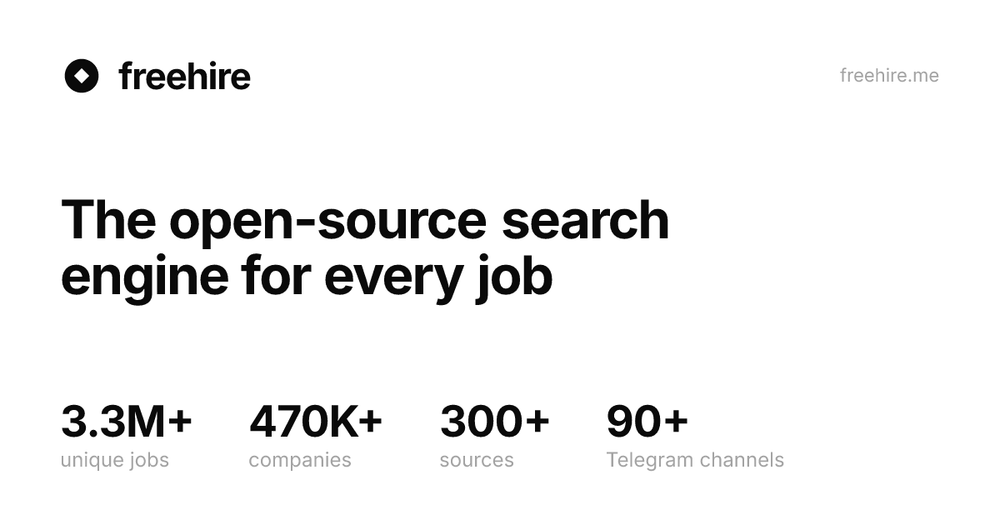
Freehire crawls ATS platforms directly: Workday, Greenhouse, Lever, Ashby, iCIMS, and 113 others. Each listing links to the canonical career page on the company's own domain. Deduplication at ingest means a role posted across multiple boards becomes one record, and the 3.3M+ figure reflects unique open postings after this deduplication.
Commercial aggregators in this category typically pull from existing job boards rather than directly from ATS providers. This introduces an extra aggregation layer between the posting and the user, which can mean stale listings and the same role appearing multiple times under different source labels.
Cost and licensing
Freehire's search is available for free at freehire.me with no account required. The full codebase is MIT licensed and self-hostable via Docker Compose; there are no per-seat fees on a self-hosted instance. Simplify.jobs is a commercial product with free and paid tiers.
Freehire ships a public, keyless HTTP API over its full catalogue, a CLI binary for terminal-based search, and an MCP server for Claude Code and Claude Desktop. These make it possible to build on top of the job data programmatically without negotiating a commercial data license.
Coverage scope
Freehire focuses on tech and IT roles. Simplify.jobs covers a wider range of industries and roles. For software engineers, data scientists, and related technical roles, freehire's direct ATS coverage is the primary advantage. For roles outside tech, a general-purpose platform with broader industry coverage may be more relevant.
When to choose freehire
Freehire suits technical job seekers who want ATS-direct data with no paid subscription, and developers who need live job data for their own tools via API or MCP. Simplify.jobs may be preferable for non-technical roles, for users who want a polished commercial application management interface, or for teams that need cross-industry coverage.