
Who Lightdash is for#
Analytics teams standardizing metrics in dbt
Use Lightdash when analysts already maintain dbt models and want business users to explore governed metrics without duplicating definitions.
Skip if:
Your organization does not use dbt or needs a spreadsheet-first BI workflow.
Startups replacing heavyweight BI
Use Lightdash when Looker-style governance matters but the team wants more control over hosting and data-model ownership.
Skip if:
You need a mature enterprise BI procurement package with every managed-service feature included.
The problem it solves#
Business intelligence breaks down when dashboards drift from the data models analysts maintain. Teams end up with one layer in dbt, another layer in BI, and a trail of duplicated definitions for revenue, activation, churn, and usage metrics.
Paid BI platforms can solve governance, but they often add licensing friction and vendor lock-in around the semantic layer. Smaller data teams need a way to keep trusted metrics close to their dbt project while still giving business users charts and dashboards.
How it solves it#
dbt-centered metrics workflow
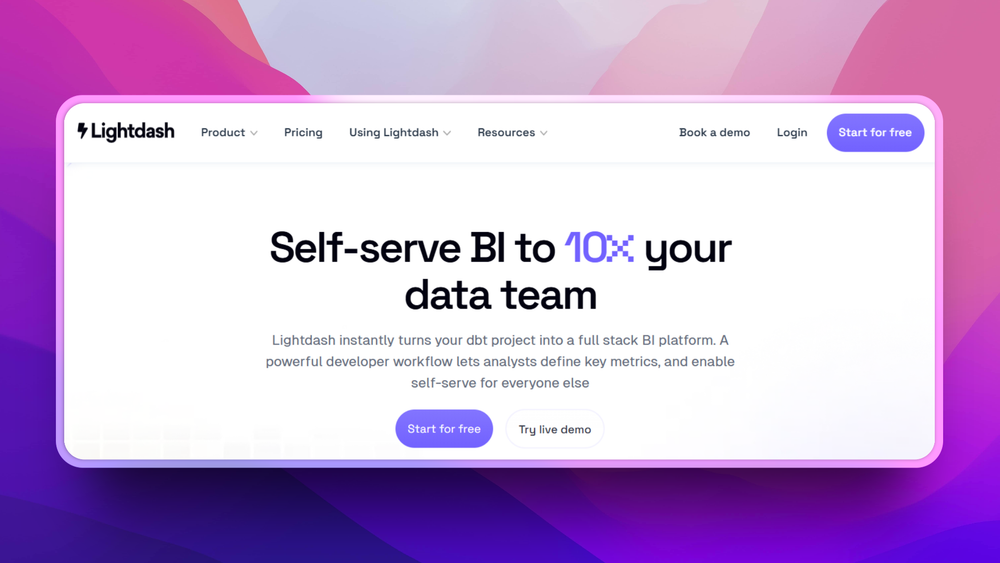
Lightdash connects BI exploration to dbt projects, letting teams define and document metrics near the transformation code analysts already maintain.
Dashboards and explores
Business users can explore modeled data, build charts, and assemble dashboards without asking analysts to hand-code every report.
Self-hosted deployment path
Lightdash supports self-hosting for teams that need control over analytics infrastructure, data access, and internal deployment policy.
Strengths and trade-offs#
Strengths
- Keeps BI close to dbtLightdash is strongest when a team already treats dbt as the source of truth for transformations and wants BI definitions to follow that same model.
- Lower lock-in than classic BI suitesBecause metric definitions live near the data project, teams can reduce dependence on a proprietary BI-only semantic layer.
Trade-offs
- -Best fit requires dbt maturityLightdash is less compelling if the team has not standardized on dbt models and metric definitions. It may add process before it adds reporting speed.
What it's built on#
- Languages
- TypeScript
- Frameworks
- Express
- Databases
- PostgreSQL
- Infrastructure
- AWS
- Messaging
- NATS
FAQ#
What is Lightdash?
Lightdash is a BI platform that connects dashboards and exploration workflows to dbt-modeled data.
Is Lightdash a Looker alternative?
Yes, Lightdash can replace Looker for teams that want governed BI built around dbt. Looker may still fit organizations that rely on its mature enterprise ecosystem.
Can Lightdash be self-hosted?
Lightdash documents a self-hosted deployment path, which helps teams keep BI infrastructure under their own operational control.
Similar open-source tools#
Redash
Connect to any data source, query, visualize, and share
Apache Superset
Open source data visualization and BI exploration tool
MindsDB
Query machine learning models and LLMs directly from SQL
CocoIndex
Incremental data framework for AI agents.
Local Deep Research
Your AI research assistant, fully local and encrypted.
Maigret
Collect OSINT data by username effortlessly

