Open Source Alternatives LogoOpen Source Alternatives
AlternativesBlogAdvertise
Open Source Alternatives LogoOpen Source Alternatives

Stay Updated

Subscribe to our newsletter for the latest news and updates about Alternatives

Open Source Alternatives LogoOpen Source Alternatives

Handpicked Open Source Alternatives to Paid Softwares

Product
  • Categories
  • Tag
  • Sign In
Resources
  • Blog
  • Collection
  • Submit
  • Advertise your tool
Company
  • Privacy Policy
  • Terms of Service
  • Refund Policy
  • Sitemap
Alternatives
  • Superhuman
  • Notion
  • Slack
  • Linear
  • Airtable
  • Wispr Flow
  • All alternatives
Copyright © 2026 All Rights Reserved.
Home/Categories/AI & Machine Learning/OmniRoute
icon of OmniRoute

OmniRoute

Open source alternative to OpenRouter, Portkey, Requesty, Vercel AI Gateway and Inworld Router

Connect 352 AI providers through one OpenAI-compatible endpoint, with automatic fallback, 19 routing strategies, and 15-95% token compression. MIT licensed.

63.5K starsTypeScriptMITActive this week
Visit websiteGitHub repo
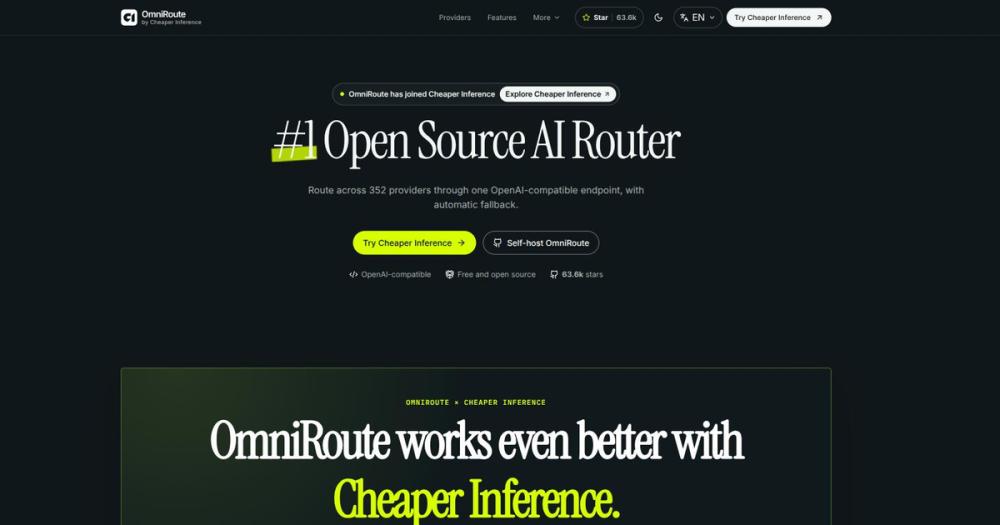
OmniRoute homepage hero
Contents
  1. 01Who OmniRoute is for
  2. 02The problem it solves
  3. 03How it solves it
  4. 04Strengths and trade-offs
  5. 05OmniRoute vs alternatives
  6. 06Install and self-host
  7. 07Tech stack
  8. 08FAQ
  9. 09Similar open-source tools
TL;DR

OmniRoute is an MIT-licensed AI gateway that connects 352 providers through a single OpenAI-compatible local endpoint, with automatic 4-tier fallback and 15-95% token compression. It replaces paid routing services like OpenRouter and Portkey with a self-hosted, local-first gateway where your API keys and usage data never leave your machine. One npm install starts the gateway and dashboard; Claude Code, Codex, Cursor, Cline, and 31 other tools connect by pointing at localhost:20128/v1. Best for developers running coding agents who want to maximize free quota, reduce token costs, and stay online when any single provider goes down.MIT · TypeScript · 63.5K stars · Active this week

who it's for

Who OmniRoute is for#

Developers running coding agents (Claude Code, Cursor, Cline)

Connect your existing coding agent to http://localhost:20128/v1 and let OmniRoute handle provider selection, fallback, and token compression. When a provider's rate limit kicks in mid-task, OmniRoute routes the next request to the next healthy target without interrupting the session.

Skip if:

Skip if you rely on provider-specific features that OmniRoute cannot pass through, such as Anthropic's extended thinking controls or provider-specific streaming behaviors outside the OpenAI-compatible API surface.

Teams sharing one paid subscription across multiple engineers

Key pools with fair-share quota allocation distribute a shared subscription across team members without each person needing their own API key. Usage analytics on the dashboard show token spend per provider and model, making it possible to identify which workloads consume the most quota.

Skip if:

Skip if each developer already has their own separate API accounts and the team does not need central quota management or a shared fallback configuration.

Developers building LLM apps who want to avoid provider lock-in

One OpenAI-compatible endpoint lets you switch providers by changing the model name in your request, not your code. The 19 routing strategies and catalog of 352 providers mean you can shift between OpenAI, Anthropic, Google, and cheaper alternatives without rewriting your integration.

Skip if:

Skip if your application requires provider-specific API features outside the OpenAI-compatible surface, such as Anthropic's tool_choice parameter or Google's safety settings.

Solo developers who want to maximize access without paying

OmniRoute catalogs 150+ free-tier providers and a keyless quick-start mode. On a fresh install, the auto combo routes through free providers before escalating to paid tiers. The /dashboard/free-tiers page shows live used and remaining quota across every pool, deduplicated.

Skip if:

Skip if your workflow requires sustained high-throughput output from a specific model. Free tiers are rate-limited; once quota is exhausted within the billing window, OmniRoute falls back to paid routes or stops if no paid fallback is configured.

the problem

The problem it solves#

Managing AI providers as separate services creates a fragile workflow for developers building coding agents and LLM pipelines. Each provider has its own SDK, authentication format, rate limit, and quota tracker. When Anthropic's rate limit kicks in mid-task, the coding session freezes until you manually switch to a different provider or wait for the quota window to reset.

Token costs compound the problem. Tool-calling agents generate large context windows that providers charge at full rate, and there is no built-in mechanism for compressing tool output before sending it upstream. Teams running Claude Code or Cursor across multiple machines often share a single API key or subscription, which accelerates quota burn with no visibility into where the tokens went.

how OmniRoute solves it

How it solves it#

4-tier automatic fallback

Routes requests through a Subscription, API Key, Cheap, then Free tier cascade when a provider is unavailable or out of quota. Fallback happens in milliseconds, so a coding session in Claude Code or Cursor continues without interruption even if the primary provider is rate-limited.

12-engine token compression pipeline

An RTK and Caveman compression pipeline reduces eligible context payloads by 15-95%. A tool-heavy workload example in the documentation reduced context from 18,400 tokens to 2,024, an 89% reduction. Compression is composable across dedup, RTK, Caveman, and ultra modes.

352-provider catalog with 150+ free tiers

The local provider catalog covers 352 providers including OpenAI, Anthropic, Google, DeepSeek, Mistral, Groq, and Ollama. The documented recurring free-tier budget totals approximately 1.47 billion tokens per month across 34 pool keys, deduplicated so shared pools are counted once.

19 routing strategies (Combos)

Nineteen routing strategies let you pick a preset (auto, auto/coding, auto/fast, auto/cheap, auto/offline, auto/smart) or build a custom combo with tiered fallback. A 15-factor scoring engine selects the next healthy target at request time based on quota, cost, and provider health.

Built-in MCP server and A2A protocol

A built-in MCP server exposes 110 gateway tools across 33 scopes via stdio or HTTP. The A2A protocol layer provides a JSON-RPC 2.0 agent server with 6 skills and an Agent Card at /.well-known, enabling agent-to-agent communication without external infrastructure.

35 coding tool integrations

Claude Code, Codex CLI, Cursor, Cline, GitHub Copilot, Gemini CLI, Aider, Goose, Windsurf, and 26 other tools connect by updating their base URL to http://localhost:20128/v1. The OmniCopilot VS Code extension adds OmniRoute models to the Copilot Chat model picker without requiring a Copilot plan.

strengths · trade-offs

Strengths and trade-offs#

Strengths

  • MIT license with fully local operationThe MIT license places no restrictions on commercial or team use. API keys are encrypted at rest with AES-256-GCM and stay on your local machine; no credentials or usage data pass through a third-party cloud. Unlike OpenRouter or Portkey, which route traffic through their own servers, OmniRoute is a process you run on your own hardware.
  • Keyless quick-start with no signupA fresh install responds to requests immediately via keyless free-tier providers (OpenCode Free is pre-wired into the auto combo). No API key, no account creation, no configuration required to get a response. This lets a developer validate the setup before connecting paid accounts.
  • Persistent memory with vector recallConversational memory with FTS5 keyword search and Qdrant vector recall persists across sessions and providers. This is a capability that commercial AI gateways like Portkey and Vercel AI Gateway do not include natively, requiring external memory infrastructure.
  • Nine supported deployment targetsOmniRoute runs as an npm global package, Docker container (AMD64 and ARM64), native desktop app (Windows, macOS, Linux), Android app via Termux without root, Raspberry Pi or ARM server, PWA, OpenCode plugin, VS Code extension, or from source. Teams can run it on a shared server or each developer can run a local instance.

Trade-offs

  • -611 open issues on a seven-month-old projectThe GitHub repo had 611 open issues as of the research date. The project was created in February 2026 and has grown rapidly to 63,000+ stars, which means the issue tracker has accumulated faster than it can be resolved. Users integrating OmniRoute into production workflows should expect rough edges, particularly around newer provider integrations and edge-case routing scenarios.
  • -Provider terms risk varies across the free-tier catalogThe README documentation flags 13 providers as having terms-of-service risk (reselling or pooling free tiers may violate their terms). OmniRoute publishes a terms-risk catalog so users can review these, but teams relying on free tiers for production workloads should audit which providers they route through.
  • -Free-tier budget is re-audited and can decreaseThe documented 1.47B free tokens per month is recalculated every two weeks against the live provider catalog. A provider ending its free tier removes that budget from the count. Teams building workflows that depend on free-tier capacity should monitor the /dashboard/free-tiers page, as the budget moves both directions when upstream providers change their policies.
versus alternatives

OmniRoute vs alternatives#

OmniRoute vs OpenRouter

OpenRouter and OmniRoute both unify access to multiple AI providers through a single API endpoint. The primary difference is deployment model: OpenRouter is a managed cloud service that routes your requests through its own servers; OmniRoute is a self-hosted gateway that runs on your own hardware.

FeatureOmniRouteOpenRouter
LicenseMITProprietary
DeploymentSelf-hosted local or serverCloud-only
Request routingLocal process, direct to providerVia OpenRouter servers
Token compression12-engine pipeline, 15-95%None built in
MCP server110 tools, 33 scopesNot included
Free-tier catalog150+ entries, ~1.47B tokens/monthAggregated free routing
MemoryFTS5 + vectorNot included
Setupnpm install or DockerAccount signup

OmniRoute is the better choice when data privacy is a requirement, since prompts go directly from your machine to the provider without touching a third-party server. The token compression pipeline and MCP integration are also differentiators that OpenRouter does not match. OpenRouter is worth considering when you need zero-install simplicity: it works immediately from any HTTP client with no server to run.

OmniRoute vs Portkey

Portkey is a commercial AI gateway aimed at teams that want observability, guardrails, and prompt management for production LLM applications. It is a managed service with no self-hosting option for the core platform.

FeatureOmniRoutePortkey
LicenseMITProprietary (managed cloud)
Self-hostingYesNo (cloud-only)
GuardrailsPII, injection, visionYes (richer production set)
Prompt managementNot includedYes
ObservabilityUsage and quota dashboardFull LLM observability suite
Token compression12-engine pipelineNot included
Coding tool integrations35 toolsNot a primary use case
PricingFree to self-hostPaid tiers

OmniRoute covers the developer-local and coding-agent scenario better: it installs on a laptop, integrates directly with 35 coding tools, and costs nothing to run beyond provider API fees. Portkey covers the production team scenario better: it provides prompt versioning, richer guardrails, and observability tooling that OmniRoute's dashboard does not match. Teams running OmniRoute for local development and Portkey for production observability are solving different problems with each tool.

install · self-host

Install and self-host#

bash
Install using the npm package manager and start the gateway on port 20128.

```bash
npm install -g omniroute
omniroute
```
tech stack · detected from GitHub

What it's built on#

Languages
JavaScriptTypeScript
Frameworks
ExpressNext.jsReact
Infrastructure
AWS
Cache
Redis
Tooling
esbuild
frequently asked

FAQ#

Is OmniRoute free to use?

Yes. OmniRoute is MIT licensed and free to self-host on your own infrastructure. The keyless quick-start mode routes through free-tier providers on a fresh install with no API key required. The documented free-tier budget is approximately 1.47 billion tokens per month across 34 recurring pool keys, recalculated every two weeks against the live catalog. Using paid providers (OpenAI, Anthropic, etc.) through OmniRoute requires your own API keys, which you pay to those providers directly.

Does OmniRoute send my API keys or prompts to a third-party server?

No. OmniRoute is a local process that runs on your machine at localhost:20128. API keys are stored with AES-256-GCM encryption in local storage and sent directly from your machine to the provider. No credentials or prompt content pass through OmniRoute's servers. The self-hosted deployment model means OmniRoute itself never handles your data in the cloud unless you deploy the Docker image to a remote server you control.

Which coding tools work with OmniRoute?

OmniRoute supports 35 integrations as of the research date, including Claude Code, Codex CLI, Cursor, Cline, GitHub Copilot (via the OmniCopilot VS Code extension), Gemini CLI, Aider, Goose, Windsurf, Devin CLI, and Kilo Code. Any OpenAI-compatible client that accepts a configurable base URL will work. Configuration typically requires setting the base URL to http://localhost:20128/v1 and an API key (which can be any string for keyless providers).

How does OmniRoute handle a provider outage or rate limit?

OmniRoute runs a 3-layer resilience stack: a provider circuit breaker, a connection cooldown, and a model lockout that isolates failures at the smallest useful scope. When the circuit breaker trips, OmniRoute falls back to the next healthy target in the 4-tier cascade (Subscription, API Key, Cheap, Free) without the calling client needing to retry. The fallback selection uses a 15-factor scoring engine that considers quota, cost, and provider health.

How does OmniRoute compare to OpenRouter?

Both route AI requests across multiple providers through a single endpoint. OpenRouter is a managed cloud service; OmniRoute is a local gateway you self-host. With OmniRoute, requests go from your machine directly to the provider, so your prompts and API keys never touch a third-party server. OpenRouter offers a simpler setup (no install required) but requires an account and routes traffic through its infrastructure. OmniRoute adds token compression, an MCP server, persistent memory, and coding-tool integrations that OpenRouter does not include.

also worth a look

Similar open-source tools#

freellmapi

freellmapi

One OpenAI-compatible key for 635 free LLM endpoints

24.6KTypeScriptMIT
sub2api

sub2api

One API gateway for Claude, OpenAI, Gemini, and Grok subscriptions

40.7KGoLGPL-3.0
Switchyard

Switchyard

LLM proxy with API translation and multi-backend routing

2.8KPythonApache-2.0
rtk

rtk

CLI proxy that removes 89% of agent context noise on average

79.1KRustApache-2.0
9Router

9Router

Smart AI Router with 3-Tier Fallback

27.3KJavaScriptMIT
Apache APISIX

Apache APISIX

Cloud-native API gateway with dynamic routing and plugins

17.1KLuaApache-2.0

Repository

Stars
63.5K
Forks
8.9K
License
MIT
Latest
v3.8.50
Last commit
today
Last verified
Sep 10, 2026
Repo
diegosouzapw/OmniRoute ↗

Additional details

Language
TypeScript
Open issues
609
Contributors
591
First release
2026

Categories

AI & Machine LearningDeveloper ToolsAPIs & IntegrationCloud & Hosting

Tags

LLMAI Coding AssistantDeveloper ToolsSelf HostedAPI Infrastructure