Open Source Alternatives LogoOpen Source Alternatives
AlternativesBlogAdvertise
Open Source Alternatives LogoOpen Source Alternatives

Stay Updated

Subscribe to our newsletter for the latest news and updates about Alternatives

Open Source Alternatives LogoOpen Source Alternatives

Handpicked Open Source Alternatives to Paid Softwares

Product
  • Categories
  • Tag
  • Sign In
Resources
  • Blog
  • Collection
  • Submit
  • Advertise your tool
Company
  • Privacy Policy
  • Terms of Service
  • Refund Policy
  • Sitemap
Alternatives
  • Superhuman
  • Notion
  • Slack
  • Linear
  • Airtable
  • Wispr Flow
  • All alternatives
Copyright © 2026 All Rights Reserved.
Home/Categories/Cloud & Hosting/seaweedfs
icon of seaweedfs

seaweedfs

Open source alternative to Amazon S3, Cloudflare R2, Azure Blob Storage, Google Cloud Storage and Wasabi Hot Cloud Storage

Scale distributed storage across billions of files with S3, POSIX, and Iceberg from one cluster. Apache-2.0 licensed, runs on bare metal or Kubernetes.

34.5K starsGoApache-2.0Active this week
Visit websiteGitHub repo
image of seaweedfs
Contents
  1. 01Who seaweedfs is for
  2. 02The problem it solves
  3. 03How it solves it
  4. 04Strengths and trade-offs
  5. 05seaweedfs vs alternatives
  6. 06Install and self-host
  7. 07Tech stack
  8. 08FAQ
  9. 09Similar open-source tools
TL;DR

seaweedfs is a distributed storage system that serves S3 objects, a POSIX filesystem, and Apache Iceberg tables from one cluster, replacing paid object storage services like Amazon S3 and Azure Blob Storage for self-hosted infrastructure teams. It resolves every file in a single disk seek regardless of total file count, keeping read latency flat at any scale. Apache-2.0 licensed, deployable with a single binary on bare metal or Kubernetes. Best for high-volume storage workloads where cloud egress and capacity bills have outgrown the cost of operating your own cluster.Apache-2.0 · Go · 34.5K stars · Active this week

who it's for

Who seaweedfs is for#

Infrastructure teams replacing cloud object storage

Teams with large monthly bills for Amazon S3, Azure Blob Storage, or Google Cloud Storage and on-premises or colo hardware can replace the managed service with SeaweedFS. The S3 API compatibility means application code changes are usually limited to updating the endpoint URL and access keys.

Skip if:

If your team does not operate bare-metal or colo hardware, or if you rely on S3's global edge network for low-latency delivery to end users across multiple regions, managed cloud storage remains the lower-overhead choice.

Data engineers building on-premises lakehouses

SeaweedFS's built-in Iceberg REST catalog eliminates AWS Glue, a Hive Metastore, or Project Nessie as a separate service. Spark, Trino, DuckDB, and ClickHouse connect to the same tables concurrently. Parquet compaction and snapshot expiration run automatically per bucket without a separate maintenance job.

Skip if:

If your query engines already connect to a working Iceberg catalog and it is performing well, adding SeaweedFS solely for its catalog is unnecessary overhead.

Platform engineers provisioning Kubernetes storage

SeaweedFS ships a first-class Helm chart and CSI driver for Kubernetes, making it a candidate to replace cloud-provisioned PersistentVolumes and object storage buckets inside a cluster. The CSI driver presents SeaweedFS volumes as standard Kubernetes PersistentVolumeClaims, so existing workloads are unchanged.

Skip if:

If your Kubernetes cluster already has a working storage class from your cloud provider and you are not hitting cost or data locality limits, a self-managed storage layer adds operational complexity without a clear gain.

Teams migrating HDFS workloads off Hadoop

SeaweedFS implements a Hadoop-compatible filesystem at `seaweedfs://`, so Spark, Flink, and HBase jobs that reference HDFS paths work against it without modification. Teams decommissioning a Hadoop cluster but keeping Spark or Flink jobs can migrate storage without changing job code.

Skip if:

If your organization runs a well-maintained Hadoop cluster with a dedicated operations team, migrating storage to SeaweedFS adds risk without a clear operational benefit.

the problem

The problem it solves#

Running object storage on cloud platforms like Amazon S3 or Azure Blob Storage is convenient until the bill arrives. At high file counts and transfer volumes, per-request fees, per-GB egress charges, and multi-region replication costs compound fast. Teams processing millions of files daily can pay several thousand dollars a month for storage that costs a fraction of that to provision on their own hardware.

The deeper challenge is architecture. Most teams combine separate services: an object store for blobs, an HDFS cluster for Spark jobs, and a catalog service for Iceberg tables. Each layer adds operational overhead, cross-service data copies, and separate access control to manage. A schema change or a new query engine means another integration to maintain.

how seaweedfs solves it

How it solves it#

S3 API with IAM, STS, and S3 Tables

The S3 gateway implements 73 bucket and object operations plus 36 S3 Tables operations, 39 IAM operations, and 5 STS operations. AWS SDKs, the AWS CLI, rclone, restic, Spark, and Trino connect without modification. Versioning, Object Lock, lifecycle rules, SSE-S3, SSE-KMS, SSE-C encryption, and atomic RenameObject are included.

O(1) disk reads at any file count

Each volume server keeps a 16-byte in-memory index per blob and reads any blob in a single disk seek, including erasure-coded data. The master tracks volumes rather than individual files, so a cluster with billions of files has only a few thousand volume entries. Read latency stays flat whether the cluster holds 1 million or 10 billion objects.

Built-in Apache Iceberg REST catalog

SeaweedFS serves an Iceberg REST catalog directly from the cluster with no separate Hive Metastore, AWS Glue, or catalog service to deploy. Spark, Trino, Dremio, DuckDB, Apache Doris, and ClickHouse query from the same tables simultaneously. Automated table maintenance handles Parquet compaction, snapshot expiration, and orphan file removal per bucket or table.

Multi-protocol access from one dataset

The same data is accessible over S3, FUSE or kernel POSIX mount, HDFS-compatible path, WebDAV, SFTP, and HTTP from one cluster with no gateways or sync jobs between protocols. Enables Spark jobs over HDFS, POSIX access from Linux daemons, and S3 access from application code reading the same underlying blobs without duplication.

Horizontal scaling by adding volume servers

Capacity grows by starting another volume server and pointing it at the master. No data reshuffle happens until requested. Filer and S3 gateways are stateless and scale linearly behind a load balancer. The filer metadata store supports 15+ external databases: LevelDB, PostgreSQL, Redis, Cassandra, TiKV, FoundationDB, CockroachDB, and more.

Erasure coding with cloud tiering

Hot data is replicated; warm data moves to erasure coding in the background, so writes never pay the encoding cost. A 10+4 ratio protects 10 PB of data on 14 PB of raw capacity instead of 30 PB for three-way replication. Cloud Drive mounts existing S3, Google Cloud Storage, or Azure buckets and serves them at local speed.

strengths · trade-offs

Strengths and trade-offs#

Strengths

  • Apache-2.0 license with no usage restrictionsSeaweedFS is Apache-2.0 licensed, permitting commercial use, modification, and distribution without restriction. Unlike AGPL tools, you can run a modified version as a hosted service. The enterprise tier adds data protection and support at a fee, but the core cluster covering S3, POSIX, HDFS, and Iceberg is fully open source.
  • Full storage stack in a single binary`weed mini` starts a complete S3 object store with Iceberg catalog in one command on a laptop or a single production node. Unlike tools limited to one protocol (S3-only or HDFS-only), SeaweedFS runs all four interface layers from the same binary against the same dataset, eliminating gateways and synchronization between storage layers.
  • Active-active replication across data centersSeaweedFS supports active-active and active-passive replication between clusters, continuous and resumable, for the whole directory tree or chosen folders. Replication runs over the filer layer, follows directory structure, and is resumable after network interruptions without replaying the full dataset.
  • Filer metadata in your existing databaseDirectory metadata lives in a database you already run: LevelDB, SQLite, PostgreSQL, MySQL, Redis, Cassandra, HBase, MongoDB, etcd, TiKV, FoundationDB, CockroachDB, and more. The filer connects directly to the chosen store with no additional translation layer.

Trade-offs

  • -Multi-process architecture adds operational complexityA production cluster runs at least three process types: master servers (one or a Raft group of three for failover), volume servers, and filer servers. Each has its own configuration, monitoring, and failure modes. Single-node `weed mini` is simpler, but a multi-node cluster requires more operational knowledge than a managed object storage service.
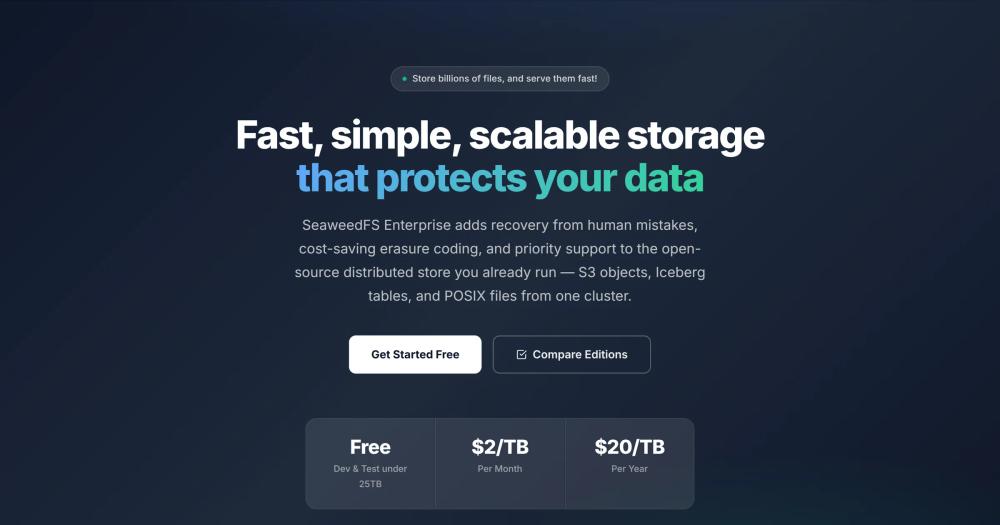
  • -Key data-protection features require a paid licensePoint-in-time recovery, undelete within a retention window, automatic EC repair, bitrot scrubbing, kernel mount, admin UI with OIDC, and multi-tenancy with S3 QoS are Enterprise features at $2/TB/month (25TB free for dev and test). The open source cluster covers S3, POSIX, HDFS, Iceberg, and erasure coding at a fixed ratio.
  • -High open issue count across a wide feature surfaceSeaweedFS has over 760 open GitHub issues across a codebase covering S3, POSIX, HDFS, Iceberg, cloud tiering, and encryption. Some long-running issues affect edge cases in replication and erasure coding. Teams near the edge of tested configurations should review open issues before committing to a deployment.
versus alternatives

seaweedfs vs alternatives#

SeaweedFS vs Amazon S3

SeaweedFS and Amazon S3 serve the same core use case (object storage accessible via the S3 API), but from opposite deployment models. S3 is a fully managed service with no infrastructure to operate; SeaweedFS runs on hardware you provision and maintain.

FeatureSeaweedFSAmazon S3
LicenseApache-2.0Proprietary
DeploymentSelf-hostedManaged
Egress feesNone (internal network)$0.09/GB beyond free tier
S3 API coverage73 operations + IAM + STSFull native AWS
Iceberg catalogBuilt-in, no extra serviceAWS Glue (separate, billed)
Global edge deliveryNoYes (via CloudFront)

SeaweedFS is the stronger choice when monthly S3 egress or capacity costs have grown large, when data residency requirements rule out third-party cloud, or when you need Iceberg support without paying for AWS Glue. Amazon S3 remains the better choice when you need managed global edge delivery, when S3's SLA and durability guarantees justify the cost, or when your team lacks the capacity to operate a distributed storage cluster.

SeaweedFS vs Cloudflare R2

Cloudflare R2 is the closest commercial comparison: S3-compatible object storage with zero egress fees and no per-request charges on a usage tier. R2 is fully managed; SeaweedFS runs on your own hardware.

FeatureSeaweedFSCloudflare R2
LicenseApache-2.0Proprietary
DeploymentSelf-hostedManaged (Cloudflare)
Egress feesNoneZero to internet
POSIX filesystemYes (FUSE + kernel mount)No
Iceberg supportBuilt-in REST catalogNone native
Multi-protocol (HDFS, WebDAV)YesNo

R2 is the simpler path for teams that want zero-egress S3 storage without operating infrastructure. SeaweedFS is the right choice when you need POSIX mount access, HDFS compatibility, Iceberg tables, or complete data sovereignty that no external vendor can access.

SeaweedFS vs Google Cloud Storage and Azure Blob Storage

Google Cloud Storage and Azure Blob Storage follow the same managed-service model as Amazon S3: per-GB capacity pricing, egress fees, and no self-hosting path. The tradeoff is the same: SeaweedFS trades operational burden for cost control and data ownership. Teams already invested in Google Cloud (BigQuery, Dataproc, Vertex AI) or Azure's data stack generally find native integration more valuable than switching storage layers.

install · self-host

Install and self-host#

bash
Install SeaweedFS with the official script, then start a single-node S3 server.
```bash
curl -fsSL https://raw.githubusercontent.com/seaweedfs/seaweedfs/master/install.sh | bash
weed mini -dir=./data
```
tech stack · detected from GitHub

What it's built on#

Languages
GoJavaJavaScriptPythonRust
Infrastructure
AWSKubernetes
frequently asked

FAQ#

Is SeaweedFS a drop-in replacement for Amazon S3?

For most workloads, yes. The S3 gateway covers 73 bucket and object operations including versioning, Object Lock, multipart uploads, presigned URLs, SSE encryption, and lifecycle rules. AWS SDKs, the AWS CLI, rclone, and Spark connect by updating the endpoint URL. A small number of S3 APIs tied to AWS-specific services are not implemented, so check the SeaweedFS wiki for the full list before committing.

How does SeaweedFS handle metadata at billions of files?

The master tracks volumes rather than individual files. A cluster holding billions of files typically has only a few thousand volumes, so the master fits in memory and stays out of the read path. Volume servers keep a 16-byte in-memory index per blob and resolve any blob in a single disk seek. Filer metadata for directory structure lives in an external database of your choice.

Can I run a lakehouse on SeaweedFS without prior Iceberg experience?

Yes. SeaweedFS includes an Iceberg REST catalog served directly by the cluster. Spark, Trino, DuckDB, and ClickHouse connect to it without a separate catalog service. Running S3_TABLE_BUCKET=warehouse ./weed mini -dir=./data brings up the full stack on a single node. Standard Iceberg SQL DDL then works through any supported query engine.

What does the Enterprise tier add over the open source release?

Enterprise adds point-in-time recovery (roll any folder or bucket back to any second in a retention window), undelete within that window, automatic EC repair and bitrot scrubbing, a kernel mount that keeps flat memory regardless of file count, an admin UI with OIDC sign-in, multi-tenancy with per-tenant S3 request rate limits, and priority support. Pricing is $2/TB/month or $20/TB/year, with dev and test under 25TB free. The open source cluster includes S3, POSIX, HDFS, Iceberg, replication, and erasure coding at a fixed ratio.

Does SeaweedFS support encryption at rest?

Yes. The filer supports AES256-GCM encryption at rest. The S3 gateway supports SSE-S3, SSE-KMS, and SSE-C server-side encryption, with OpenBao, Vault, AWS KMS, Azure Key Vault, and GCP KMS as key providers. TLS and mTLS protect traffic between components, JWT signs volume access, and FIPS builds are available.

also worth a look

Similar open-source tools#

MinIO AIStor

MinIO AIStor

Hyperscale S3-compatible object storage for AI workloads

61.4KGoAGPL-3.0
Storj

Storj

Decentralized S3 storage with end-to-end client-side encryption

3.3KGoAGPL-3.0
Spinifex

Spinifex

Run AWS workloads on your own hardware, free and open-source.

157GoAGPL-3.0
Jellyfin

Jellyfin

Free open source media server for movies, TV, and music

56.5KC#GPL-2.0
FckSignups

FckSignups

Open-source tools that work instantly, no signup required

2.9KTypeScriptGPL-3.0
Windshift

Windshift

Self-hosted work management for teams leaving Jira

144GoAGPL-3.0

Repository

Stars
34.5K
Forks
3K
License
Apache-2.0
Latest
4.45
Last commit
today
Last verified
Sep 8, 2026
Repo
seaweedfs/seaweedfs ↗

Additional details

Language
Go
Open issues
763
Contributors
584
First release
2014

Categories

Cloud & HostingDatabases & StorageIT Management

Tags

Cloud NativeKubernetesDeveloper ToolsInfrastructure as CodeData Visualization