Open Source Alternatives
  • Alternatives
  • Categories
    Categories by size892 projects
    • Developer Tools463
    • AI & Machine Learning404
    • Web Development196
    • Business & Productivity194
    • Communication & Collaboration128
    • Security & Monitoring128
    • IT Management123
    • Cloud & Hosting108
    • Product & Project Management106
    • Data & Analytics104
    Browse all 21 categoriesLLMOps & AI Tooling, Design & Creative and 9 more
  • Blog
  • Advertise
SearchNotion, Slack, password manager.../
Submit
Open Source Alternatives
  • Alternatives
    • Developer Tools463
    • AI & Machine Learning404
    • Web Development196
    • Business & Productivity194
    • Communication & Collaboration128
    • Security & Monitoring128
    • Browse all 21 categories
  • Blog
  • Advertise
Submit your project

New open source projects by email

The projects we add and every new guide. Free, unsubscribe any time.

Open Source Alternatives LogoOpen Source Alternatives

Handpicked Open Source Alternatives to Paid Softwares

Product

  • Categories
  • Tag
  • Advertise

Resources

  • Blog
  • Collection
  • Submit

Company

  • Privacy Policy
  • Terms of Service
  • Refund Policy
  • Sitemap

Alternatives

  • Claude Code
  • Jira
  • Notion
  • Slack
  • Linear
  • Wispr Flow
  • All alternatives
© 2026 Open Source Alternatives. All rights reserved.
Open SourceAlternatives
Home/Categories/DevOps & CI/CD/Dokku
icon of Dokku

Dokku

Open source alternative to Heroku, Railway, Render, Fly.io, DigitalOcean App Platform and Porter

  • 32.2K stars
  • MIT
  • Active this week
  • Last commit today

Last verified Oct 22, 2026

Deploy apps to your own server via git push. MIT-licensed Docker PaaS that replaces Heroku and managed hosting platforms with self-hosted infrastructure.

Visit websiteGitHub32.2K starsDeploy on Hostinger
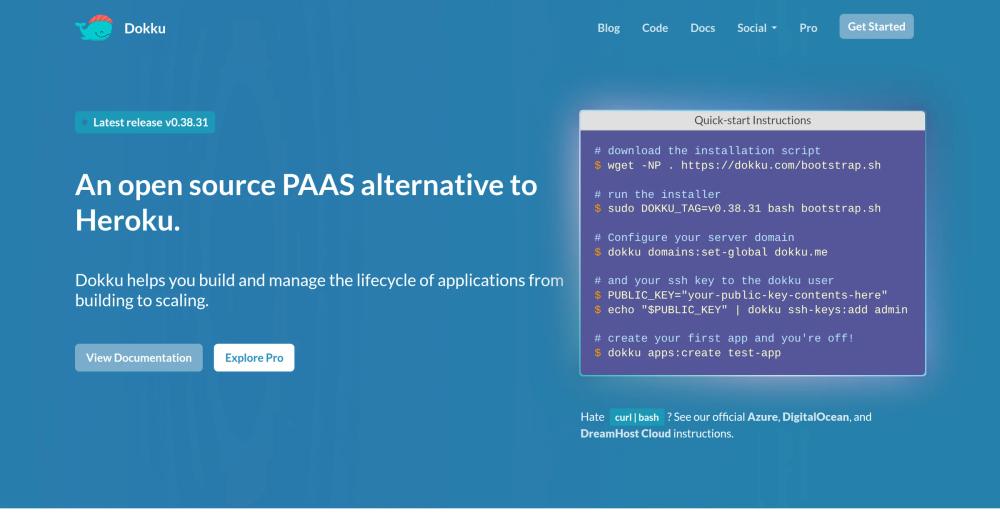
Image for Dokku
TL;DR

Dokku is a Docker-powered PaaS that runs on your own server and accepts app deploys via git push, replacing managed platforms like Heroku. MIT licensed and built in Go, it uses buildpacks to containerize and serve apps from a single Ubuntu or Debian host. Best for developers managing multiple small apps who want Heroku-style deploys without per-app platform fees.

Read the full breakdownHide the full breakdownWho it is for, how it works, trade-offs and the FAQ
who it's for

Who Dokku is for#

Solo developers hosting multiple side projects on one VPS

Dokku turns a single low-cost VPS into a personal PaaS. Each project runs as an isolated app with its own domain, environment variables, and deploy history. A `git push` from any machine deploys updates without manual SSH access to the server.

Skip if:

Your projects each require dedicated server resources, or you need managed databases with automatic failover that Dokku plugins do not cover.

Small teams migrating away from Heroku

Teams using Heroku's buildpack-based workflow can move to Dokku with minimal friction. Existing Procfiles, buildpack configurations, and git-push habits transfer directly. The main adjustment is taking on server provisioning and maintenance in exchange for eliminating per-dyno fees.

Skip if:

Your team has no server administration experience and cannot absorb the overhead of managing a VM, or your apps depend on Heroku-specific add-ons with no Dokku plugin equivalent.

DevOps engineers standardizing internal app deployment

Dokku provides a consistent CLI interface for building, deploying, and managing internal tools across a single host. Teams that want a repeatable deployment process for small internal apps without standing up Kubernetes can use Dokku as a lightweight alternative.

Skip if:

Your internal apps require multi-region deployment, autoscaling, or tight integration with a cloud provider's managed services.

the problem

The problem it solves#

Managed hosting platforms charge per dyno, per service, or per seat. A small portfolio of five or ten apps on Heroku, Render, or Railway can cost more each month than a dedicated VPS running all of them, and that gap widens as the number of apps grows. Pricing changes are at the platform's discretion, with no cost floor and no path to reducing spend short of removing apps.

Developers who control their own server sidestep per-app billing entirely. The obstacle is that setting up deployment infrastructure from scratch is tedious. Managing buildpacks, routing, SSL, environment variables, and access control manually means rebuilding the tooling that PaaS platforms provide, work that does not ship features.

how Dokku solves it

How it solves it#

Git-push deployment workflow

Running `git push dokku main` triggers a full build and deploy cycle. Dokku detects the app's buildpack, builds a Docker image, and swaps the running container. The workflow mirrors Heroku's git-push flow, so existing Procfiles and buildpack configurations work without modification.

Buildpack and Dockerfile support

Apps that use Heroku-compatible buildpacks deploy without configuration changes. Projects with a Dockerfile are also supported, letting you use any runtime or build process that containers can express.

Domain configuration via CLI

Set a global server domain with `dokku domains:set-global` and add per-app custom domains as needed. Domain management is handled entirely through the Dokku CLI without touching the server's DNS configuration directly.

SSH key access control

Deployment access is granted via SSH keypairs. Add a key with `dokku ssh-keys:add`, and that key gains push access to deploy apps. No web dashboard or OAuth flow is required to manage who can deploy.

App lifecycle management

Dokku tracks the full lifecycle from creation through deployment. The `dokku apps:create` command provisions a new app; subsequent git pushes deploy updates. Domains, environment variables, and SSH keys are managed through separate namespaced commands without touching the app's source code.

strengths · trade-offs

Strengths and trade-offs#

Strengths

  • MIT license, zero platform feesDokku is MIT licensed and free to run on any server. Unlike Heroku, Render, or Railway where each deployed service adds to the monthly bill, Dokku's cost ceiling is the server itself. A single VPS can host any number of apps without per-app charges.
  • Heroku-compatible workflow with low migration effortDokku replicates Heroku's buildpack and git-push conventions. Teams moving away from Heroku can bring their Procfiles, environment variables, and deployment habits with minimal rework. The learning curve is near zero for anyone who has used Heroku before.
  • Over a decade of active developmentDokku reached version v0.38.31 in 2026 and has over 32,000 GitHub stars with 2,093 forks. The repository received its last push on 2026-10-22, showing continuous development since the project started in 2013.
  • Minimal infrastructure requirementsDeployment requires only a fresh Ubuntu or Debian server with an SSH keypair. No Kubernetes cluster, no managed cloud provider, and no container registry are needed. For small to mid-sized workloads, a single VPS is the only dependency.

Trade-offs

  • -Single-server architecture limits horizontal scalingDokku is designed for a single host. Apps scale vertically (more CPU and RAM on one server) but do not distribute across multiple nodes out of the box. High-traffic applications that require horizontal scaling or geographic redundancy need a different deployment approach.
  • -Server management falls entirely on the operatorUnlike managed PaaS platforms, Dokku does not handle OS updates, security patches, server monitoring, or disk management. Teams that want hands-off infrastructure need to set up separate tooling for backups, uptime monitoring, and system maintenance.
  • -No built-in web dashboardAll management happens through the Dokku CLI. Teams expecting a visual UI for deployments, logs, or app configuration must build or integrate one separately. The CLI-only interface can be a barrier for non-technical team members who need deployment access.
versus alternatives

Dokku vs alternatives#

Dokku vs Heroku

Heroku pioneered the git-push PaaS model that Dokku replicates. The two share buildpack conventions and the same deploy trigger, which makes Dokku the most direct open source alternative to Heroku's core workflow.

FeatureDokkuHeroku
LicenseMITProprietary
Self-hostingYesNo
PricingServer cost onlyPer-dyno subscription
Buildpack supportYesYes
Managed infrastructureNoYes

Dokku wins when you want the Heroku workflow on hardware you control, especially when managing multiple small apps where per-dyno billing accumulates. Heroku is the better fit when zero server management is the priority and the ongoing subscription cost is acceptable.

Dokku vs Railway

Railway offers a modern git-connected deploy experience with a visual dashboard, built-in managed databases, and automatic scaling. Dokku is CLI-only and single-server.

FeatureDokkuRailway
LicenseMITProprietary
Self-hostingYesNo
PricingServer cost onlyPer-service billing
DashboardNoYes
Horizontal scalingNo (single server)Yes
Built-in databasesVia pluginsYes

Dokku is the better choice for developers already maintaining a VPS who want to deploy multiple apps without per-service fees. Railway is the stronger option for teams that want managed databases, a web interface, and no server administration overhead.

tech stack · detected from GitHub

What it's built on#

Languages
GoPython
Frameworks
Express
Infrastructure
DockerKubernetes
frequently asked

FAQ#

Is Dokku free to use?

Dokku is MIT licensed and free to download, install, and run on your own server. You pay only for the server it runs on. There is no Dokku subscription, per-app fee, or SaaS tier.

What operating systems does Dokku support?

Dokku supports Ubuntu 22.04, 24.04, and 26.04 (amd64 and arm64) and Debian 11 or newer. The README specifies a fresh server installation; installing Dokku on an existing production server alongside other services is not the documented setup path.

How does Dokku deploy apps?

You add a Dokku remote to your Git repository and run git push dokku main. Dokku detects the buildpack, builds a Docker container from your app, and starts it. The process mirrors Heroku's git-push deploy without requiring a managed platform.

Does Dokku support Docker?

Yes. Dokku is Docker-powered: every app runs in a Docker container. Apps with a Dockerfile deploy using that file directly. Apps without one use Heroku-compatible buildpacks to produce a container automatically.

How does Dokku differ from Kubernetes?

Dokku and Kubernetes address different scales. Dokku runs on a single host and handles the full deploy-and-serve loop with minimal setup, making it practical for small to mid-sized app portfolios. Kubernetes is built for multi-node clusters, autoscaling, and production workloads that need orchestration across many servers. Dokku's GitHub topics list both kubernetes and nomad, indicating plugin-level integrations exist, but the core tool is single-server.

also worth a look

Similar open-source tools#

Kamal

Alternative toFly.io

Zero-downtime Docker deploys to any server, no managed platform.

  • 14,675 GitHub stars
  • MITLicence MIT

CapRover

Alternative toHeroku

Self-hosted PaaS: deploys any language, automatic HTTPS, zero fees.

  • 15,187 GitHub stars
  • CustomLicence Apache-2.0 with additional terms

Dokploy

Alternative toHeroku

Self-hosted PaaS to deploy apps and databases across multiple servers

  • 37,935 GitHub stars

openship

Alternative toHeroku

Self-hosted deployment platform with built-in CI/CD

  • 14,865 GitHub stars
  • Apache-2.0Licence Apache-2.0

Void Cloud

Alternative toVercel

Full-stack Vite toolkit with one-command Cloudflare deployment

  • 507 GitHub stars
  • MITLicence MIT

Radar

Alternative toLens

Open-source Kubernetes UI with topology, GitOps, and AI agent MCP.

  • 3,866 GitHub stars
  • Apache-2.0Licence Apache-2.0
by category

Open source tools in these categories#

89

DevOps & CI/CD

Nvm, Uptime Kuma, Netdata
108

Cloud & Hosting

dify, RuView, rtk
Hostinger

Run Dokku on your own server

Self-host Dokku on a Hostinger VPS.

Deploy on Hostinger

Featured

Omnara

Alternative toCClaude Managed Agents

Open-source agent deployment API. Self-host or use Omnara Cloud.

  • 2,957 GitHub stars
  • Apache-2.0Licence Apache-2.0
  • #AI Agents

rakazo

Alternative toGrok Bot

AI teammates you own: your keys, your model, your machine.

  • 4,904 GitHub stars
  • Apache-2.0Licence Apache-2.0
  • #AI Agents

Inbox Zero

Alternative toSuperhuman

AI email assistant that drafts replies and clears your inbox

  • 12,712 GitHub stars
  • AGPL-3.0Licence AGPL-3.0
  • #Email
Feature your project

New open source projects by email

The projects we add and every new guide. Free, unsubscribe any time.

Find open source alternatives to paid software

/
  • Claude Code to OpenCode
  • Jira to Windshift
  • Notion to AppFlowy
  • Slack to Mattermost
  • Linear to GitLab
  • Wispr Flow to Handy
  • CapCut to Concat
  • Grok Bot to rakazo
  • Superhuman to Inbox Zero
  • Airtable to AITable
  • Muse to OpenClaw
  • GitHub Copilot to Cline
  • Datadog to Netdata
  • Microsoft Teams to Rocket.Chat
  • Confluence to Docmost
  • Pinecone to Qdrant
  • Zapier to n8n
  • Devin AI to OpenHands
  • Firebase to Supabase
  • 1Password to KeePassXC
  • Contentful to Strapi
  • Adobe Premiere Pro to Shotcut
  • ChatGPT to AnythingLLM
  • LangSmith to Langfuse