Open Source Alternatives
  • Alternatives
  • Categories
    Categories by size913 projects
    • Developer Tools472
    • AI & Machine Learning411
    • Web Development198
    • Business & Productivity197
    • Security & Monitoring133
    • Communication & Collaboration129
    • IT Management127
    • Cloud & Hosting109
    • Data & Analytics106
    • Product & Project Management106
    Browse all 21 categoriesDesign & Creative, LLMOps & AI Tooling and 9 more
  • Blog
  • Advertise
SearchNotion, Slack, password manager.../
Submit
Open Source Alternatives
  • Alternatives
    • Developer Tools472
    • AI & Machine Learning411
    • Web Development198
    • Business & Productivity197
    • Security & Monitoring133
    • Communication & Collaboration129
    • Browse all 21 categories
  • Blog
  • Advertise
Submit your project

New open source projects by email

The projects we add and every new guide. Free, unsubscribe any time.

Open Source Alternatives LogoOpen Source Alternatives

Handpicked Open Source Alternatives to Paid Softwares

Product

  • Categories
  • Tag
  • Advertise

Resources

  • Blog
  • Collection
  • Submit

Company

  • Privacy Policy
  • Terms of Service
  • Refund Policy
  • Sitemap

Alternatives

  • Claude Code
  • Jira
  • Notion
  • Slack
  • Linear
  • Wispr Flow
  • All alternatives
© 2026 Open Source Alternatives. All rights reserved.
Open SourceAlternatives
Home/Categories/AI & Machine Learning/Fish Speech
icon of Fish Speech

Fish Speech

Open source alternative to ElevenLabs, PlayHT, Cartesia and Resemble AI

  • 33.4K stars
  • Fish Audio Community License v1.0
  • Active this month
  • Last commit 9 days ago

Last verified Oct 24, 2026

Generate TTS audio with voice cloning, natural-language emotion tags, and multi-character scene production. Multilingual, self-hosted, Python.

Visit websiteGitHub33.4K starsDeploy on Hostinger
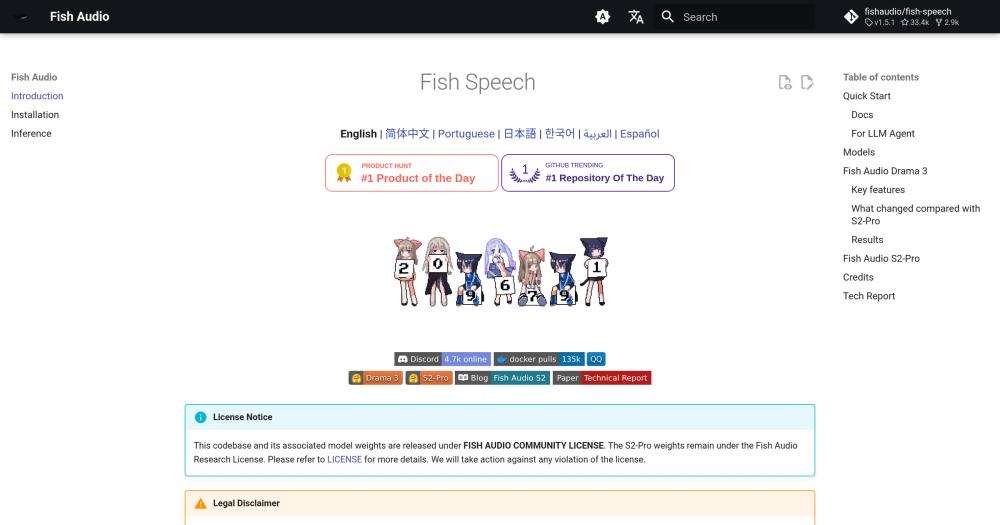
Fish Speech documentation home page
TL;DR

Fish Speech is a Python-based text-to-speech system with voice cloning, natural-language emotion tags, and multi-character scene production, positioned as an alternative to paid TTS services like ElevenLabs and PlayHT. Two model checkpoints are available: Drama 3 (35B MoE, 3B active per token) for long-form and multi-character content, and S2-Pro (4B) for faster inference across roughly 100 languages. Self-hosting uses Docker or a local API server with no per-character fee. Licensed under the Fish Audio Community License v1.0, which permits internal commercial use for organizations under $500,000 USD in annual gross revenue.

Read the full breakdownHide the full breakdownWho it is for, how it works, trade-offs, the quick start and the FAQ
who it's for

Who Fish Speech is for#

Developers building voice agents and LLM pipelines

Fish Speech's local API server accepts text and returns audio, fitting directly into agent frameworks or server-side pipelines. Inline emotion tags allow downstream control of speech delivery without additional fine-tuning.

Skip if:

If your application needs a fully managed TTS API with enterprise SLAs and no infrastructure to maintain, a commercial provider removes the ops overhead that self-hosting requires.

Content studios producing audiobooks or multi-character narration

Drama 3 voices complete scripts with multiple named characters in one pass, and multi-turn director revision lets producers adjust delivery without re-generating from scratch. Streaming support handles long recordings without chunking.

Skip if:

If your production requires human voice acting or broadcast-quality direction for flagship content, self-hosted TTS serves as a supplement rather than a full replacement.

Teams generating synthetic speech training datasets

Voice cloning from short clips and multi-language support enable diverse synthetic speech generation at scale, with no per-character API cost on self-hosted infrastructure.

Skip if:

The Fish Audio Community License v1.0 explicitly prohibits using the model to train competing generative speech models. Verify your dataset use case against the license before building a training pipeline.

Small organizations replacing paid TTS subscriptions

Organizations under $500,000 USD in annual gross revenue can self-host Fish Speech for internal products under the community license. Docker deployment and CLI access lower the setup barrier for teams without dedicated ML infrastructure.

Skip if:

If your organization's annual gross revenue exceeds $500,000 USD, a separate commercial license is required before production deployment. Factor that licensing cost into the evaluation alongside infrastructure costs.

the problem

The problem it solves#

Commercial text-to-speech APIs charge per character generated, per API call, or through subscription tiers that scale with volume. For developers building voice agents, content pipelines, or LLM interfaces, those costs grow quickly once beyond small-scale testing. A product that narrates articles, voices audiobook chapters, or generates game dialogue can reach hundreds of dollars monthly before hitting production-level request volumes.

Beyond cost, hosted TTS services place voice profiles on the provider's infrastructure. Cloned voices stay on their servers, and switching providers means re-cloning and re-validating across your content. For teams with data-handling requirements, routing audio generation through a third-party API adds compliance friction that a self-hosted model stack avoids.

how Fish Speech solves it

How it solves it#

Voice Cloning from Short Reference Audio

Reproduces a speaker's timbre from 10 to 30 seconds of reference audio. Drama 3 extends this with lower cross-lingual cloning error rates, achieving state-of-the-art results on the MiniMax Multilingual Testset benchmarks across 24 languages.

Natural-Language Emotion and Prosody Tags

Inline tags like [whisper], [angry], [laughing], [pause], and [excited] control emotion and prosody at any point in the text without separate fine-tuning. Tags are placed directly in the input string alongside the text they modify.

Scene-Style Multi-Character Production

Drama 3 voices a complete script with multiple named speakers in one pass. Speaker IDs separate characters inside one text block, removing the step of generating and concatenating individual speaker tracks one at a time.

Multi-Turn Director Revision

After generating a take, you can send a natural-language instruction to Drama 3 referencing the previous output, such as "gentler, and a bit sadder," and the model regenerates with that context. Revision history accumulates across turns rather than starting from scratch.

Word-Level Infilling and Audio Editing

Drama 3 supports replacing a single word in finished audio while keeping the surrounding timbre and transitions intact. A clip where the speaker says "Wednesday" can be edited to say "Thursday" without re-generating the full take.

CLI, API Server, and WebUI Access

All three interfaces share the same model backend. The API server supports production streaming with RTF 0.195 on a single H200 and roughly 100 ms to first audio. SGLang-Omni is available for higher-efficiency inference in production deployments.

strengths · trade-offs

Strengths and trade-offs#

Strengths

  • Benchmark-Leading Transcription AccuracyS2-Pro achieves 0.54% word error rate on Chinese and 0.99% on English in Seed-TTS evaluation, lower than Qwen3-TTS (0.77%/1.24%), MiniMax Speech-02 (0.99%/1.90%), and Seed-TTS (1.12%/2.25%). On the Audio Turing Test it scores 0.515 posterior mean, surpassing Seed-TTS (0.417) by 24%.
  • No Per-Character Billing on Self-Hosted DeploymentsOnce the model weights are downloaded and the inference server is running, generation costs only compute. There is no API fee, no character limit, and no subscription. High-volume use cases like audiobook production or dataset generation become significantly cheaper than paid API alternatives at scale.
  • Dual-Model Selection for Hardware FlexibilityDrama 3 (35B MoE, 3B active per token) and S2-Pro (4B) share the same CLI and API server, with the model type detected from the checkpoint's config.json. Teams can deploy S2-Pro on consumer-grade GPUs for cost-sensitive work and switch to Drama 3 for quality-critical content with a checkpoint swap.
  • Active Development with 33,000+ GitHub StarsThe repository has over 33,000 stars and 2,897 forks. Two major model releases shipped in 2026 (S2-Pro and Drama 3), each with arXiv technical reports. The last commit was in October 2026, and the project maintains a Discord community for support.

Trade-offs

  • -Fair-Code License with Revenue ThresholdFish Speech is released under the Fish Audio Community License v1.0, not an OSI-approved open source license. Self-hosting for internal commercial use is permitted for organizations with annual gross revenue under $500,000 USD. Above that threshold, or for any deployment offering TTS to third parties via API, SDK, or UI, a separate commercial license is required from Fish Audio regardless of revenue. Mandatory "Built with Fish Audio" attribution applies to all deployments.
  • -Drama 3 Requires High-End GPU HardwareDrama 3's 35B parameters require a capable server GPU for practical inference latency. The project recommends SGLang-Omni for production efficiency, which adds an integration step beyond a basic server setup. S2-Pro (4B) is more accessible but lacks infilling, multi-turn revision, and Drama 3's emotion expressiveness improvements.
  • -No Bundled Hosting or Auto-Scaling InfrastructureFish Speech provides model weights and a local inference server. Auto-scaling, monitoring, authentication, and API management must be built or adopted separately. Teams that need a fully managed TTS endpoint without infrastructure overhead are better served by a commercial API provider.
versus alternatives

Fish Speech vs alternatives#

Fish Speech vs ElevenLabs

ElevenLabs is one of the leading paid TTS platforms Fish Speech is positioned to replace. The key difference is deployment model: ElevenLabs provides a managed API with no self-hosting option; Fish Speech runs on your own infrastructure with no per-use cost once the model weights are deployed.

FeatureFish SpeechElevenLabs
LicenseFish Audio Community License v1.0Proprietary
Self-hostingYesNo
Pricing modelInference compute onlySubscription/pay-per-use
Voice cloningYes (10-30s reference audio)Yes
Emotion tagsInline natural-language tagsManaged
Multi-character scenesYes (Drama 3)Not supported

Fish Speech is the better choice for teams that need self-hosted inference, data ownership, or high-volume generation where managed API fees scale with usage. ElevenLabs is the better choice when you need a fully managed API with no infrastructure to provision or maintain.

Fish Speech vs PlayHT

PlayHT is another paid TTS platform Fish Speech targets as a direct alternative. Both support voice cloning, but PlayHT operates as a hosted service with subscription pricing. Fish Speech removes recurring API costs and places generation on your own hardware. PlayHT offers simpler onboarding and avoids GPU provisioning; Fish Speech trades that convenience for cost control at scale and offline capability.

Fish Speech vs Cartesia and Resemble AI

Cartesia and Resemble AI are paid TTS services listed among Fish Speech's primary alternatives. Fish Speech's S2-Pro delivers RTF 0.195 on production hardware with roughly 100 ms to first audio, competitive latency for teams willing to manage their own inference endpoint. Cartesia and Resemble AI remain stronger choices when you need a fully managed service, enterprise support, or rapid onboarding without infrastructure work.


install · quick start

Quick start#

bash
Self-hosting uses Docker for deployment; install docs at speech.fish.audio cover full setup including weight downloads and server configuration.
```bash
docker pull fishaudio/fish-speech
```
tech stack · detected from GitHub

What it's built on#

Languages
PythonTypeScript
Frameworks
React
frequently asked

FAQ#

Is Fish Speech free to self-host?

Self-hosting is free under the Fish Audio Community License v1.0 for organizations with annual gross revenue under $500,000 USD. Above that threshold, or for any service letting third parties generate speech via API or UI, a separate commercial license is required from Fish Audio. The model weights are downloadable from HuggingFace at no charge.

What GPU hardware is required to run Fish Speech?

S2-Pro (4B parameters) runs on consumer-grade GPUs. Drama 3 (35B parameters, 3B active per token) requires a capable server GPU; the project recommends SGLang-Omni for production inference efficiency. S2-Pro achieves RTF 0.195 on a single H200 with roughly 100 ms to first audio in streaming mode.

How much reference audio is needed to clone a voice?

S2-Pro can reproduce a speaker's timbre from 10 to 30 seconds of reference audio. Drama 3 extends voice cloning with lower multilingual error rates, achieving state-of-the-art results on the MiniMax Multilingual Testset across 24 languages.

Can I use Fish Speech to build a public TTS service?

No, not under the community license. Offering a hosted service where third parties generate speech via API, SDK, or UI is explicitly excluded from the Fish Audio Community License v1.0 and requires a separate commercial license from Fish Audio, regardless of your organization's revenue.

How does Fish Speech's accuracy compare to closed-source TTS models?

S2-Pro achieves 0.54% word error rate on Chinese and 0.99% on English in Seed-TTS evaluation, lower than Seed-TTS (1.12%/2.25%), MiniMax Speech-02 (0.99%/1.90%), and Qwen3-TTS (0.77%/1.24%). On the Audio Turing Test, S2-Pro scores 0.515 posterior mean, surpassing Seed-TTS (0.417) by 24% and MiniMax Speech (0.387) by 33%.

also worth a look

Similar open-source tools#

F5-TTS

Alternative toElevenLabs

Open source TTS with zero-shot voice cloning and multilingual support.

  • 15,442 GitHub stars
  • MITLicence MIT

VoiceStudio

Alternative toElevenLabs

Voice cloning, dubbing, and transcription that runs fully offline

  • 82,867 GitHub stars
  • AGPL-3.0Licence AGPL-3.0

supertonic

Alternative toElevenLabs

Instantly convert text to speech with customizable options

  • 13,772 GitHub stars
  • MITLicence MIT

VoxCPM

Alternative toElevenLabs

Tokenizer-free multilingual text-to-speech with voice cloning

  • 39,999 GitHub stars
  • Apache-2.0Licence Apache-2.0

Voicebox

Alternative toElevenLabs

Open source voice synthesis studio for generating audio

  • 58,132 GitHub stars
  • MITLicence MIT

Hume AI

Alternative toElevenLabs

Empathic voice AI SDK with open source emotional models

  • 84 GitHub stars
  • MITLicence MIT
by category

Open source tools in these categories#

411

AI & Machine Learning

freeCodeCamp, OpenClaw, REA (Reverse Engineer Anything)
Hostinger

Run Fish Speech on your own server

Self-host Fish Speech on a Hostinger VPS.

Deploy on Hostinger

Featured

Omnara

Alternative toCClaude Managed Agents

Open-source agent deployment API. Self-host or use Omnara Cloud.

  • 2,957 GitHub stars
  • Apache-2.0Licence Apache-2.0
  • #AI Agents

Inbox Zero

Alternative toSuperhuman

AI email assistant that drafts replies and clears your inbox

  • 12,787 GitHub stars
  • AGPL-3.0Licence AGPL-3.0
  • #Email

rakazo

Alternative toGrok Bot

AI teammates you own: your keys, your model, your machine.

  • 5,406 GitHub stars
  • Apache-2.0Licence Apache-2.0
  • #AI Agents
Feature your project

New open source projects by email

The projects we add and every new guide. Free, unsubscribe any time.

Find open source alternatives to paid software

/
  • Claude Code to OpenCode
  • Jira to Windshift
  • Notion to AppFlowy
  • Slack to Mattermost
  • Linear to GitLab
  • Wispr Flow to Handy
  • CapCut to Concat
  • Grok Bot to rakazo
  • Superhuman to Inbox Zero
  • Airtable to AITable
  • Muse to OpenClaw
  • GitHub Copilot to Cline
  • Datadog to Netdata
  • Microsoft Teams to Rocket.Chat
  • Confluence to Docmost
  • Pinecone to Qdrant
  • Zapier to n8n
  • Devin AI to OpenHands
  • Firebase to Supabase
  • 1Password to KeePassXC
  • Contentful to Strapi
  • Adobe Premiere Pro to Shotcut
  • ChatGPT to AnythingLLM
  • LangSmith to Langfuse