Open Source Alternatives
  • Alternatives
  • Categories
    Categories by size874 projects
    • Developer Tools456
    • AI & Machine Learning402
    • Web Development196
    • Business & Productivity188
    • Communication & Collaboration126
    • Security & Monitoring124
    • IT Management122
    • Product & Project Management106
    • Cloud & Hosting103
    • Data & Analytics102
    Browse all 21 categoriesLLMOps & AI Tooling, Design & Creative and 9 more
  • Blog
  • Advertise
SearchNotion, Slack, password manager.../
Submit
Open Source Alternatives
  • Alternatives
    • Developer Tools456
    • AI & Machine Learning402
    • Web Development196
    • Business & Productivity188
    • Communication & Collaboration126
    • Security & Monitoring124
    • Browse all 21 categories
  • Blog
  • Advertise
Submit your project

New open source projects by email

The projects we add and every new guide. Free, unsubscribe any time.

Open Source Alternatives LogoOpen Source Alternatives

Handpicked Open Source Alternatives to Paid Softwares

Product

  • Categories
  • Tag
  • Advertise

Resources

  • Blog
  • Collection
  • Submit

Company

  • Privacy Policy
  • Terms of Service
  • Refund Policy
  • Sitemap

Alternatives

  • Claude Code
  • Jira
  • Notion
  • Slack
  • Linear
  • Wispr Flow
  • All alternatives
© 2026 Open Source Alternatives. All rights reserved.
Open SourceAlternatives
Home/Categories/Developer Tools/Forgejo
icon of Forgejo

Forgejo

Open source alternative to GitHub and GitLab

  • 5.7K stars
  • GPL-3.0
  • Active this week
  • Last commit today

Last verified Oct 21, 2026

Host your Git repositories and project workflows on your own server, with issues, pull requests, wikis, CI, and a package registry included.

Visit websiteGitHub5.7K starsDeploy on Hostinger
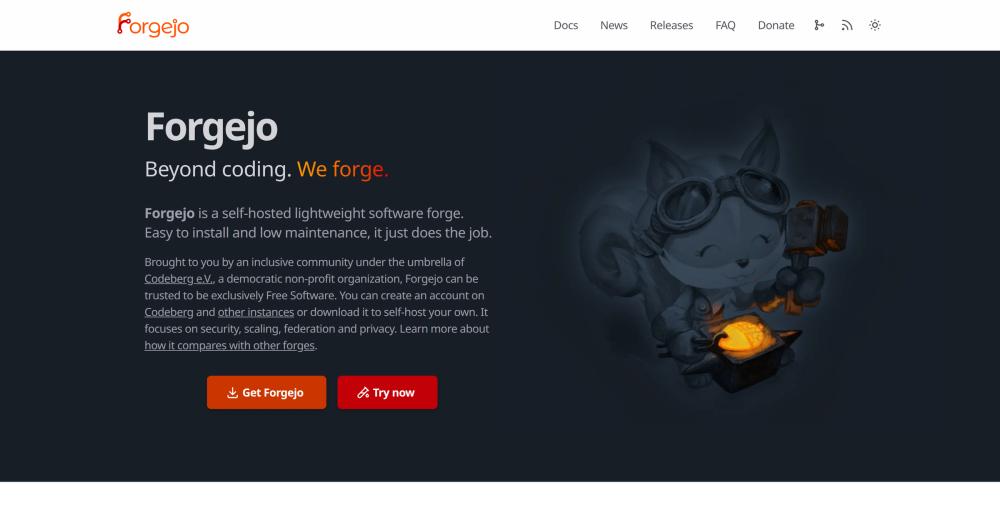
image of Forgejo
TL;DR

Forgejo is a self-hosted Git forge covering code hosting, issues, pull requests, wikis, and a package registry in a single lightweight install. A community fork of Gitea, it moved to GPL-3.0 at v9.0 and is governed by Codeberg e.V., a democratic non-profit. It is a self-hosted alternative to commercial platforms like GitHub and GitLab for teams who want full data ownership on infrastructure they control. Best for development teams and open source projects wanting platform independence on modest hardware.

Read the full breakdownHide the full breakdownWho it is for, how it works, trade-offs and the FAQ
who it's for

Who Forgejo is for#

Development teams leaving GitHub due to cost or data concerns

Forgejo provides a GitHub-like interface at self-hosted cost. Pull requests, issues, wikis, and package publishing are all built in. The website describes it as designed to offer a familiar environment to GitHub users, allowing a smooth transition to a platform the team owns.

Skip if:

If the team depends heavily on GitHub's third-party app marketplace, GitHub Copilot, or public discoverability for open source contributions, Forgejo does not replicate those. The GitHub network effect does not transfer to a private instance.

Open source projects wanting governance-aligned hosting

Forgejo is governed by a democratic non-profit community under Codeberg e.V., meaning the roadmap and terms are shaped by contributor input rather than a single company's commercial interests. A project with community governance may prefer hosting on a forge with matching governance values.

Skip if:

If discoverability matters to the project, with new contributors finding it via GitHub search, a private or small public Forgejo instance will have much less reach than GitHub.

Small teams or individuals self-hosting on modest hardware

Forgejo is designed to run on nearly every machine. The README calls this out explicitly, noting it runs on a Raspberry Pi or small cloud instance. The website states it requires an order of magnitude less resources than other forges, making it suitable for basic server setups.

Skip if:

If no one on the team is comfortable with basic server administration, setup and ongoing maintenance (backups, upgrades, SSL certificates) will require learning or outside help.

Teams already using Gitea considering a switch

Forgejo shares a common codebase with Gitea, making the interface and feature set comparable. The main reasons to switch are Forgejo's GPL-3.0 license and community-governed roadmap under Codeberg e.V. Both tools are listed in this directory and serve similar use cases.

Skip if:

If the team is satisfied with Gitea's current governance and the MIT license, the migration offers limited practical benefit in day-to-day use.

the problem

The problem it solves#

Development teams on GitHub or GitLab ship code in an environment they do not own. Their commit history, issue threads, CI runs, and access control rules all live on servers run by a third party at prices the third party sets. When pricing structures change, migrating is expensive because the data format, URLs, and integrations are all tied to the platform.

Self-hosting solves the ownership problem, but most self-hosted forge options have historically demanded either large server resources or significant administrator time to keep running. A team wanting more control could find themselves maintaining a heavier forge that requires substantial infrastructure before serving a single request. Forgejo addresses both pressures: it is light enough to run on modest hardware and designed to stay low-maintenance, so the team spends time on code rather than forge administration.

how Forgejo solves it

How it solves it#

Git hosting with pull requests and code review

Full Git repository management with pull request workflows and collaborative code review. The website describes the interface as designed for GitHub users, with the goal of allowing a smooth transition to a platform the team owns.

Issues, wikis, and kanban boards

Issues, wikis, and kanban boards are all built in alongside code hosting, so teams can coordinate work without connecting a separate project management tool. The README describes this as covering everything needed to coordinate with your team.

Package registry for Docker, npm, and more

Built-in registry supports Docker, npm, and many other package managers per the README. Teams publish directly to their Forgejo instance and pull packages through standard tooling, keeping artifact hosting internal alongside the source.

Built-in CI integration

Forgejo includes CI integration for automating builds and tests alongside code hosting. The README lists it alongside LDAP, OAuth, code search, and organization permissions as part of the capabilities available for teams with advanced workflow needs.

LDAP, OAuth, and organization permissions

Connects to existing LDAP setups and OAuth identity providers. Organization and team permissions let administrators control repository access at a granular level, all listed in the README as part of Forgejo's advanced capabilities.

ActivityPub federation across forge instances

Forgejo is actively building cross-instance federation via ActivityPub. When complete, users on separate Forgejo instances will be able to follow repositories and interact across server boundaries, moving forge collaboration toward a decentralized model.

strengths · trade-offs

Strengths and trade-offs#

Strengths

  • Runs on minimal hardware including a Raspberry PiForgejo runs on a Raspberry Pi or a small cloud instance. The README explicitly calls this out as a design goal. For teams with modest infrastructure budgets, this removes the cost floor that makes self-hosting unattractive compared to paying for a hosted platform.
  • Permanently Free Software under GPL-3.0Forgejo is governed by Codeberg e.V., a democratic non-profit, with an explicit commitment to remaining Free and Open Source Software permanently. There is no open-core model and no enterprise tier withheld from the GPL release.
  • GitHub-like interface with a smooth migration pathThe interface is close enough to GitHub's that developers switching platforms rarely need onboarding. The website notes Forgejo is designed to offer a familiar environment to GitHub users, allowing a smooth transition to a platform you own.
  • Community-governed roadmap via Codeberg e.V.Governance is handled through a democratic community process under Codeberg e.V. Roadmap decisions reflect contributor and user input rather than a single company's commercial interests. This is the practical distinction from Gitea's current governance structure.

Trade-offs

  • -Active issue backlog with over 1,500 open itemsThe Codeberg repository shows over 1,500 open issues covering feature requests and bug reports across a wide surface area. Response time on non-critical bugs varies. Teams that need guaranteed support response times will need to arrange their own support.
  • -GPL-3.0 requires source disclosure when distributing modificationsGPL-3.0 means any modified version you distribute must carry the same license and include the source. Running a private internal Forgejo instance is unrestricted. Shipping a modified Forgejo as part of a product distributed to customers triggers the disclosure requirement.
  • -ActivityPub federation is still in developmentCross-instance federation is listed as a work in progress in the README. Teams selecting Forgejo specifically for its federated future should check current release notes to confirm the status before committing to that as a feature.
versus alternatives

Forgejo vs alternatives#

Forgejo vs GitHub

GitHub offers self-hosting only through GitHub Enterprise Server, a paid enterprise product. Forgejo is free software you run on your own infrastructure, with all data under your control, at no license cost.

FeatureForgejoGitHub
Self-hostingYes (free)Paid (Enterprise Server only)
LicenseGPL-3.0Proprietary
Hosting modelYour infrastructureGitHub.com managed, or Enterprise Server (paid)
CI/CDBuilt-in CI integrationGitHub Actions
Package registryYes (Docker, npm, and more)GitHub Packages
App marketplaceNoYes

Forgejo is the better choice when the team wants to own its code and collaboration data, or run on isolated infrastructure without being subject to a hosted platform's terms. GitHub is the better fit when public discoverability matters for an open source project expecting contributions from strangers, when the project depends on third-party GitHub marketplace integrations, or when GitHub-native features are central to the workflow.

Forgejo vs GitLab

GitLab publishes a self-hostable Community Edition. Both cover self-hosted Git hosting, CI, and issues, but they target different operational scales. Forgejo is designed to run on minimal hardware; the website states it requires an order of magnitude less resources than other forges. GitLab's full installation is suited to larger organizations.

FeatureForgejoGitLab CE
Self-hostingYesYes
LicenseGPL-3.0MIT (CE)
Hardware footprintVery low (Raspberry Pi-class)Substantial (multi-service)
Built-in CIYesGitLab CI/CD
Enterprise paid tierNoYes (EE)
FederationIn development (ActivityPub)No

GitLab is the better choice for larger organizations that need its built-in security scanning, compliance dashboards, or Kubernetes integration at scale. Forgejo is the better choice for teams that value low resource use, community governance under Codeberg e.V., and GPL-3.0 freedom.


tech stack · detected from GitHub

What it's built on#

Languages
GoJavaScriptTypeScript
frequently asked

FAQ#

What is the difference between Forgejo and Gitea?

Forgejo is a community fork of Gitea, created in 2022 to move the project under independent governance via Codeberg e.V. The codebase overlaps substantially, but Forgejo adopted GPL-3.0 at v9.0 while Forgejo versions before v9.0 used MIT. The two projects have diverged in governance and roadmap priorities. Gitea is also listed separately in this directory.

Can Forgejo replace GitHub for a private development team?

Yes. Forgejo covers the core GitHub workflow: Git hosting, pull requests, issues, CI integration, and a package registry. It runs on your own server with all data on infrastructure you control. The main trade-off is losing the GitHub network: public discoverability, the app marketplace, and third-party integrations built specifically for GitHub.

How does Forgejo's GPL-3.0 license work for commercial use?

GPL-3.0 permits running Forgejo internally for any purpose, including commercial work. You can run it for your company's private development without any license fees. The GPL-3.0 source disclosure requirement applies only if you distribute a modified version of Forgejo itself; running it as an internal hosted tool does not trigger it.

What server resources does a Forgejo instance require?

Forgejo is designed to run on minimal hardware. The README explicitly notes it runs on a Raspberry Pi or a small cloud instance. The website states it requires an order of magnitude less resources than other forges, making it suitable for basic server setups without significant infrastructure investment.

Does Forgejo support CI/CD pipelines?

Yes. The README lists CI integration as a built-in capability alongside LDAP, OAuth, code search, and organization permissions. Teams can run automated builds and tests within the same forge that hosts their code and issues. For specifics on supported runner types and workflow configuration, check the official documentation at forgejo.org/docs/latest.

also worth a look

Similar open-source tools#

OneDev

Alternative toGitHub

Git, CI/CD, issue tracking, wikis, and AI agents on your own server.

  • 15,318 GitHub stars
  • MITLicence MIT

gitdeck

Alternative toGitKraken

Self-hosted Git dashboard for GitHub, GitLab, and Forgejo

  • 423 GitHub stars
  • MITLicence MIT

tuicr

Alternative toGraphite

Terminal UI for code review with vim keybindings and GitHub-style

  • 3,419 GitHub stars
  • MITLicence MIT

Gitea

Alternative toGitHub

Self-hosted Git server with CI, issues, and pull requests

  • 58,588 GitHub stars
  • MITLicence MIT

Gogs

Alternative toGitHub

Lightweight self-hosted Git server that is painless to set up

  • 47,895 GitHub stars
  • MITLicence MIT

GitLab

Alternative toGitHub

Self-hosted Git server with CI/CD, security scans, and planning

  • 24,535 GitHub stars
  • MITLicence MIT
by category

Open source tools in these categories#

456

Developer Tools

REA (Reverse Engineer Anything), superpowers, Skills for Real Engineers
85

DevOps & CI/CD

Nvm, Uptime Kuma, Netdata
106

Product & Project Management

freeCodeCamp, agency-agents, Gstack
Hostinger

Run Forgejo on your own server

Self-host Forgejo on a Hostinger VPS.

Deploy on Hostinger

Featured

Inbox Zero

Alternative toSuperhuman

AI email assistant that drafts replies and clears your inbox

  • 12,712 GitHub stars
  • AGPL-3.0Licence AGPL-3.0
  • #Email

rakazo

Alternative toGrok Bot

AI teammates you own: your keys, your model, your machine.

  • 4,904 GitHub stars
  • Apache-2.0Licence Apache-2.0
  • #AI Agents

Omnara

Alternative toCClaude Managed Agents

Open-source agent deployment API. Self-host or use Omnara Cloud.

  • 2,939 GitHub stars
  • Apache-2.0Licence Apache-2.0
  • #AI Agents
Feature your project

New open source projects by email

The projects we add and every new guide. Free, unsubscribe any time.

Find open source alternatives to paid software

/
  • Claude Code to OpenCode
  • Jira to Windshift
  • Notion to AppFlowy
  • Slack to Mattermost
  • Linear to GitLab
  • Wispr Flow to Handy
  • CapCut to Concat
  • Grok Bot to rakazo
  • Superhuman to Inbox Zero
  • Airtable to AITable
  • Muse to OpenClaw
  • GitHub Copilot to Cline
  • Datadog to Netdata
  • Microsoft Teams to Rocket.Chat
  • Pinecone to Qdrant
  • Zapier to n8n
  • Devin AI to OpenHands
  • Firebase to Supabase
  • 1Password to KeePassXC
  • Confluence to Docmost
  • Contentful to Strapi
  • Adobe Premiere Pro to Shotcut
  • ChatGPT to AnythingLLM
  • LangSmith to Langfuse