

Who jsreport is for#
Development teams building invoice and document generation
jsreport renders PDF invoices, statements, and compliance documents from live application data via its REST API. JavaScript hooks fetch data at render time, so the report always reflects current records without a separate batch export step.
Skip if:
Your reports are primarily simple tabular data exports to CSV or Excel without complex layout requirements. A lighter library like pdfmake or ExcelJS may be faster to set up for that narrower case.
Operations and BI teams automating recurring report delivery
The built-in scheduler generates and distributes reports on a defined cadence, sending outputs by email or storing them for download. This replaces custom cron scripts and templated email jobs for recurring reporting workflows.
Skip if:
You need interactive dashboards, ad-hoc SQL queries, or data exploration tools. jsreport renders defined templates; tools like Metabase or Redash are better suited for exploratory analysis.
Product teams adding PDF export to a SaaS application
jsreport connects to any application through its REST API. Product teams add PDF export by sending data to jsreport and receiving a rendered file, without building a PDF renderer from scratch inside the application.
Skip if:
Your application needs end-user customizable report layouts. jsreport templates are developer-defined; giving non-technical users template editing requires a custom UI layer on top.
The problem it solves#
Generating production-quality reports from business applications is harder than it looks. PDF rendering that respects complex CSS layouts, Excel exports with dynamic content, and DOCX document generation each require separate libraries with their own quirks. Running all of them reliably in a server environment, while also supporting scheduling, user management, and template versioning, creates significant engineering overhead.
Commercial reporting tools address this, but they come with per-developer or per-server licensing costs that scale poorly as report volumes grow. They also store templates in proprietary formats, making migration difficult and creating vendor dependency. For teams generating dozens of report types or running report generation inside a private network, the cost and lock-in of a managed platform become a concrete operational constraint.
How it solves it#
Multiple output formats from one template
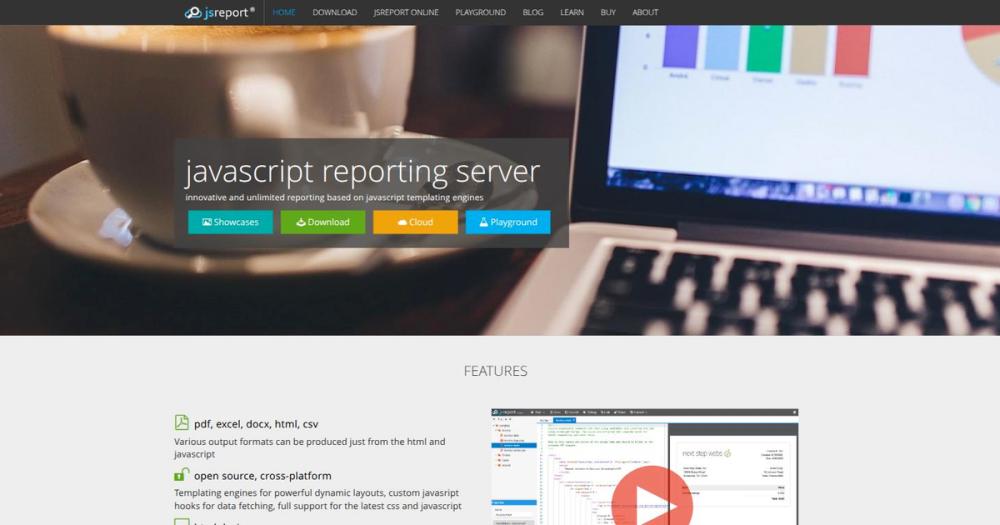
Renders reports as PDF, Excel (XLSX), DOCX, HTML, and CSV from a single template definition. The same template can produce a PDF dashboard or an Excel export by switching the recipe, without redesigning the layout.
JavaScript templating engines for layout logic
Uses Handlebars, EJS, JSRender, and other JavaScript templating engines for report layout. Custom JavaScript hooks run at render time to fetch data from any API or database, so reports always reflect live data without an intermediate export step.
Browser-based report designer
Ships with a web-based studio accessible from any modern browser. Designers connect to the running server to build and preview templates without a desktop application or local rendering setup on the designer's machine.
REST API and CLI for report rendering
Exposes a REST API for triggering renders from any application, script, or data pipeline. A CLI and SDKs for common languages are also available, making jsreport callable from any tech stack without coupling rendering logic to the calling application.
Scheduling and automated report delivery
Built-in scheduling queues recurring report jobs and sends outputs by email or stores them for download. This replaces custom cron scripts and ad-hoc email jobs for recurring report delivery without an external job scheduler.
Strengths and trade-offs#
Strengths
- Self-hosted on any Node.js-compatible platformRuns on Linux, Windows, AWS, Azure, and OpenShift with no mandatory cloud dependency. Docker images are available on Docker Hub. Over 200,000 server installations confirm it works across a wide range of production environments.
- JavaScript-native templating, no proprietary DSLTemplates use Handlebars, EJS, JSRender, and other engines that JavaScript developers already know. Data binding uses plain JavaScript functions, so the report pipeline integrates naturally into existing Node.js applications without a new templating language.
- Mature project with active maintenanceCreated in 2013 and under active development through September 2026. The project has 1,320 GitHub stars, 266 forks, and 600 enterprise customers. Long-running projects with commercial adoption tend to have stable APIs and better coverage of production edge cases.
Trade-offs
- -Commercial use above 5 templates requires a paid licenseThe LGPL-3.0 license covers personal, academic, and non-profit use, and any deployment storing up to 5 report templates. Commercial projects with more than 5 stored templates need a paid license from the author. Self-hosting does not exempt commercial users from this restriction. Review the pricing page before building a large template library in production.
- -Node.js runtime adds a dependency for non-Node.js stacksjsreport runs as a Node.js process. Teams whose infrastructure is primarily Python, Ruby, Go, or Java need to provision a separate server for it. Docker simplifies this, but it introduces a distinct runtime not shared by the main application.
- -101 open issues indicate a moderate backlogThe GitHub repository has 101 open issues. For a project covering multiple templating engines, output formats, extensions, and scheduling, this is a moderate backlog. Development is active, but some edge cases and feature requests may have extended resolution times.
jsreport vs alternatives#
jsreport vs Stimulsoft Reports.JS
Both tools generate business reports in PDF, Excel, DOCX, and HTML formats from application data. The central difference is deployment model and licensing: jsreport is LGPL-3.0 licensed and self-hosted; Stimulsoft Reports.JS is a commercial product with proprietary per-developer licensing.
| Feature | jsreport | Stimulsoft Reports.JS |
|---|---|---|
| License | LGPL-3.0 (additional commercial terms above 5 templates) | Proprietary |
| Self-hosting | Yes | Developer install only |
| Templating | Handlebars, EJS, JSRender, custom JavaScript | Proprietary visual designer |
| Output formats | PDF, Excel, DOCX, HTML, CSV | PDF, Excel, DOCX, HTML |
| REST API | Yes | Yes |
| Scheduling | Built-in extension | Via application integration |
jsreport is the stronger choice for development teams that want to define report templates as code, version them in Git alongside the application, and avoid per-developer seat costs. Its JavaScript-native templating makes the report pipeline auditable and testable like any other application code. Self-hosting also keeps report data on your own infrastructure, which matters for compliance-sensitive environments.
Stimulsoft Reports.JS is worth considering when your organization needs a drag-and-drop visual designer that business analysts can use without writing template code, or when you need commercial support with SLAs. Teams that prioritize a fast setup with minimal engineering over long-term code ownership may find Stimulsoft's bundled designer faster to start with.
Quick start#
Install jsreport globally via npm, then initialize and start a local server.
```bash
npm install -g @jsreport/jsreport-cli
jsreport init
jsreport configure
jsreport start
```What it's built on#
- Languages
- JavaScriptPython
- Tooling
- Rollup
FAQ#
Is jsreport free for commercial use?
jsreport is free for personal, school, and non-profit projects, and for any deployment storing up to 5 report templates. Commercial projects with more than 5 stored templates require a paid license from the author. The source code is LGPL-3.0 licensed, but additional commercial terms apply above the 5-template threshold. Check the pricing page at jsreport.net/buy for current plan details.
What output formats does jsreport support?
jsreport generates PDF, Excel (XLSX), DOCX, HTML, and CSV outputs. Output format is selected per template via a recipe setting, so the same template definition can produce different formats by changing the recipe without redesigning the layout. Additional output formats are available through community extensions.
How do I integrate jsreport with my application?
jsreport exposes a REST API for report rendering. Your application sends a request naming the template and providing the data, and receives the rendered file in response. SDKs are available for common languages, and a CLI is also available for scripted or pipeline-based rendering. Documentation is at jsreport.net/learn.
Does jsreport support Docker?
Yes. Official Docker images are available on Docker Hub. jsreport also ships compiled binaries for Linux and Windows for teams that prefer not to manage a Node.js installation directly. Both deployment paths are documented at jsreport.net/on-prem.
Can jsreport schedule and send reports automatically?
Yes. jsreport includes a scheduling extension that generates and sends reports on a recurring schedule. Outputs can be delivered by email or stored for download. The scheduling feature is part of the standard distribution and does not require a separate extension install.
Similar open-source tools#

FckSignups
Open-source tools that work instantly, no signup required

jnv
Interactive jq filter editor with live JSON navigation

pdf-inspector
Rust-powered PDF parser with smart OCR routing for AI pipelines

crawl4ai
LLM-ready web crawling without API keys or rate limits

browser-use
Python library giving any LLM full browser control, MIT licensed

deer-flow
Build super agents with DeerFlow's powerful framework