Open Source Alternatives
  • Alternatives
  • Categories
    Categories by size979 projects
    • Developer Tools505
    • AI & Machine Learning432
    • Business & Productivity220
    • Web Development202
    • Security & Monitoring147
    • IT Management133
    • Communication & Collaboration132
    • Cloud & Hosting116
    • LLMOps & AI Tooling111
    • Data & Analytics108
    Browse all 21 categoriesProduct & Project Management, Design & Creative and 9 more
  • Blog
  • Advertise
SearchNotion, Slack, password manager.../
Submit
Open Source Alternatives
  • Alternatives
    • Developer Tools505
    • AI & Machine Learning432
    • Business & Productivity220
    • Web Development202
    • Security & Monitoring147
    • IT Management133
    • Browse all 21 categories
  • Blog
  • Advertise
Submit your project

New open source projects by email

The projects we add and every new guide. Free, unsubscribe any time.

Open Source Alternatives LogoOpen Source Alternatives

Handpicked Open Source Alternatives to Paid Softwares

Product

  • Categories
  • Tag
  • Advertise

Resources

  • Blog
  • Collection
  • Submit

Company

  • Privacy Policy
  • Terms of Service
  • Refund Policy
  • Sitemap

Alternatives

  • Claude Code
  • Jira
  • Notion
  • Slack
  • Linear
  • Wispr Flow
  • All alternatives
© 2026 Open Source Alternatives. All rights reserved.
Open SourceAlternatives
Home/Categories/Business & Productivity/Kimai
icon of Kimai

Kimai

Open source alternative to Toggl Track, Harvest, Clockify and TimeCamp

  • 5.1K stars
  • AGPL-3.0
  • Active this week
  • Last commit 1 day ago

Last verified Oct 31, 2026

Track billable hours, projects, and client work with a self-hosted AGPL-3.0 time tracker built for freelancers, agencies, and companies.

Visit websiteGitHub5.1K starsDeploy on Hostinger
image of Kimai
TL;DR

Kimai is an open source time-tracking application that handles timesheets, invoicing, and reporting for freelancers, agencies, and companies with any number of users. It replaces paid tools like Toggl Track and Harvest with a self-hosted, AGPL-3.0-licensed option that runs on your own server with no per-seat fees. Deployment uses Docker images or a manual PHP and MariaDB setup. Best for teams that bill clients by the hour and need full data ownership without a monthly subscription.

Read the full breakdownHide the full breakdownWho it is for, how it works, trade-offs, the quick start and the FAQ
who it's for

Who Kimai is for#

Freelancers billing clients by the hour

Kimai tracks time per client and project, generates invoices from recorded entries, and exports timesheets in XLSX or PDF. The customer portal lets you share a read-only view with clients via a private URL so they can review project hours without creating an account.

Skip if:

Skip if you need a mobile-first timer with offline recording and no server to maintain. Kimai is a web application that requires a running server or a cloud subscription.

Agencies managing multiple customers and projects

Team and project-level permission controls let managers scope access so each staff member sees only their assigned work. Configurable billing rates per user, customer, and project produce accurate client invoices with entry grouping by activity or date range.

Skip if:

Skip if your agency primarily needs project task management or sprint boards. Kimai tracks time and generates invoices; task management requires a separate tool.

Companies requiring a self-hosted timesheet system

SAML and LDAP authentication connect Kimai to existing identity providers like Google Workspace or Azure AD so employees log in with existing credentials. Role-based teams and manager-level reporting support department structure, and all data stays on company infrastructure.

Skip if:

Skip if your organization is not ready to maintain a PHP application and MariaDB database on its own servers. The Kimai Cloud subscription removes that operational burden.

Finance teams enforcing time-tracking compliance

The time-clock mode restricts staff to punch-in and punch-out records only, preventing retrospective edits. Budget limits per project let managers set ceiling values before overruns, and exported timesheet records can be locked against further changes after review.

Skip if:

Skip if your compliance requirement involves payroll integration or digital signatures on time records. Kimai does not document a built-in payroll connector.

the problem

The problem it solves#

Billing clients for time is harder than it should be when hours live in spreadsheets, sticky notes, or rough mental tallies. Freelancers and agencies that bill by the hour lose revenue every time a project runs over scope without a written record, and assembling a monthly invoice from scattered logs takes hours that do not bill.

The deeper challenge is that without structured time data grouped by customer, project, and activity, there is no reliable way to know which engagements are profitable, where team members are overallocated, or when a project is approaching its budget ceiling. Commercial time-tracking platforms address these needs but charge per-user fees that multiply with team size and store all billing data on external servers.

how Kimai solves it

How it solves it#

Invoice generation in PDF and DOCX

Configurable invoice templates let you group timesheet entries by project, activity, or user and output invoices in PDF or DOCX format. The invoice number format is configurable, and Kimai can generate e-invoices compliant with EN 16931, XRechnung 3.0, and ZUGFeRD/Factur-X for customers in Germany and the EU.

Time reporting by user, project, and activity

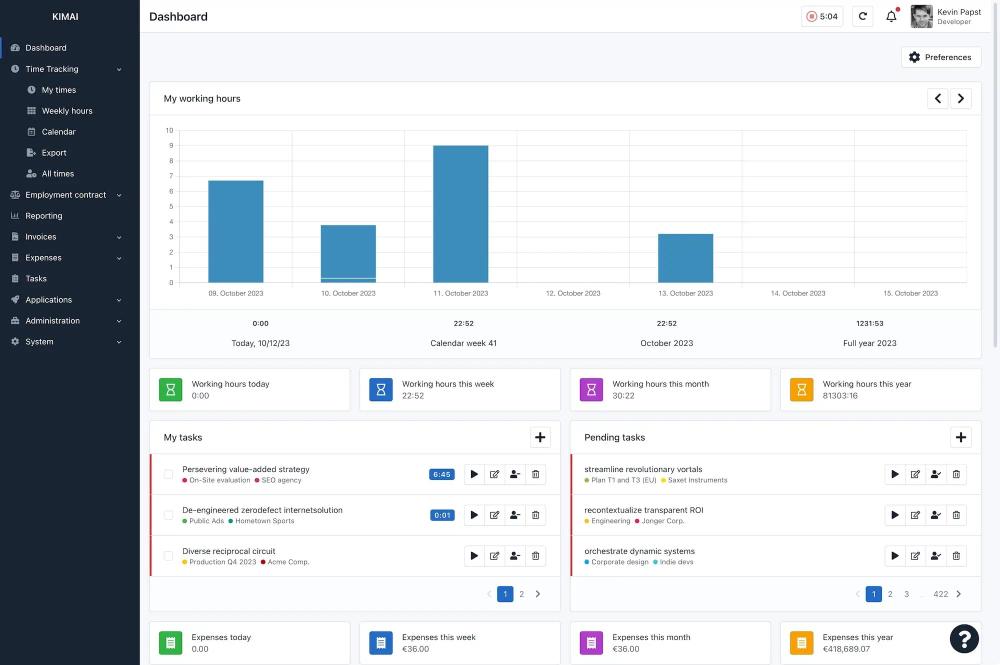
Reports break down recorded hours across any dimension: user, customer, project, activity, tag, or time period. The dashboard shows live statistics on collected data, and all timesheet data can be exported to XLSX, PDF, CSV, or HTML format for use in external billing or payroll systems.

Full read/write JSON API

Kimai ships with a JSON API that covers both reading and writing time data. External tools, custom dashboards, and billing integrations can pull or push timesheets, customers, projects, and activities without manual data entry or CSV export.

SAML, LDAP, and two-factor authentication

Teams using Google Workspace, Azure AD, or Authentik can connect Kimai via SAML or LDAP for centralized login. Two-factor authentication via TOTP tokens is available for local accounts, and the permission system supports granular role definitions per team.

Multi-user teams with role-based access

Kimai supports unlimited users per installation, organized into teams that reflect departments or client groups. Customers and projects can be scoped to specific teams, so staff only see the work relevant to their role. Each user, customer, and project can carry its own billing rate.

strengths · trade-offs

Strengths and trade-offs#

Strengths

  • No per-seat pricing with full data ownershipThe self-hosted edition is AGPL-3.0 licensed, so installation is free with no user count limits. Commercial alternatives like Harvest charge $12 per user per month and store all billing data on their servers; Kimai runs on your own infrastructure with no recurring seat cost.
  • Active project with a decade-long track recordCreated in 2016, the repository has 5,119 GitHub stars and 877 forks as of October 2026, with code pushes as recently as October 2026. The active release cadence, a documented plugin marketplace, and community forum reduce the risk of depending on the project for production billing.
  • 30+ language translationsKimai ships with over 30 translations maintained through Weblate by a volunteer contributor community. For multinational teams where staff work in different native languages, this is available out of the box without additional licensing or configuration.
  • SAML and LDAP SSO without a paid upgradeSAML-based login via Google Workspace, Azure AD, or Authentik, and LDAP directory authentication, are available in the self-hosted edition without an enterprise plan. Comparable paid tools like Clockify put SSO behind a premium tier.

Trade-offs

  • -Requires PHP, a database, and a web server to deploySelf-hosting Kimai requires PHP 8.2 or newer, MariaDB or MySQL, a webserver, and a subdomain (subdirectory installs are not supported). This is a higher setup bar than tools that ship as a single self-contained container. Teams without server administration experience will need time or outside help to configure and maintain it.
  • -310 open GitHub issuesAs of October 2026, the repository carries 310 open issues (GitHub issues API, pull requests excluded). For a production billing tool, reviewing open issues in your invoicing or reporting workflow before deploying is advisable.
  • -AGPL-3.0 restricts offering Kimai as a hosted serviceAGPL-3.0 permits running Kimai internally for your own team or clients with no restrictions. The license applies only if you modify the code and offer that modified version as a hosted service to third parties, at which point you must release your changes under AGPL-3.0. Internal self-hosting is unrestricted.
versus alternatives

Kimai vs alternatives#

Kimai vs Toggl Track

Toggl Track and Kimai both track time by project and client for freelancers and small teams. Toggl Track is a managed SaaS product with no self-hosting option; Kimai runs on your own server with no per-seat fee.

FeatureKimaiToggl Track
LicenseAGPL-3.0Proprietary
Self-hostingYesNo
PricingFree (self-hosted)Free tier; paid from $10/user/month
Invoice generationBuilt-inNot included
SAML/LDAP SSOYesPaid plans only

Kimai is a better fit when invoicing is needed within the time tracker, when per-seat pricing becomes expensive at scale, or when billable-hour data cannot leave your own infrastructure. Toggl Track is the better choice when the team needs a polished mobile app with offline sync and a zero-setup experience.

Kimai vs Harvest

Harvest combines time tracking, expense tracking, and invoicing, which overlaps directly with Kimai's scope. Harvest charges $12 per user per month; Kimai is free to self-host.

FeatureKimaiHarvest
LicenseAGPL-3.0Proprietary
Self-hostingYesNo
PricingFree (self-hosted)$12/user/month
Expense trackingPaid pluginIncluded
Languages30+Limited

Kimai removes the per-seat cost and keeps all billing data on your own infrastructure, which matters for teams with strict data residency requirements. Harvest is a better fit when expense tracking is a core workflow and when native integrations with Jira, GitHub, or Basecamp are needed without custom API work.

Kimai vs Clockify

Clockify and Kimai both offer unlimited users at the base tier and cover time tracking, reporting, and team management. Clockify provides an on-premise option but charges for it; Kimai's self-hosting is free under AGPL-3.0.

FeatureKimaiClockify
Self-hosting costFreePaid on-premise
Invoice generationFree tierPaid plans
SAML/SSOFree tierPaid plans
APIFull read/write JSONYes

For teams running their own servers, Kimai removes all subscription cost and includes invoicing and SAML in the self-hosted edition. Clockify is a better fit when the team prefers managed hosting, values the Clockify mobile app ecosystem, or needs browser extensions and desktop integrations without additional setup.

install · quick start

Quick start#

bash
Self-hosting Kimai uses Docker with a MariaDB or MySQL database; Docker Compose configurations for production are documented at kimai.org.

```bash
docker pull kimai/kimai2:apache
```
tech stack · detected from GitHub

What it's built on#

Languages
JavaScriptPHP
Tooling
Webpack
frequently asked

FAQ#

Is Kimai free to self-host?

Yes. Kimai is open source under AGPL-3.0, which means you can install and run it on your own server at no charge with no per-user fees. A managed cloud subscription at kimai.org is available for teams that prefer not to manage their own server.

How do I install Kimai with Docker?

Kimai publishes official Docker images on Docker Hub at hub.docker.com/r/kimai/kimai2. There are images with FPM only and images with Apache bundled. The README links to Docker Compose configurations for Hetzner Cloud and DigitalOcean. PHP 8.2 or newer and a MariaDB or MySQL database are the core requirements; the Docker images bundle those runtime dependencies.

Does Kimai generate invoices from tracked time?

Yes. Kimai generates invoices directly from timesheet entries, with configurable templates, entry grouping by project or activity, and output in PDF or DOCX format. Invoice numbers are configurable. For EU customers, it can produce e-invoices compliant with XRechnung 3.0 and ZUGFeRD/Factur-X.

Does Kimai support single sign-on?

Yes. Kimai supports SAML and LDAP authentication for identity providers including Google Workspace, Azure AD, and Authentik. Two-factor authentication via TOTP tokens is available for accounts using local database login. Both SSO options are part of the self-hosted edition without a paid upgrade.

How does Kimai compare to Clockify?

Both tools offer unlimited users on a base plan and cover time tracking, reporting, and team management. Kimai's self-hosting is free under AGPL-3.0, while Clockify's on-premise edition requires a paid license. Kimai includes invoicing and SAML SSO in the self-hosted tier; Clockify puts both behind paid plans. The trade is Kimai's higher setup cost against Clockify's managed convenience and a richer mobile app ecosystem.

also worth a look

Similar open-source tools#

Solidtime

Alternative toToggl Track

Self-hosted time tracker for freelancers and agencies with billing.

  • 9,070 GitHub stars
  • AGPL-3.0Licence AGPL-3.0

meridian

Alternative toEverpaper

Local work journal that logs your day and drafts your standup.

  • 402 GitHub stars
  • CustomLicence PolyForm Strict 1.0.0

invoiceninja

Alternative toFreshBooks

Self-hosted invoicing, expenses, and time tracking

  • 10,386 GitHub stars
  • CustomLicence Elastic License 2.0 (ELv2)

FckSignups

InCustomer Support

Open-source tools that work instantly, no signup required

  • 4,531 GitHub stars
  • GPL-3.0Licence GPL-3.0

rakazo

Featured

Alternative toGrok Bot

AI teammates you own: your keys, your model, your machine.

  • 6,242 GitHub stars
  • Apache-2.0Licence Apache-2.0

paperclip

Featured

Alternative toGrok Bot

Self-hosted AI agent management with org charts and budgets

  • 108,591 GitHub stars
  • MITLicence MIT
by category

Open source tools in these categories#

220

Business & Productivity

OpenClaw, Excalidraw, RustDesk
33

Finance & Fintech

TradingAgents, MiroFish, OpenBB
108

Product & Project Management

freeCodeCamp, agency-agents, Gstack
Hostinger

Self-host Kimai on a Hostinger VPS

Keep it running 24/7, even when your laptop is off. A Hostinger VPS gives it a server of its own.

  1. 01

    Choose a plan

    Starts from $6.49/mo

  2. 02

    Apply

    Extra 10% off yearly plans

  3. 03

    Install Kimai

    On a server that stays on

  4. 04

    Start building

    Focus on the app, not the server

Deploy on Hostinger

Sponsors

Inbox Zero

Alternative toSuperhuman

AI email assistant that drafts replies and clears your inbox

  • 12,855 GitHub stars
  • AGPL-3.0Licence AGPL-3.0
  • #Email

Omnara

Alternative toCClaude Managed Agents

Open-source agent deployment API. Self-host or use Omnara Cloud.

  • 3,325 GitHub stars
  • Apache-2.0Licence Apache-2.0
  • #AI Agents

rakazo

Alternative toGrok Bot

AI teammates you own: your keys, your model, your machine.

  • 6,242 GitHub stars
  • Apache-2.0Licence Apache-2.0
  • #AI Agents
Advertise your product

New open source projects by email

The projects we add and every new guide. Free, unsubscribe any time.

Find open source alternatives to paid software

/
  • Claude Code to OpenCode
  • Jira to Windshift
  • Notion to AppFlowy
  • Slack to Mattermost
  • Linear to GitLab
  • Wispr Flow to Handy
  • Arc to Zen Browser
  • CapCut to Concat
  • Grok Bot to rakazo
  • Superhuman to Inbox Zero
  • Airtable to AITable
  • Muse to OpenClaw
  • Railway to Coolify
  • GitHub Copilot to Cline
  • Datadog to Netdata
  • Microsoft Teams to Rocket.Chat
  • Confluence to Docmost
  • Pinecone to Qdrant
  • Zapier to n8n
  • Devin AI to OpenHands
  • Firebase to Supabase
  • 1Password to KeePassXC
  • Contentful to Strapi
  • Adobe Premiere Pro to Shotcut