Open Source Alternatives
  • Alternatives
  • Categories
    Categories by size927 projects
    • Developer Tools479
    • AI & Machine Learning416
    • Business & Productivity201
    • Web Development199
    • Security & Monitoring136
    • Communication & Collaboration129
    • IT Management128
    • Cloud & Hosting110
    • Data & Analytics107
    • Design & Creative106
    Browse all 21 categoriesProduct & Project Management, LLMOps & AI Tooling and 9 more
  • Blog
  • Advertise
SearchNotion, Slack, password manager.../
Submit
Open Source Alternatives
  • Alternatives
    • Developer Tools479
    • AI & Machine Learning416
    • Business & Productivity201
    • Web Development199
    • Security & Monitoring136
    • Communication & Collaboration129
    • Browse all 21 categories
  • Blog
  • Advertise
Submit your project

New open source projects by email

The projects we add and every new guide. Free, unsubscribe any time.

Open Source Alternatives LogoOpen Source Alternatives

Handpicked Open Source Alternatives to Paid Softwares

Product

  • Categories
  • Tag
  • Advertise

Resources

  • Blog
  • Collection
  • Submit

Company

  • Privacy Policy
  • Terms of Service
  • Refund Policy
  • Sitemap

Alternatives

  • Claude Code
  • Jira
  • Notion
  • Slack
  • Linear
  • Wispr Flow
  • All alternatives
© 2026 Open Source Alternatives. All rights reserved.
Open SourceAlternatives
Home/Categories/APIs & Integration/Pomerado
icon of Pomerado

Pomerado

Open source alternative to Skyvern and MultiOn

  • 841 stars
  • MIT
  • Active this week
  • Last commit today

Last verified Oct 26, 2026

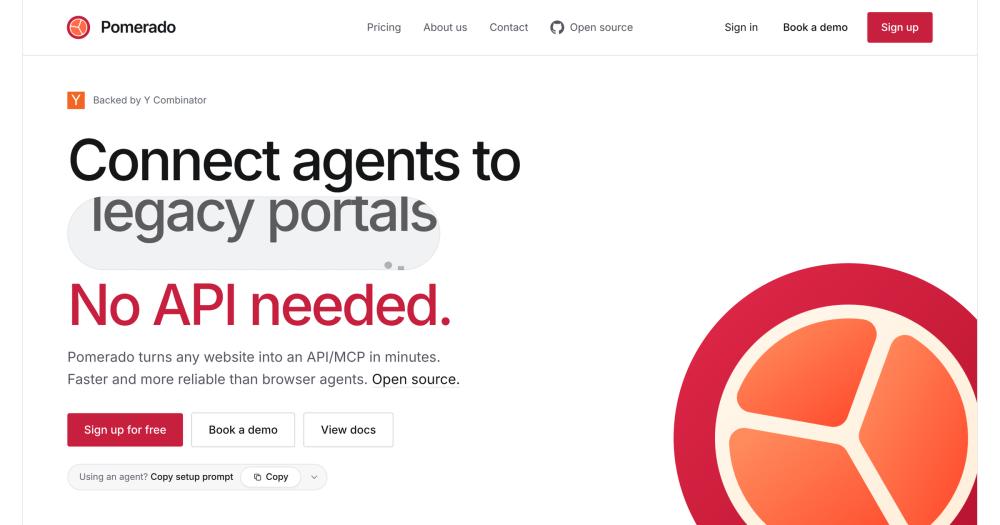
Build deterministic MCP integrations for any website from a natural language task description, with no existing API required.

Visit websiteGitHub841 stars
image of Pomerado
TL;DR

Pomerado is an open source tool that builds deterministic MCP integrations for any website from a natural language task description, with no existing API required. It replaces paid browser-agent tools like Skyvern and MultiOn by minting reusable, deterministic APIs that run in milliseconds instead of replaying browser sessions each time. MIT licensed under the open source core, it runs locally on Node 24 with an OpenAI key for builds; integrations execute with no model calls afterward. Best for developers and AI engineers automating tasks on legacy portals, enterprise ERPs, and consumer sites with no public API.

Read the full breakdownHide the full breakdownWho it is for, how it works, trade-offs, the quick start and the FAQ
who it's for

Who Pomerado is for#

AI engineers building agent automations against enterprise portals

Pomerado replaces fragile browser-agent scripts for teams running Codex, Claude Code, or Cursor agents that need to interact with procurement systems, CRMs, ERPs, and HR portals. The agent calls Pomerado's MCP tools to mint and run integrations without leaving its own context, and the resulting integration files can be committed to version control.

Skip if:

If the target system has a public REST or GraphQL API, use that directly. Pomerado's value is specific to sites with no existing programmatic interface.

Developers automating healthcare and insurance portal workflows

Claims status checks, prior authorizations, and billing lookups all live behind provider portals with no public API. Pomerado's benchmark covers OpenEMR, OpenMRS, and payer portal tasks. The self-healing feature on Pomerado Cloud catches portal layout changes that would otherwise break automated claims checks mid-run.

Skip if:

If your healthcare vendor offers an HL7 FHIR API or EDI integration, that path is more reliable. Pomerado suits portals where no programmatic interface exists.

Developers running personal AI assistants that need live site data

Pomerado's free cloud tier covers 100 tool calls per day and 10 new integrations per month, which is enough for personal use cases such as checking flight prices, reading order status, or searching hotel availability. The keyless MCP endpoint at mcp.pomerado.ai lets an agent connect for read-only tasks with no account setup.

Skip if:

If the data you need is available through a public API or RSS feed, use that instead. Pomerado's advantage is for sites with no structured data export path.

Platform teams providing web automation to multiple internal agents

Pomerado's Business tier covers 100,000 or more tool calls per day, private integrations, roles and permission management, audit logs, SLAs, and custom 2FA, which suits organizations running several internal agents that need access to vendor portals and SaaS tools under SSO. Integrations can be shared across agents without each team re-minting.

Skip if:

Teams whose vendor catalog primarily exposes native API access or webhook integrations will see less benefit. Pomerado is most valuable for the portion of your catalog that has no programmatic interface at all.

the problem

The problem it solves#

Automating tasks on websites that have no API requires a browser agent to navigate and interact with each page in real time. This approach is slow, expensive, and breaks whenever the site changes its layout or form structure, because the agent must rediscover the right sequence of clicks and inputs on every run.

For AI engineers and developers building production workflows against legacy portals, healthcare systems, procurement tools, or consumer sites, browser-agent instability creates a ceiling: the automation is never reliable enough to run unattended. The cost compounds too; a single multi-step browser session can spend dollars in model tokens, making high-frequency automation economically unviable.

how Pomerado solves it

How it solves it#

Integration minting from natural language

Pomerado builds a complete MCP integration from a plain-language task description and a target URL, with no HAR file, recording, or API spec needed. The minter runs in a real Chromium browser, completes an example of the task, generalizes the steps, and saves the integration as a folder of TypeScript source modules your agent can call directly.

Deterministic API execution

Once minted, an integration runs as a fast, deterministic API rather than a live browser session. Task completion takes seconds instead of the minutes a browser agent needs for the same operation, and the cost per call is near zero because no model inference runs at execution time. Running an existing integration requires no OpenAI key.

Login and 2FA handling

Pomerado signs into password-protected portals and handles two-factor authentication codes, including SMS, authenticator app TOTP codes, email OTPs, and recovery codes. Credentials can be stored securely in Pomerado or passed with each API request; saved credentials never appear in chat or logs.

Self-healing integrations (Pomerado Cloud)

Pomerado Cloud detects when a site changes its layout or form fields, repairs the integration automatically, and completes the original call without returning an error to the agent. The repair runs in the background and the calling agent receives its result once the fix is validated, rather than receiving a failure.

Source code ownership

Each minted integration is saved as a folder of TypeScript modules you own. The integration ships with a README, MCP server entry, input and output schemas, and sign-in records. Running an integration makes no model requests, so the code can be audited, modified, and version-controlled independently of the Pomerado service.

Agent-native MCP workflow

Pomerado exposes four MCP tools to the calling agent: mint, get_job, provide_input, and cancel_job. Any MCP-compatible coding agent, including Claude Code, Codex, Cursor, Gemini CLI, or VS Code, can trigger an integration build and run results without leaving its own context.

strengths · trade-offs

Strengths and trade-offs#

Strengths

  • MIT licensed open source coreThe complete Pomerado minter, runtime, and integration core are MIT licensed. You can run the full stack on your own infrastructure, modify the source, and use the integrations commercially. The Pomerado Cloud service runs the same core code for teams that prefer managed hosting over self-operated infrastructure.
  • Benchmark-verified speed and cost advantageThe published benchmark covers 30 tasks in 25 business applications. Pomerado completed them 2x faster, at 10 to 1,000 times lower cost, and with 30% better accuracy than Astra Computer Use, Instinct, and Muse. The employee onboarding task completed in 8 minutes 16 seconds for $0.03, versus Codex Computer Use at 21 minutes 22 seconds for $41.01.
  • No model inference at execution timeOnly the mint phase requires an OpenAI API key. Once an integration is minted, every subsequent run executes without any model call. This makes the per-call cost near zero and execution latency predictable, unlike browser agents that spend model tokens on each run regardless of whether the task changes.
  • Works on any website without an existing APIPomerado covers legacy portals, government systems, healthcare EMRs, ERPs, and consumer sites, as shown by the 25 test applications in its benchmark, including OpenEMR, ERPNext, Moodle, QuickBooks, and Delta flight search. If a site has a login and a URL, Pomerado can mint an integration for it.

Trade-offs

  • -Requires an OpenAI API key to mint integrationsThe build phase uses OpenAI models to explore the site, generalize steps, and write the integration source. You need a valid OpenAI API key to create new integrations. Running existing integrations has no model requirement, but adding new sites to your catalog always does. The key is read from the server environment, not chat.
  • -Very new project with an active open issue countPomerado was created in October 2026 and had 842 stars and 40 open issues at the time this was written. The codebase is early-stage; expect API surface changes and gaps in documentation for edge cases. The team reviews all pull requests before merging, which keeps quality up but slows the pace of external contributions.
  • -Self-healing and managed fleet are Cloud-only featuresAutomatic breakage detection and repair, managed browser fleet with bot protection, OAuth brokerage, and team access controls are Pomerado Cloud features, not available in the self-hosted core. Self-hosted users must manage their own Chromium instance and re-mint integrations manually when sites change.
versus alternatives

Pomerado vs alternatives#

Pomerado vs Skyvern

Skyvern is a browser-automation tool for AI agents that uses computer vision and LLMs to navigate web UIs in real time. Both tools let AI agents take actions on websites without a public API, but they approach the problem differently.

FeaturePomeradoSkyvern
LicenseMIT (open source core)MIT
Self-hostingYesYes
Execution modelDeterministic minted APILive browser session per call
Model cost per runNone after mintingCharged per run
Self-healingCloud onlyNot built-in
AuthenticationLogin and 2FA handlingLogin supported

Pomerado mints an integration once; every subsequent call runs that deterministic API in milliseconds without any model inference. Skyvern navigates the page from scratch on each call, which works well for one-off or highly dynamic tasks but spends model tokens every time. For recurring, high-frequency workflows such as daily claims checks or invoice pulls, Pomerado's execution model is materially cheaper. Skyvern is the better fit for one-off tasks on any page where you need zero upfront build time, or for target sites that change so frequently that a stable integration would need constant rebuilding.

Pomerado vs MultiOn

MultiOn is a commercial browser-agent API that allows AI applications to perform actions on the web on a user's behalf. Pomerado's open source core is a direct alternative for teams with self-hosting or data-privacy requirements.

FeaturePomeradoMultiOn
LicenseMIT (open source core)Proprietary
Self-hostingYesNo
Execution modelDeterministic minted APILive browser agent per call
Source code ownershipYes (saved locally)No
Free tierYes (self-hosted; 100 calls/day cloud)No self-hosted option

Pomerado's integrations are saved as source code you own and can audit, while MultiOn is a closed managed service with no self-hosted path. Teams with data privacy requirements, cost sensitivity on high-frequency tasks, or a need to inspect and version-control their automation logic will find Pomerado's model more suitable. MultiOn may be the better choice when you want a zero-infrastructure managed service and are targeting only publicly accessible consumer websites with no recurring cost sensitivity.

install · quick start

Quick start#

bash
Install Pomerado globally via npm, then install the Chromium browser it uses for minting integrations.
```bash
npm install -g pomerado
npx -y -p pomerado playwright install chromium
```
tech stack · detected from GitHub

What it's built on#

Languages
TypeScript
frequently asked

FAQ#

Does the open source version require a Pomerado account or cloud service?

No. The MIT-licensed open source core runs entirely on your machine with no Pomerado account. You need Node 24, an OpenAI API key for minting new integrations, and an MCP client such as Claude Code or Cursor. The cloud service at pomerado.ai is optional and adds managed hosting, breakage repair, and OAuth brokerage for teams that want production-grade reliability without managing their own infrastructure.

How does Pomerado differ from Skyvern or MultiOn?

Skyvern and MultiOn are browser-agent tools that navigate the page from scratch on each call, spending model tokens to find and interact with elements every run. Pomerado mints a deterministic API once and runs it with no model inference afterward. The published benchmark shows 2x faster task completion and 10 to 1,000 times lower cost than comparable browser-agent approaches across 30 tasks. Pomerado also saves integrations as source code you own and can audit; browser-agent tools run statelessly with no persistent artifacts.

Can Pomerado handle sites that require two-factor authentication?

Yes. Pomerado handles SMS codes, authenticator app TOTP codes, email OTPs, and recovery codes. On Pomerado Cloud, it uses its own phone number for SMS 2FA so your personal number is not exposed. Credentials and 2FA details are stored encrypted and never appear in chat or logs. The free tier supports one saved account per website; the Business tier adds unlimited accounts and custom 2FA configurations.

What happens when a website changes its layout and breaks an integration?

On the self-hosted core, a failed call returns an error object with a code, a write_status, and a retry flag. You would re-mint the integration to rebuild it for the new site layout. On Pomerado Cloud, breakage detection runs automatically: when a site change causes a run to fail, Pomerado starts a maintenance job, repairs the integration, and completes the original call. The calling agent receives its result rather than an error.

Is there a limit on how many integrations I can build?

The free Pomerado Cloud tier allows 10 new integrations per month; the $50 per month Premium tier allows 100. The self-hosted open source version has no integration limit beyond your own compute and OpenAI API costs. Each mint takes up to 20 minutes of active browser work, and time spent waiting for your answers during the build does not count against that limit.

also worth a look

Similar open-source tools#

browser-use

Alternative toSkyvern

Python library giving any LLM full browser control, MIT licensed

  • 118,982 GitHub stars
  • MITLicence MIT

Omnara

Featured

Alternative toCClaude Managed Agents

Open-source agent deployment API. Self-host or use Omnara Cloud.

  • 3,235 GitHub stars
  • Apache-2.0Licence Apache-2.0

Agent Reach

Featured

Alternative toFirecrawl

Give any AI agent internet access, free and local

  • 103,240 GitHub stars
  • MITLicence MIT

Openspline

Alternative toHeyGen LiveAvatar

Talking-avatar SDK for voice AI agents, MIT-licensed, Python and Node.

  • 295 GitHub stars
  • MITLicence MIT

Marker

Alternative toUnstructured.io

Convert documents to clean markdown and JSON with open source AI.

  • 40,612 GitHub stars
  • Apache-2.0Licence Apache-2.0

Bifrost

Alternative toPortkey

Open-source AI gateway with 23+ providers, failover, and MCP support.

  • 9,066 GitHub stars
  • Apache-2.0Licence Apache-2.0
by category

Open source tools in these categories#

81

APIs & Integration

n8n, Firecrawl, iptv
416

AI & Machine Learning

freeCodeCamp, OpenClaw, REA (Reverse Engineer Anything)
479

Developer Tools

REA (Reverse Engineer Anything), superpowers, Skills for Real Engineers

Sponsors

Inbox Zero

Alternative toSuperhuman

AI email assistant that drafts replies and clears your inbox

  • 12,787 GitHub stars
  • AGPL-3.0Licence AGPL-3.0
  • #Email

Omnara

Alternative toCClaude Managed Agents

Open-source agent deployment API. Self-host or use Omnara Cloud.

  • 3,235 GitHub stars
  • Apache-2.0Licence Apache-2.0
  • #AI Agents

rakazo

Alternative toGrok Bot

AI teammates you own: your keys, your model, your machine.

  • 5,406 GitHub stars
  • Apache-2.0Licence Apache-2.0
  • #AI Agents
Advertise your product

New open source projects by email

The projects we add and every new guide. Free, unsubscribe any time.

Find open source alternatives to paid software

/
  • Claude Code to OpenCode
  • Jira to Windshift
  • Notion to AppFlowy
  • Slack to Mattermost
  • Linear to GitLab
  • Wispr Flow to Handy
  • CapCut to Concat
  • Grok Bot to rakazo
  • Superhuman to Inbox Zero
  • Airtable to AITable
  • Muse to OpenClaw
  • Railway to Coolify
  • GitHub Copilot to Cline
  • Datadog to Netdata
  • Microsoft Teams to Rocket.Chat
  • Confluence to Docmost
  • Pinecone to Qdrant
  • Zapier to n8n
  • Devin AI to OpenHands
  • Firebase to Supabase
  • 1Password to KeePassXC
  • Contentful to Strapi
  • Adobe Premiere Pro to Shotcut
  • ChatGPT to AnythingLLM