

Who Omnara is for#
Customer-Facing Agent Products
Ship a product where your customers interact with AI agents directly. Access controls, audit trails, and durable execution ensure agents survive failures mid-session and customers see only their own data.
Skip if:
You only need internal tooling with no customer-facing agent interface.
Internal Team Agents
Deploy agents that teams interact with through the Omnara dashboard or Slack connector. Per-project permissions let different teams see only their own agents and secrets.
Skip if:
You have no need for team-level agent collaboration or Slack integration.
Long-Running Automated Workflows
Run agents for recurring tasks like code review, data processing, or report generation. Agent state persists through failures and machine restarts, so a long job finishes even after an outage.
Skip if:
Your use case involves only short, synchronous agent calls where durability is not a concern.
The problem it solves#
Building production-grade agent infrastructure from scratch takes months. You need durable execution so agents survive crashes and disconnects, a way to manage long-running jobs, access controls for teams and customers, and an audit trail for risky tool calls. Anthropic's Claude Managed Agents offers a managed solution, but it ties you to their infrastructure and proprietary platform. Organizations with data residency requirements, teams that need to run agents on their own machines, or developers who want to avoid vendor lock-in need a self-hostable alternative that delivers the same infrastructure primitives without the closed-platform constraints.
How it solves it#
Durable Agents
Agent state is committed atomically to PostgreSQL. When an agent crashes, disconnects, or the machine restarts, it picks up exactly where it left off. No lost progress, no manual recovery required.
Bring Any Model
Run agents on OpenAI, Anthropic, OpenRouter, LiteLLM, or any self-hosted endpoint compatible with OpenAI or Anthropic APIs. Bring your own API keys and switch providers without changing your agent code.
Computer-Use Sandboxes
Use managed sandboxes from Blaxel, Daytona, Modal, or Unikraft, or connect your own laptops or VMs. An agent can run with no sandbox or use several at once, and you can add or remove machines while the agent is running.
Access Controls and Audit Trail
Organizations and projects get role-based access management, encrypted scoped secrets, and human approval gates for risky tool calls. An append-only audit trail records every agent action for compliance and debugging.
Agent-Ready APIs
Launch, steer, and observe agents through a REST API, TypeScript SDK, or CLI from one control plane. Your application controls who can use each agent, what input it receives, and how its output reaches users.
MCP Servers and Slack
Connect HTTP MCP servers to extend agents with external tools and data sources. A first-party Slack connector lets teams launch and interact with agents directly from Slack without leaving their workflow.
Strengths and trade-offs#
Strengths
- Self-Hosted or CloudRun Omnara in your own VPC for full data control and compliance, or use Omnara Cloud for a managed experience. Self-hosted deployments can query agent history directly in PostgreSQL for analytics, evals, and training data.
- Open-Source (Apache 2.0)The full platform source is on GitHub under Apache 2.0. You can inspect, fork, or extend the platform without depending on Omnara's commercial continuity.
- Model-Agnostic with Your Own KeysBring your own API keys and run any model through a compatible endpoint. OpenAI, Anthropic, OpenRouter, LiteLLM, Ollama, and self-hosted models all work through the same platform.
- Access Controls Built InRBAC, encrypted scoped secrets, human approval gates for risky tool calls, and an append-only audit trail are first-class primitives, not add-ons.
Trade-offs
- -Early-Stage PlatformOmnara is a young project. APIs and platform behaviors are still evolving, and the ecosystem of integrations is smaller than established managed platforms.
- -Self-Hosting ResponsibilityChoosing the self-hosted path means you own the maintenance, updates, and uptime. Docker Compose is the supported setup; production infrastructure management is on your team.
- -Smaller Community Than Closed AlternativesClaude Managed Agents has Anthropic's engineering and support behind it. Omnara's community and documentation are growing but not yet at the same depth.
Omnara vs alternatives#
Omnara vs Claude Managed Agents
Claude Managed Agents is Anthropic's closed, managed platform for running long-running agent sessions. It provides a pre-built agent-execution environment with sandboxes on Anthropic's infrastructure, built-in tools (Bash, file operations, web search, MCP servers), and a session API optimized for Claude models. It is currently in beta and requires an Anthropic API key.
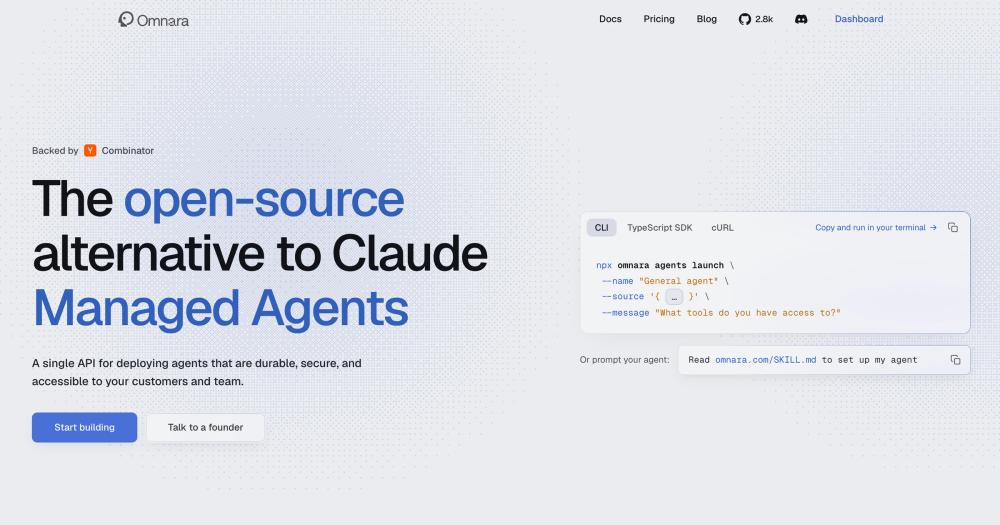
Omnara is the open-source alternative built around the same API-first design. You define agents as YAML profiles, launch sessions through a REST API or TypeScript SDK, and run compute in sandboxes from providers like Blaxel, Daytona, Modal, or Unikraft, or on your own machines. The control plane runs on Omnara Cloud or entirely in your own VPC.
Vendor lock-in. Claude Managed Agents runs on Anthropic's infrastructure; you cannot self-host the platform itself (though self-hosted sandboxes are available). Omnara is Apache 2.0 and fully self-hostable as a complete platform.
Model choice. Claude Managed Agents is optimized for and tied to Claude. Omnara is model-agnostic: OpenAI, Anthropic, OpenRouter, LiteLLM, and self-hosted endpoints all work through the same control plane.
Access controls. Both platforms offer organizational access management. Omnara adds human approval gates for risky tool calls and an append-only audit trail on every agent action.
Durability. Both platforms persist agent state across failures. Omnara commits state atomically to PostgreSQL; self-hosted deployments can query that history directly for analytics and evals.
License. Claude Managed Agents is proprietary. Omnara is Apache 2.0.
Quick start#
Install and launch an agent with the Omnara CLI:

```bash
npx omnara login
npx omnara profiles create --name agent --file agent.yaml
```

Self-host with Docker Compose:

```bash
git clone https://github.com/omnara-ai/omnara.git
cd omnara
docker compose -f compose.yaml --profile app up -d
```What it's built on#
- Languages
- GoTypeScript
- Frameworks
- React
FAQ#
Is Omnara truly open source?
Yes. Omnara is Apache 2.0 licensed. The full platform source is on GitHub at github.com/omnara-ai/omnara, including the server, CLI, and TypeScript SDK.
How does Omnara compare to Claude Managed Agents?
Claude Managed Agents is Anthropic's closed, managed platform for running long-running agents on their infrastructure. Omnara is the open-source alternative: self-hostable in your own VPC, model-agnostic, and Apache 2.0. Both offer durable sessions, sandboxes, access controls, and a session API. Omnara adds model flexibility and the option to run the whole stack yourself.
What models does Omnara support?
Any model through a compatible endpoint. Omnara supports OpenAI Responses, OpenAI Chat Completions, and Anthropic Messages APIs, which covers OpenAI, Anthropic, OpenRouter, LiteLLM, Ollama, and most self-hosted models.
Can I run Omnara on my own infrastructure?
Yes. Omnara self-hosts via Docker Compose. Self-hosted deployments can query agent history directly in PostgreSQL for analytics, evals, and training data. Use Omnara Cloud if you prefer a fully managed setup.
What does Omnara cost?
The software is Apache 2.0, so self-hosting is free. Omnara Cloud pricing had not been published as of this listing. You bring your own model API keys either way.
Similar open-source tools#

OmniRoute
352-provider AI gateway with automatic fallback and token compression

FckSignups
Open-source tools that work instantly, no signup required

Agent Reach
Give any AI agent internet access, free and local

Marker
Convert documents to clean markdown and JSON with open source AI.

Bifrost
Open-source AI gateway with 23+ providers, failover, and MCP support.

MinerU
Document parsing for LLM workflows, OCR, and agent reading.