Who stremio-web is for#
Cord-cutters replacing a paid media server
Stremio Web provides a browser-based replacement for proprietary media centers, letting you browse and watch content from addon catalogs without installing or paying for a closed platform. Chromecast support means you can still get content onto a TV.
Skip if:
Skip if you have a large personal media library you need to transcode and organize. Stremio Web has no local library management or transcoding; a dedicated media server is a better fit for that use case.
Developers contributing to or forking the official UI
The repository is a React application backed by a Rust/WASM core, with a complete dev environment (Node.js 22+, pnpm, hot reload), a translation toolchain, and a contribution guide. The modular architecture lets you modify the UI layer independently of the core engine.
Skip if:
Skip if you need to change the core streaming logic or addon protocol. That lives in stremio-core, a separate repository.
Multilingual households or international deployments
With 50+ community-translated languages available through stremio-translations, Stremio Web is usable by non-English speakers out of the box. Teams deploying it for diverse audiences can extend language coverage by contributing to the translation project.
Skip if:
Skip if your required language has incomplete coverage in the community translation project; check the stremio-translations repository before committing.
Browser-only environments without a native app
Stremio Web runs as a PWA and installs as a standalone app from the browser, bypassing app stores. It is an option for environments where installing native Stremio clients is restricted or impractical.
Skip if:
Skip if you need hardware-accelerated video decoding or DRM-protected content. Browser-based media playback has capability limits that native apps do not share.
The problem it solves#
Personal media streaming is fragmented. Content lives across dozens of catalog sources, and commercial media servers require a dedicated machine, library management, and ongoing maintenance. Paid platforms charge monthly or annual fees for features like mobile sync, hardware transcoding, and multi-device access.
For users who stream from online catalog sources rather than a personal library, this setup is overkill. The real challenge is catalog access: getting a unified discovery interface that spans multiple sources without paying per-catalog subscription fees or managing a full media server installation.
How it solves it#
Addon-powered catalog discovery
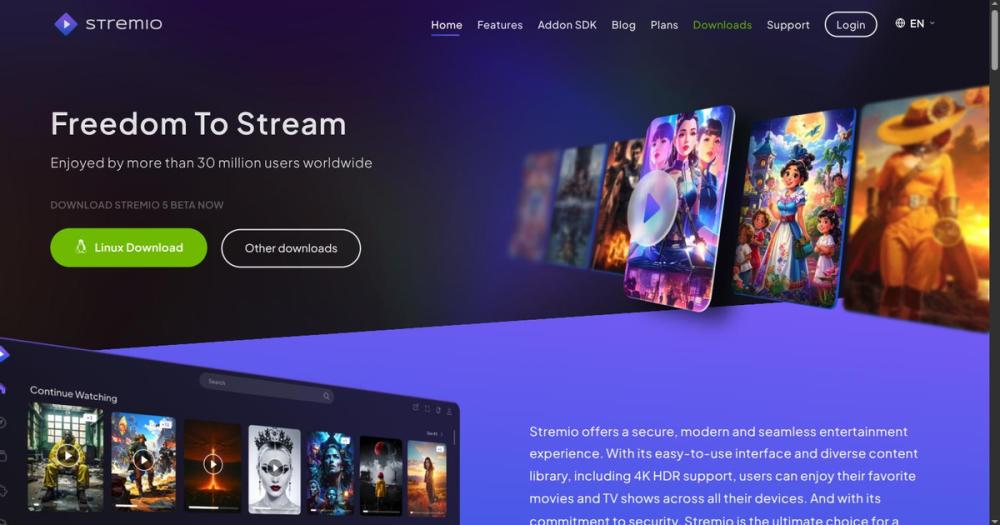
Connect community-built addons that provide movies, series, live channels, and subtitle sources. Each addon exposes its catalog through a standard protocol, so you combine multiple sources in one library view without separate subscriptions or custom integrations.
Cross-device library sync
Your library and Continue Watching list follow your Stremio account across every device. Pick up where you left off in the browser, desktop app, or mobile app without manual sync or state management.
Chromecast support
Cast any stream to a Chromecast-enabled TV directly from the web player. The web interface handles device discovery and session handoff; no separate desktop or mobile app is required.
Customizable subtitles
Subtitles load from addon providers or from local subtitle files. Font, size, color, and background styling are adjustable per viewing session to match viewer preferences.
Installable as a PWA
Stremio Web is a Progressive Web App and installs as a standalone window on desktop or mobile. Install directly from the browser without an app store or native package manager.
Keyboard-first player controls
Full playback control is available via keyboard shortcuts without touching the mouse. Useful for living room setups with a wireless keyboard or for accessibility workflows.
Strengths and trade-offs#
Strengths
- GPL-2.0 licensed and self-hostableThe web front-end is released under GPL-2.0, meaning you can inspect, fork, and run it on your own infrastructure. Self-hosting is a Docker build away, giving you control over the web layer without paying for a commercial media platform.
- Rust/WebAssembly core for reliabilityBusiness logic runs in stremio-core, a Rust engine compiled to WebAssembly that executes in a Web Worker. Rust's memory safety and WebAssembly's sandbox keep the core predictable and portable across browsers without native binaries.
- 50+ languages via community translationsThe interface ships in 50+ languages maintained through the separate stremio-translations repository. Missing or incomplete translations can be contributed directly; no approval gate from the core team is required.
Trade-offs
- -Content availability depends entirely on the addon ecosystemStremio Web has no built-in content catalog. What you can watch depends on which addons are available and maintained at any given time. Community-maintained addons can disappear or stop working without notice, leaving gaps in catalog coverage.
- -Self-hosting covers only the web front-endDeploying Stremio Web only gives you the UI layer. Account sync, library state, and the addon network still depend on the Stremio API operated by Smart Code OOD. A fully independent media stack requires additional server infrastructure and self-hosted addon sources.
- -No pre-built image: self-hosters must build from sourceThe repository provides Docker build commands but does not reference a pre-built image on a public container registry. Self-hosters must clone the repository and build the image locally before running it, adding a step compared to tools that ship a ready-to-pull image.
stremio-web vs alternatives#
Stremio Web vs Plex
Stremio Web and Plex both let you watch video content across devices, but they address different use cases. Plex is a proprietary media server that organizes and streams your personal library; Stremio Web is a browser-based front-end that streams from community addon catalogs. The primary question is whether your content lives on your own hardware or in online catalog sources.
| Feature | Stremio Web | Plex |
|---|---|---|
| License | GPL-2.0 | Proprietary |
| Self-hosting | Web front-end only | Full media server |
| Local library management | No | Yes |
| Transcoding | No | Yes |
| Content source | Community addons | Personal library |
| PWA / browser install | Yes | No |
| Chromecast | Yes | Yes |
Stremio Web is the better choice when you primarily stream from catalog sources and do not want to run a transcoding server. You skip disk management, library scanning, and encoding overhead entirely. The GPL-2.0 license means you can fork and deploy your own build of the web interface without licensing fees.
Plex is the better fit when your media collection lives on local storage. Its library scanning, metadata matching, and transcoding pipeline are purpose-built for personal collections served to multiple devices. If you have a large library of local video files and need reliable remote streaming with format conversion, Plex's media server model serves that use case better than Stremio Web's catalog-only approach.

Install and self-host#
Self-hosting Stremio Web requires building the Docker image from the repository.
```bash
git clone https://github.com/Stremio/stremio-web.git
docker build -t stremio-web .
docker run -p 8080:8080 stremio-web
```What it's built on#
- Languages
- JavaScriptTypeScript
- Frameworks
- React
- Tooling
- Webpack
FAQ#
Is Stremio Web free to use?
Yes. Stremio Web is GPL-2.0 licensed and free to self-host. The hosted version at web.stremio.com is also free to use with a Stremio account. The repository does not describe paid tiers for the web front-end itself.
How does Stremio Web compare to Plex?
Stremio Web is an addon-driven media front-end with no local library management or transcoding. Plex is a full proprietary media server built for personal libraries. Stremio Web fits better if you stream from catalog sources and want a browser-based interface; Plex fits better if you have a large local collection you need to transcode and serve to multiple devices.
Can I self-host Stremio Web?
Yes. Clone the repository, build the Docker image with docker build, and run it on port 8080. Note that self-hosting covers only the web front-end: account sync and addon discovery still depend on the Stremio API maintained by Smart Code OOD.
What are Stremio addons?
Addons are catalog providers built on the Stremio Addon SDK. Each addon exposes movies, series, channels, or subtitle sources through a standard protocol. Community members publish addons for different content sources, and anyone can build a new one using the Node.js stremio-addon-sdk.
What does the GPL-2.0 license mean for Stremio Web?
GPL-2.0 means you can run, study, share, and modify Stremio Web freely. If you distribute a modified version, you must release those changes under GPL-2.0 as well. Copyright is held by Smart Code OOD (2017-2026). Running it privately or for internal use carries no distribution obligation.
Similar open-source tools#
iptv
136k+ public TV channels, free M3U playlists and EPG data
Jellyfin
Free open source media server for movies, TV, and music
FckSignups
Open-source tools that work instantly, no signup required
agentic-inbox
Self-hosted email client with AI agent on Cloudflare Workers
CLI-Anything
Empower AI agents with agent-native CLIs
Voquill
Open source voice dictation with local AI and custom glossary