Open Source Alternatives
  • Alternatives
  • Categories
    Categories by size939 projects
    • Developer Tools486
    • AI & Machine Learning420
    • Business & Productivity205
    • Web Development199
    • Security & Monitoring140
    • Communication & Collaboration129
    • IT Management128
    • Cloud & Hosting111
    • Data & Analytics108
    • Design & Creative106
    Browse all 21 categoriesLLMOps & AI Tooling, Product & Project Management and 9 more
  • Blog
  • Advertise
SearchNotion, Slack, password manager.../
Submit
Open Source Alternatives
  • Alternatives
    • Developer Tools486
    • AI & Machine Learning420
    • Business & Productivity205
    • Web Development199
    • Security & Monitoring140
    • Communication & Collaboration129
    • Browse all 21 categories
  • Blog
  • Advertise
Submit your project

New open source projects by email

The projects we add and every new guide. Free, unsubscribe any time.

Open Source Alternatives LogoOpen Source Alternatives

Handpicked Open Source Alternatives to Paid Softwares

Product

  • Categories
  • Tag
  • Advertise

Resources

  • Blog
  • Collection
  • Submit

Company

  • Privacy Policy
  • Terms of Service
  • Refund Policy
  • Sitemap

Alternatives

  • Claude Code
  • Jira
  • Notion
  • Slack
  • Linear
  • Wispr Flow
  • All alternatives
© 2026 Open Source Alternatives. All rights reserved.
Open SourceAlternatives
Home/Categories/Developer Tools/Zeroshot
icon of Zeroshot

Zeroshot

  • 2.1K stars
  • MIT
  • Active this week
  • Last commit today

Last verified Oct 28, 2026

Orchestrate coding agents through enforced QA graphs with independent reviewers and repair loops. MIT licensed, self-hostable via Docker.

Visit websiteGitHub2.1K starsDeploy on Hostinger
image of Zeroshot
TL;DR

Zeroshot is an open-source workflow engine for coding agents that enforces your team's QA process as a directed graph rather than a system prompt. It runs Claude Code, Codex, GitHub Copilot, and Pi through configurable worker, reviewer, and repair loops so that no agent approves its own work or skips a step. MIT licensed; install via npm or run as a self-hosted Docker target. Engineering teams managing multiple coding agents in parallel are the primary fit.

Read the full breakdownHide the full breakdownWho it is for, how it works, trade-offs, the quick start and the FAQ
who it's for

Who Zeroshot is for#

Engineering teams managing multiple parallel coding agents

When your team runs Claude Code, Codex, and Copilot on different issues simultaneously, Zeroshot provides one process graph that applies the same QA standard to every run. Workers from any coding agent pass through the same reviewer chain before merging, so quality does not vary by which agent a developer used.

Skip if:

You have one agent, low PR volume, and informal review is adequate. Zeroshot adds a review and repair loop that is not justified for solo workflows where a single-pass agent run already delivers acceptable output.

Teams shipping changes to security-critical paths

Auth, payments, and database migrations can be routed through a blast-radius map and a dedicated security reviewer before standard acceptance and code review, using conditional branching in the graph. That reviewer runs with fresh context and cannot be bypassed by the worker's own assessment of the change.

Skip if:

Your security-sensitive paths already have independent automated checks (SAST, manual gates in CI) that the agent cannot merge around. Add Zeroshot where you need process enforcement at the agent level, before CI runs.

Research teams running iterative algorithmic experiments

The auto-research template runs ten rounds by default: scouts propose directions, a researcher runs the experiment, an independent reviewer checks correctness and progress. Compact records and restorable candidates are kept at the workspace root. A geometry computation task ran ten iterations and achieved a 21x CPU speedup per the README.

Skip if:

Your research loop is exploratory and does not need independent correctness verification. The roughly five model calls per auto-research round add overhead that is not worth it for low-stakes experiments.

Teams reducing model spend without sacrificing QA

On 20 ProgramBench tasks, a small model in a Zeroshot review loop matched a larger model's score at a median 58% of its cost. The review and repair loop catches mistakes a single pass misses, so you can run a cheaper worker model and still reach the quality bar a larger model would deliver unassisted.

Skip if:

Your tasks are low-volume or low-stakes and a single-pass agent run with informal review already delivers acceptable quality. The reviewer and repair overhead is not justified when the cost of rework is lower than the cost of the extra model calls.

the problem

The problem it solves#

Coding agents now write and submit code faster than engineering teams can review it. When you run multiple agents in parallel, the review bottleneck shifts from the agent to the human: engineers are rubber-stamping dozens of open pull requests late at night or staying silent while agents push directly to staging. The deeper pain is that agents operating on prompts can decide for themselves whether their own work passes review. A skill can request a code review; the agent can also declare the result acceptable without one. Nothing in a prompt-based workflow prevents an agent from skipping the step when it judges the task complete.

The result is unpredictable output quality: agents merge changes with passing tests written by the same agent that wrote the code, security-relevant changes bypass the blast-radius check that existed only in someone's head, and the team's actual QA process lives in individuals' skills files and chat history rather than in enforceable code.

how Zeroshot solves it

How it solves it#

Graph-enforced QA process

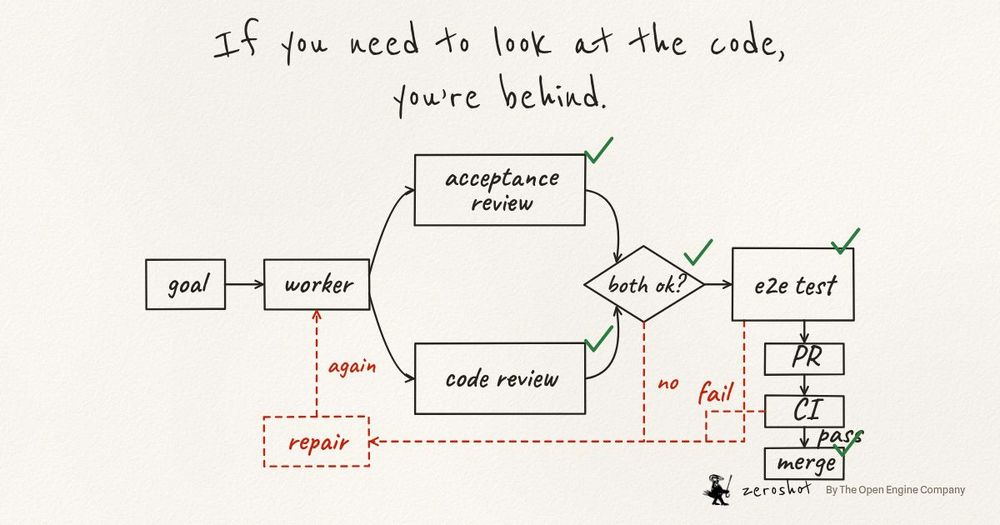
Define your workflow as a directed graph: each node is a worker, reviewer, or delivery step with explicit retry limits and failure paths. No agent can skip a node or approve its own work. The graph runs identically on every task regardless of what the implementing agent's model says about the result.

Independent parallel reviewers

The built-in software-change template runs acceptance and code review in parallel, each reviewer starting with a fresh session on every pass. Rejected work returns to the original worker session with both reviews' feedback, then goes through both reviews again. Reviewers are isolated from the implementation context by design.

Agent and provider agnostic

Each node can use a different coding agent (Claude Code, Codex, GitHub Copilot, or Pi) and model provider (Anthropic, OpenAI, OpenRouter, AWS Bedrock, or your own gateway). Bring your own API keys; the engine connects to the provider you name. Worker, acceptance, and code reviewers can run on different models in the same graph.

Configurable delivery targets

By default a software-change run opens a pull request and stops. Add --ship to proceed through CI and merge. The --delivery none flag keeps changes local for inspection. PR and ship runs address visible pull request review feedback by default. Delivery conflicts return through repair and review before merging.

Self-hosted Docker target

The Docker target image bundles the native Rust engine plus Codex, Claude Code, Copilot, and Pi CLIs. Run it with a persistent volume to keep execution and durable state on infrastructure you control. The target exposes a browser UI and HTTP API at port 8080; stopping the UI server leaves active runs running.

Auto-research with independent verification

The built-in auto-research graph runs up to ten iterations by default: three independent scouts propose directions, one researcher runs the experiment and prepares results, a fresh reviewer checks evidence and correctness. On 20 ProgramBench tasks, a small model in a review loop matched a larger model's score at a median 58% of the cost.

strengths · trade-offs

Strengths and trade-offs#

Strengths

  • QA is code, not a promptOther workflows rely on the implementing agent to decide whether its own review was sufficient. Zeroshot encodes your process in a graph the engine runs mechanically: the agent that wrote the code cannot approve its own pull request or skip the review step. That invariant holds regardless of the model or coding agent you connect.
  • MIT license, no per-seat cost on the open-source pathThe CLI and engine are MIT licensed. Run locally with any supported coding agent login, or deploy the Docker target image on your own infrastructure at no licensing cost. You bring API keys for the models you use; there is no per-seat or per-task fee on the self-hosted path. The hosted platform is a separate, optional upgrade.
  • Multi-agent, multi-model in one graphEach node in a Zeroshot graph can use a different coding agent and model. Worker on Opus, reviewer on Sonnet, delivery on Codex at a different provider, all in one run. That flexibility lets you balance cost and quality per step rather than accepting a single provider's defaults across the whole workflow.
  • Active development and verified engineering adoption2,050 GitHub stars as of October 2026, starred by engineers at Google, Meta, Shopify, Uber, Booking.com, GitHub, Cloudflare, Atlassian, and JetBrains per the README. Last pushed October 27, 2026. The repo includes active CI, coverage tracking, and a Discord community.

Trade-offs

  • -Graph authoring requires upfront design workThe default software-change template works immediately, but building a custom graph for a specific QA scenario (blast-radius check, security review, conditional routing) requires writing and tuning node configuration and reviewer prompts. Teams expecting zero-setup should recalibrate; the power is in defining the process, and that takes time to get right.
  • -Node.js 18 or newer required for the CLI installThe npm installer requires Node.js 18 or newer to install the native binary. The binary runs standalone, but you still need a compatible Node version in PATH for the install step. Teams on older Node environments need to upgrade before installing.
  • -Hosted platform charges per parallel runThe CLI, engine, and Docker target are MIT-licensed and free. The managed Zeroshot Platform is free for one concurrent run and $100 per month per extra parallel run. Teams wanting many simultaneous managed runs pay per additional slot; the self-hosted path has no such limit but requires running your own infrastructure.
versus alternatives

Zeroshot vs alternatives#

Zeroshot vs Using Coding Agents Without a QA Layer

The most common context for Zeroshot is not tool against tool but workflow against workflow: running Claude Code, Codex, or Copilot directly then reviewing output yourself, versus running those same agents through a Zeroshot graph that enforces your QA process.

When coding agents run without an enforced QA layer, each run's quality depends on the agent's self-assessment. The agent implements the task, runs tests, declares the result ready, and opens a pull request. Nothing prevents the agent from approving its own work or skipping a step when the model judges it unnecessary. Engineers review batches of agent output after the fact, often with limited context about what the agent decided.

A Zeroshot graph replaces self-assessment with a mechanically enforced process: the worker implements, independent reviewers check in parallel with fresh sessions, and rejected work returns for repair before either reviewer signs off. The graph runs identically on every task. The tradeoff is that you write and maintain the graph; for small teams with low PR volume where informal review already works, the overhead is not justified.

Zeroshot vs Devin

Devin, from Cognition AI, is a commercial autonomous coding agent that handles task planning, implementation, testing, and PR creation in one managed service. It runs on Cognition's infrastructure with no self-hosted option and is priced for enterprise teams. Zeroshot is not an autonomous agent; it is a workflow engine that orchestrates the coding agents your team already uses.

FeatureZeroshotDevin
LicenseMIT (CLI and engine)Proprietary
Self-hostingYes (Docker target)No
Coding agentBring your ownIncluded, proprietary
Model choiceAny (Anthropic, OpenAI, Bedrock, OpenRouter)Proprietary
Review enforcementMechanically enforced graphInternal to the product
PricingFree self-hosted; $100/mo per extra parallel run (platform)Enterprise pricing

Devin is worth considering when you want a fully managed, end-to-end autonomous coding agent with no infrastructure to run and are willing to accept its proprietary model and enterprise pricing. Zeroshot is the better choice when you need to enforce your own review standards over multiple heterogeneous coding agents, want full control of the models and API keys used, and need infrastructure you own with no per-seat or per-task licensing on the open-source path.

install · quick start

Quick start#

bash
Install the CLI via npm, or deploy the Docker target for server-side execution.
```bash
npm install -g @the-open-engine-company/zeroshot
docker run --detach --restart unless-stopped --name zeroshot-target -p 127.0.0.1:8080:8080 -v zeroshot-data:/var/lib/zeroshot ghcr.io/the-open-engine/zeroshot-target:latest
zeroshot target add local --url http://127.0.0.1:8080 --direct
```
tech stack · detected from GitHub

What it's built on#

Languages
JavaScriptPythonRustTypeScript
Frameworks
React
frequently asked

FAQ#

Is Zeroshot free to use?

Yes. The CLI and engine are MIT licensed and free to install via npm and run locally. The Docker target image is also free for self-hosted server execution. The managed Zeroshot Platform charges $100 per month per extra parallel run beyond the first; model API costs go directly to whichever provider you connect. The self-hosted path has no per-run or per-seat fee.

Does Zeroshot replace my coding agent?

No. Zeroshot runs above your existing coding agents (Claude Code, Codex, GitHub Copilot, Pi) and puts them through the workflow you define. You keep the agents you already use; Zeroshot adds the enforced review and repair layer around them. Your existing agent can bootstrap the setup using the skill prompt included in the install.

Can I run Zeroshot locally without a server?

Yes. Install with npm install -g @the-open-engine-company/zeroshot and run it in any project folder. Local runs reuse your existing coding agent login, including subscription-backed sessions. Add --push to publish results or --ship to proceed through CI and merge; omit both to keep changes local and inspect the output first.

How do I customize the review criteria?

Inspect the built-in graph with zeroshot template show software-change, then copy and edit the reviewer node's instructions for your project. The graph contract documents every supported node type, parallel step, retry limit, and failure path. Save the result as a named local profile to reuse across runs. Teams sharing configurations across engineers use organization profiles on the Zeroshot Platform.

What happens when a reviewer rejects the work?

Rejected work returns to the same worker session with both reviewers' feedback attached, then passes through both reviews again. The number of repair loops is bounded by the retry limit in the graph configuration. When the limit is exhausted without passing, the run reports failure. A run with a recoverable workspace can be restarted or resumed from where it stopped.

also worth a look

Similar open-source tools#

Bifrost

Alternative toPortkey

Open-source AI gateway with 23+ providers, failover, and MCP support.

  • 9,132 GitHub stars
  • Apache-2.0Licence Apache-2.0

Duckle

Alternative toFivetran

Self-hosted ETL on DuckDB with 385 connectors and no per-row billing.

  • 1,530 GitHub stars
  • Apache-2.0Licence Apache-2.0

Herdr

Alternative toConductor

Agent runtime that keeps terminals alive across machines

  • 45,889 GitHub stars
  • Apache-2.0Licence Apache-2.0

CodeBoarding

Alternative toCodeDashboard

Review code changes as architecture maps, not line diffs

  • 2,629 GitHub stars
  • MITLicence MIT

ax

Alternative toGoogle Vertex AI Agent Engine

Declarative runtime for autonomous agent workloads

  • 14,097 GitHub stars
  • Apache-2.0Licence Apache-2.0

orbi

Alternative toConductor

self-hosted, open-source (AGPL-3.0) AI coding agent

  • 231 GitHub stars
  • AGPL-3.0Licence AGPL-3.0
by category

Open source tools in these categories#

487

Developer Tools

REA (Reverse Engineer Anything), superpowers, Skills for Real Engineers
420

AI & Machine Learning

freeCodeCamp, OpenClaw, REA (Reverse Engineer Anything)
93

DevOps & CI/CD

Nvm, Uptime Kuma, Netdata
Hostinger

Run Zeroshot on your own server

Self-host Zeroshot on a Hostinger VPS.

Deploy on Hostinger

Sponsors

Inbox Zero

Alternative toSuperhuman

AI email assistant that drafts replies and clears your inbox

  • 12,826 GitHub stars
  • AGPL-3.0Licence AGPL-3.0
  • #Email

Omnara

Alternative toCClaude Managed Agents

Open-source agent deployment API. Self-host or use Omnara Cloud.

  • 3,296 GitHub stars
  • Apache-2.0Licence Apache-2.0
  • #AI Agents

rakazo

Alternative toGrok Bot

AI teammates you own: your keys, your model, your machine.

  • 5,914 GitHub stars
  • Apache-2.0Licence Apache-2.0
  • #AI Agents
Advertise your product

New open source projects by email

The projects we add and every new guide. Free, unsubscribe any time.

Find open source alternatives to paid software

/
  • Claude Code to OpenCode
  • Jira to Windshift
  • Notion to AppFlowy
  • Slack to Mattermost
  • Linear to GitLab
  • Wispr Flow to Handy
  • Arc to Zen Browser
  • CapCut to Concat
  • Grok Bot to rakazo
  • Superhuman to Inbox Zero
  • Airtable to AITable
  • Muse to OpenClaw
  • Railway to Coolify
  • GitHub Copilot to Cline
  • Datadog to Netdata
  • Microsoft Teams to Rocket.Chat
  • Confluence to Docmost
  • Pinecone to Qdrant
  • Zapier to n8n
  • Devin AI to OpenHands
  • Firebase to Supabase
  • 1Password to KeePassXC
  • Contentful to Strapi
  • Adobe Premiere Pro to Shotcut