Open Source Alternatives
  • Alternatives
  • Categories
    Categories by size1,030 projects
    • Developer Tools527
    • AI & Machine Learning455
    • Business & Productivity237
    • Web Development203
    • Security & Monitoring153
    • Communication & Collaboration138
    • IT Management137
    • Cloud & Hosting122
    • LLMOps & AI Tooling119
    • Data & Analytics112
    Browse all 21 categoriesDesign & Creative, Product & Project Management and 9 more
  • Blog
  • Advertise
SearchNotion, Slack, password manager.../
Submit
Open Source Alternatives
  • Alternatives
    • Developer Tools527
    • AI & Machine Learning455
    • Business & Productivity237
    • Web Development203
    • Security & Monitoring153
    • Communication & Collaboration138
    • Browse all 21 categories
  • Blog
  • Advertise
Submit your project

New open source projects by email

The projects we add and every new guide. Free, unsubscribe any time.

Open Source Alternatives LogoOpen Source Alternatives

Handpicked Open Source Alternatives to Paid Softwares

Product

  • Categories
  • Tag
  • Advertise

Resources

  • Blog
  • Collection
  • Submit

Company

  • Privacy Policy
  • Terms of Service
  • Refund Policy
  • Sitemap

Alternatives

  • Claude Code
  • Jira
  • Notion
  • Slack
  • Linear
  • Wispr Flow
  • All alternatives
© 2026 Open Source Alternatives. All rights reserved.
Open SourceAlternatives
Home/Categories/AI & Machine Learning/Ai Goofish Monitor
icon of Ai Goofish Monitor

Ai Goofish Monitor

  • 16.4K stars
  • MIT
  • Active this month
  • Last commit 24 days ago

Last verified Nov 4, 2026

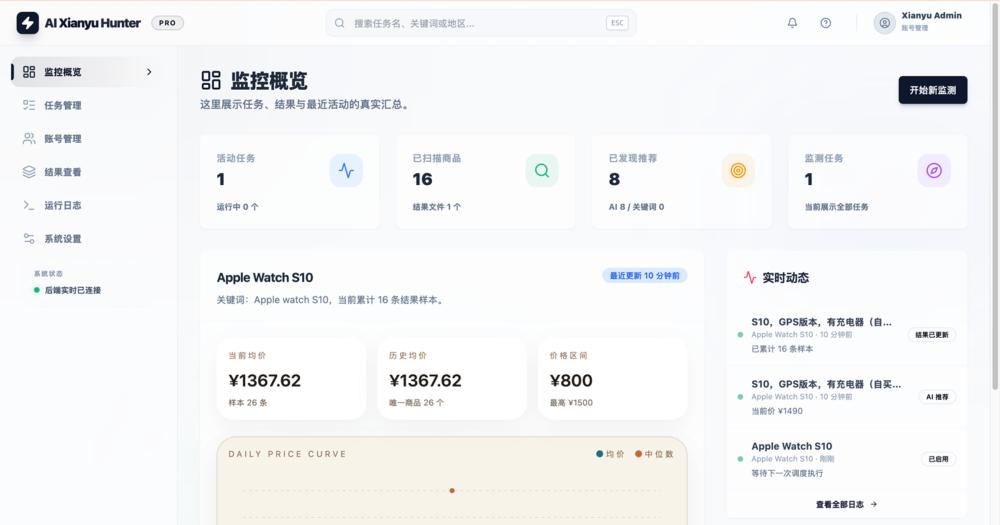
Monitor Xianyu second-hand listings with AI analysis, concurrent task scheduling, and multi-channel notifications.

Visit websiteGitHub16.4K starsDeploy on Hostinger
Image for Ai Goofish Monitor
TL;DR

Ai Goofish Monitor is an automated monitoring tool for Xianyu (闲鱼), Alibaba's second-hand marketplace, that runs concurrent search tasks and applies AI analysis to filter listings before sending notifications. It replaces manual search sessions and general-purpose web change monitors that cannot evaluate listing content semantically. Deployed on Docker with MIT license, it requires an OpenAI-compatible API key for a vision-capable model. Best for Xianyu buyers who search for specific items and want AI-scored alerts rather than raw listing feeds.

Read the full breakdownHide the full breakdownWho it is for, how it works, trade-offs, the quick start and the FAQ
who it's for

Who Ai Goofish Monitor is for#

Xianyu buyers hunting for specific second-hand items

If you regularly search for a specific product category on Xianyu, this monitor replaces manual search sessions. Configure a task with your keyword set, price ceiling, and an AI prompt describing your quality criteria, then receive alerts only when a matching listing appears.

Skip if:

Skip if your search criteria are simple enough to cover with a single keyword and you check Xianyu infrequently. The setup cost (Docker, API key, account extraction) is not worthwhile for occasional one-off searches.

Resellers monitoring multiple product categories at once

Multi-task concurrency lets a reseller run separate monitoring tasks for different product types simultaneously. Each task can be assigned its own account and proxy, reducing exposure to marketplace rate limiting across a full set of targets.

Skip if:

Skip if you are sourcing at high volume across dozens of categories. This is a single-server tool with no distributed worker support documented in the README.

Developers prototyping AI-powered marketplace automation

The FastAPI backend exposes documented endpoints for task creation, job polling, and authentication. A developer can use the API directly to build custom automation workflows on top of the monitor without touching the web UI.

Skip if:

Skip if you need a stable, versioned API contract. The project is under active development and API shapes may change between releases.

the problem

The problem it solves#

Tracking second-hand listings on Xianyu by hand is impractical at any real volume. New items appear and disappear within hours, the catalog is large, and searching multiple keyword variations manually while evaluating each listing against your criteria is slow and inconsistent. Missing a good deal because you checked the search an hour too late is a recurring pain for active buyers on the marketplace.

The problem compounds when you need to monitor multiple product types simultaneously or filter by region and price range. Manual monitoring forces a choice between checking too often (inefficient) or checking too rarely (missing listings). Xianyu does not provide a built-in alert system that accepts complex criteria and sends notifications only when a listing genuinely matches.

how Ai Goofish Monitor solves it

How it solves it#

Multi-task concurrent monitoring

Each monitoring task runs independently with its own keyword set, price range, region filter (province/city/district), and AI prompt. Tasks can run in real time or on a Cron schedule, and multiple tasks execute simultaneously without blocking each other.

AI-driven listing analysis

Each new listing passes through a configured OpenAI-compatible model that supports image input. The model receives listing photos and text and applies your criteria to decide whether to send a notification, reducing false positives from keyword-only matching.

Multi-channel notifications

Notification channels include ntfy.sh, Telegram, Bark, WeChat Work, Gotify, and custom webhooks. Each is configured through environment variables, and notifications fire only when the AI marks a listing as matching.

Account and proxy rotation

Multiple Xianyu accounts can be registered and assigned to individual tasks. A proxy pool with configurable rotation, failure thresholds, and blacklist TTL handles rate limiting and risk control responses from the marketplace.

Web management interface

A full web UI at port 8000 covers task creation, account management, AI prompt editing, run logs, and results browsing. Task creation supports both AI-generated criteria (described in natural language) and manual keyword rules.

SQLite persistence with Docker volumes

All task data, results, and price history store in a SQLite database at data/app.sqlite3, mounted as a Docker volume. Login state cookies, prompts, logs, and images each have their own persisted directory, simplifying backup and migration.

strengths · trade-offs

Strengths and trade-offs#

Strengths

  • MIT license with no seat feesThe entire codebase is MIT licensed, so running it on your own server carries no licensing cost. Unlike commercial price-alert SaaS tools with per-user or per-alert pricing, the ongoing cost is only the AI API calls you configure.
  • AI analysis works on images, not just textSecond-hand listings on Xianyu include photos that carry condition and authenticity signals a text search cannot capture. The multimodal AI layer evaluates both listing text and photos against your criteria before deciding to notify.
  • 16,000+ stars in under 18 monthsThe repo reached 16,431 stars and 2,846 forks since its July 2025 launch, with active development through October 2026 adding features like SQLite migration and three-tier region filtering after initial release.
  • Flexible notification stackThe notification system covers ntfy.sh, Telegram, Bark, WeChat Work, Gotify, and custom webhooks, all configured through environment variables. No integration middleware is needed to route alerts to your preferred channel.

Trade-offs

  • -Requires Xianyu account with extracted login stateLogin state cannot be entered as credentials. You must export a JSON cookie file using the companion Chrome extension and import it through the web UI. This setup step adds friction, and sessions require re-export when Xianyu invalidates the cookie.
  • -AI API key required for core functionalityThe AI analysis layer requires an OpenAI-compatible API key for a vision-capable model. Users without an existing API subscription must provision one before the monitor is functional. API calls add an ongoing cost per listing analyzed.
  • -Local deployment requires a frontend build stepThe Docker image includes the pre-built frontend, but running locally on bare metal requires building the web UI from source using Node.js. The start.sh script handles this automatically, but the initial setup is not a single-command install without Docker.
  • -32 open issues as of November 2026The repo had 32 open issues at the time of writing. As a tool targeting a specific marketplace, edge cases around login state expiry, risk control, and region data staleness appear in the issue tracker.
versus alternatives

Ai Goofish Monitor vs alternatives#

Ai Goofish Monitor vs Distill.io

Both tools send alerts when something on the web matches your criteria, but they target different problems. Distill.io monitors arbitrary web pages for text changes; Ai Goofish Monitor monitors Xianyu specifically and uses AI to evaluate listing content against user-defined criteria before alerting.

FeatureAi Goofish MonitorDistill.io
LicenseMIT (self-hosted)Proprietary SaaS
Self-hostingYes, via DockerNo
TargetXianyu (闲鱼) onlyAny web page
Alert logicAI analysis of listing contentText or visual diff
AI image analysisYesNo
Notificationsntfy.sh, Telegram, Bark, WeChat, Gotify, WebhookEmail, Slack, Zapier
PricingFree (server + AI API costs)Paid plans from $13/month

Ai Goofish Monitor is the better choice when you need semantic evaluation of second-hand listings on Xianyu, specifically when listing condition, quality, and relevance matter more than a simple price or availability change. The AI layer evaluates listing photos and text against your natural-language criteria, which a text-diff monitor cannot do.

Distill.io is the better choice when you need to monitor non-Xianyu pages, want a hosted service with no infrastructure management, or need to track changes across a wide range of web content types without marketplace-specific logic.

Ai Goofish Monitor vs Manual Xianyu Search

Manual searching on Xianyu requires repeated sessions to catch new listings and relies on the user's own judgment to evaluate each result. Ai Goofish Monitor automates both the search frequency and the evaluation step, running on a schedule or continuously and applying consistent AI criteria to every new listing. The practical difference is coverage: a monitor catches listings that appear between manual check-ins, which is where most time-sensitive deals are missed.

install · quick start

Quick start#

bash
Deploy with Docker using the official container image; configure your AI API key and model in .env before starting.

```bash
git clone https://github.com/Usagi-org/ai-goofish-monitor && cd ai-goofish-monitor
cp .env.example .env
docker compose up -d
```
tech stack · detected from GitHub

What it's built on#

Languages
JavaScriptPythonTypeScript
Frameworks
FastAPIVue
Tooling
Playwright
frequently asked

FAQ#

Does Ai Goofish Monitor work outside China?

The tool monitors Xianyu (闲鱼), which is Alibaba's China-based second-hand marketplace and is primarily accessible within China. Connecting from outside China typically requires a VPN or proxy configured in the .env file. Proxy rotation support is built in and configurable via environment variables.

Which AI models work with Ai Goofish Monitor?

Any model accessible through an OpenAI-compatible API endpoint that supports image (vision) input. This includes OpenAI's GPT-4o and locally hosted vision models. The required environment variables are OPENAI_API_KEY, OPENAI_BASE_URL, and OPENAI_MODEL_NAME.

How does the Xianyu login work?

You export your Xianyu login state as a JSON cookie file using the companion Chrome extension, then paste it into the Account Management section of the web UI. The session file saves to the state/ directory. Sessions expire and must be re-exported when Xianyu invalidates the cookie.

Is Ai Goofish Monitor free to run?

The software is MIT licensed and free to self-host. Running costs come from the server hosting Docker and the AI API calls for listing analysis. The AI API cost depends on your model choice and how many listings the monitor evaluates per day.

Can I run multiple monitoring tasks simultaneously?

Yes. The system supports multi-task concurrency, with each task running independently with its own keyword set, price range, region filter, and AI prompt. Tasks can run on a Cron schedule or in real time. Each task can be assigned a specific Xianyu account or left for the system to auto-select.

also worth a look

Similar open-source tools#

Paperboy

InMarketing & Growth

Fact-checked SEO articles from Search Console data, held if they fail

  • AGPL-3.0Licence AGPL-3.0

Orkas

InAI & Machine Learning

Local-first desktop AI team: 16 agents, MIT, models of your choice.

  • 8,987 GitHub stars
  • MITLicence MIT

Email Marketing Bible

InMarketing & Growth

Email automation skill for Claude, Codex, and ChatGPT agents.

  • MITLicence MIT

Claude Seo

InMarketing & Growth

SEO audit plugin for Claude Code, 26 skills and 19 agents

  • 25,703 GitHub stars
  • MITLicence MIT

superCMO-skills

Alternative toAdCreative.ai

Generate video ads and product photos from inside your AI agent

  • 287 GitHub stars
  • Apache-2.0Licence Apache-2.0

Altorank

Alternative toSurfer SEO

Open-source SEO content engine with human-approval publishing

  • 5 GitHub stars
  • AGPL-3.0Licence AGPL-3.0
by category

Open source tools in these categories#

457

AI & Machine Learning

freeCodeCamp, REA (Reverse Engineer Anything), OpenClaw
64

Marketing & Growth

agency-agents, MoneyPrinterTurbo, MiroFish
Hostinger

Self-host Ai Goofish Monitor on a Hostinger VPS

Keep it running 24/7, even when your laptop is off. A Hostinger VPS gives it a server of its own.

  1. 01

    Choose a plan

    Starts from $6.49/mo

  2. 02

    Apply

    Extra 10% off yearly plans

  3. 03

    Install Ai Goofish Monitor

    On a server that stays on

  4. 04

    Start building

    Focus on the app, not the server

Deploy on Hostinger

Sponsors

Inbox Zero

Alternative toSuperhuman

AI email assistant that drafts replies and clears your inbox

  • 12,889 GitHub stars
  • AGPL-3.0Licence AGPL-3.0
  • #Email

rakazo

Alternative toGrok Bot

AI teammates you own: your keys, your model, your machine.

  • 6,568 GitHub stars
  • Apache-2.0Licence Apache-2.0
  • #AI Agents

SnitchFeed

Live monitoring on LinkedIn, X, Reddit & more. Agentic social listening for startups.

Marketing & Growth

Advertise your product

New open source projects by email

The projects we add and every new guide. Free, unsubscribe any time.

Find open source alternatives to paid software

/
  • Claude Code to OpenCode
  • Jira to Windshift
  • Notion to AppFlowy
  • Slack to Mattermost
  • Linear to GitLab
  • Wispr Flow to Handy
  • Arc to Zen Browser
  • CapCut to Concat
  • Grok Bot to rakazo
  • Superhuman to Inbox Zero
  • Airtable to AITable
  • Muse to OpenClaw
  • Railway to Coolify
  • GitHub Copilot to Cline
  • Datadog to Netdata
  • Microsoft Teams to Rocket.Chat
  • Confluence to Docmost
  • Pinecone to Qdrant
  • Zapier to n8n
  • Devin AI to OpenHands
  • Firebase to Supabase
  • 1Password to KeePassXC
  • Contentful to Strapi
  • Adobe Premiere Pro to Shotcut