

Open Source Alternatives
  • Alternatives
  • Categories
    Categories by size931 projects
    • Developer Tools480
    • AI & Machine Learning416
    • Business & Productivity204
    • Web Development199
    • Security & Monitoring137
    • Communication & Collaboration129
    • IT Management128
    • Cloud & Hosting111
    • Data & Analytics108
    • Design & Creative106
    Browse all 21 categoriesProduct & Project Management, LLMOps & AI Tooling and 9 more
  • Blog
  • Advertise
SearchNotion, Slack, password manager.../
Submit
Open Source Alternatives
  • Alternatives
    • Developer Tools480
    • AI & Machine Learning416
    • Business & Productivity204
    • Web Development199
    • Security & Monitoring137
    • Communication & Collaboration129
    • Browse all 21 categories
  • Blog
  • Advertise
Submit your project

New open source projects by email

The projects we add and every new guide. Free, unsubscribe any time.

Open Source Alternatives LogoOpen Source Alternatives

Handpicked Open Source Alternatives to Paid Softwares

Product

  • Categories
  • Tag
  • Advertise

Resources

  • Blog
  • Collection
  • Submit

Company

  • Privacy Policy
  • Terms of Service
  • Refund Policy
  • Sitemap

Alternatives

  • Claude Code
  • Jira
  • Notion
  • Slack
  • Linear
  • Wispr Flow
  • All alternatives
© 2026 Open Source Alternatives. All rights reserved.
Open SourceAlternatives
Home/Categories/Business & Productivity/Body.build
icon of Body.build

Body.build

Open source alternative to Fitbod, RP Hypertrophy and Alpha Progression

  • 37 stars
  • AGPL-3.0
  • Active this week
  • Last commit 5 days ago

Last verified Oct 27, 2026

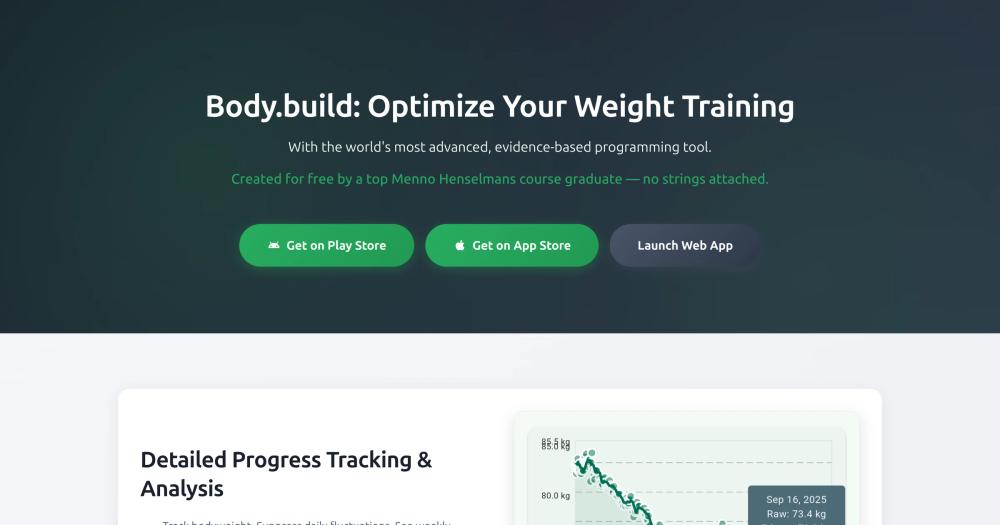
Track workouts and plan evidence-based training programs with fractional volume counting, a science-backed exercise library, and no sign-up or data collection.

Visit websiteGitHub37 stars
image of Body.build
TL;DR

Body.build is a free, AGPL-3.0 licensed Flutter app for evidence-based weight training, available on the web, Android, and iOS. Its site states no payment, no ads, no sign-up, and no personal data collection. Built by a graduate of the Menno Henselmans Personal Training Course, the program maker uses fractional volume counting, an exercise library with technique cues and study links, and personalized per-muscle-group volume recommendations. Set logging and bodyweight tracking are available today; an in-gym tracker and personal analytics are listed as in development.

Read the full breakdownHide the full breakdownWho it is for, how it works, trade-offs and the FAQ
who it's for

Who Body.build is for#

Intermediate and advanced lifters following evidence-based programming

Lifters who want fractional volume counting, muscle-group coverage guidance, and per-group volume recommendations without a monthly subscription. Body.build encodes the Henselmans course curriculum into the program maker.

Skip if:

Skip if you are a beginner who needs guided progressions and polished onboarding. The README notes that making the app more accessible to beginners is a future roadmap goal, not a current priority.

Coaches building programs for clients

The exercise library with technique cues, coaching ratings, and scientific study links doubles as a reference tool. Coaches can use the program maker to design volume-balanced, muscle-complete programs.

Skip if:

Skip if you need client management features such as check-ins, form review, or billing. Body.build is a programming and exercise reference tool only.

Privacy-conscious athletes who want no data collection

Body.build requires no account and, per the site, collects no personal data. For athletes who want no cloud dependency tied to a third-party account, this is the clearest advantage over paid apps in the category.

Skip if:

Skip if you need to access your training data on multiple devices. Cross-device sync is not documented.

Developers who want to read or contribute to the codebase

The AGPL-3.0 source is on GitHub and written in Flutter (Dart). Developers can read the volume calculation logic, contribute new exercises to the library, or extend the project under the license terms.

Skip if:

Skip if you need a self-hosting setup guide. The README does not include deployment instructions; building the app from source requires Flutter toolchain knowledge.

the problem

The problem it solves#

The best evidence-based programming tools all charge ongoing subscription fees. Fitbod, RP Hypertrophy, and Alpha Progression are paid apps, so you cannot read the source behind the programming approach you are trusting your training to. Lifters who want fractional volume counting, muscle-group coverage guidance, and per-muscle-group volume recommendations face a choice between paid apps and managing spreadsheets.

Data ownership is a secondary concern. When training history lives inside a paid subscription app, access depends on keeping payments current.

how Body.build solves it

How it solves it#

Exercise library with technique cues and study links

Covers major exercises with technique variations, cue descriptions, links to relevant scientific studies, and ratings from coaches and content creators. The site describes it as an extensive catalog of exercises with technique tweaks and cues.

Fractional volume counting for precise load balancing

Measures training load in fractions rather than whole sets, giving more precise volume balancing across muscle groups. The program maker uses this to surface volume imbalances across the muscles you are training.

Antagonist superset and time-efficiency detection

Identifies antagonist muscle pairings and non-overlapping musculature sets within a program. Per the site, this flags opportunities for exercise pairing that improve both time efficiency and training gains.

Personalized weekly volume recommendations

Generates per-muscle-group volume targets based on your body stats, lifestyle, nutrition, and training goals. The site describes these as recommendations based on the latest evidence.

Anatomy module for muscles and joint articulations

Interactive anatomy reference covering all major muscles and the joint movements they control. The program maker uses it to confirm complete muscle coverage across movement patterns and muscle lengths, as the site describes.

Set logging and bodyweight tracking

Logs individual sets with exercise cues, variations, and notes. Tracks bodyweight with weekly progress views that suppress daily fluctuations. The site also notes that deep analysis comparing performance across technique variations is coming soon.

strengths · trade-offs

Strengths and trade-offs#

Strengths

  • Completely free with no account and no adsBody.build charges nothing and requires no sign-up. The site states: "100% Free. No payment, no ads, no sign-up. No personal data collection." The creator's stated goal is a free public tool for lifting, like Wikipedia but for training.
  • AGPL-3.0 source on GitHubThe full source is on GitHub at github.com/Dieterbe/body.build under AGPL-3.0. Anyone can read the volume calculation logic, fork the project, or contribute exercises to the library.
  • Creator is a Menno Henselmans course graduateThe creator is a graduate of the Menno Henselmans Personal Training Course, as stated on the product website. The programming recommendations in the app reflect that course curriculum.
  • Active development across web, Android, and iOSAvailable as a web app and as native Android and iOS apps. The GitHub repository received its last push in October 2026, with an in-gym tracker and personal analytics listed as the next features in the roadmap.

Trade-offs

  • -Small community and early-stage codebaseThe GitHub repository has 37 stars and 17 open issues. Compared to mature fitness apps, the user base is small, and early adopters should expect rough edges as the project matures.
  • -In-gym tracker and personal analytics not yet shippedThe README lists an in-gym performance tracker and personal analytics as in the works. The site also marks cut, bulk, and contest-prep cycle comparison as coming soon. Lifters who need those features today will find the feature set incomplete.
  • -AGPL-3.0 restricts commercial hosted service deploymentsAnyone who deploys a modified version of Body.build as a public network service must publish their source changes under AGPL-3.0. Using the app as a lifter is unaffected, but building a commercial hosted service on the codebase means releasing those changes.
versus alternatives

Body.build vs alternatives#

Body.build vs Fitbod

Body.build is free; Fitbod is paid. The site states Body.build has no payment, no ads, no sign-up, and no personal data collection.

Body.buildFitbod
CostFree (per site)Paid

Body.build is the right choice when cost is the deciding factor and you want no account or data collection. If you need features Body.build has not yet shipped, such as an in-gym tracker and personal analytics (listed as in development in the README), a paid app like Fitbod is an option.

Body.build vs RP Hypertrophy

Body.build is free; RP Hypertrophy is paid. Both are positioned around evidence-based training.

Body.buildRP Hypertrophy
CostFree (per site)Paid

Body.build suits lifters who want evidence-based programming tools at no cost and with no data collection. For lifters who prefer a paid commercially available app in this category, RP Hypertrophy is the primary alternative.

tech stack · detected from GitHub

What it's built on#

Languages
DartJavaScript
Frameworks
React
frequently asked

FAQ#

Is Body.build free to use?

Yes. The site states: "100% Free. No payment, no ads, no sign-up. No personal data collection." There are no subscription tiers or premium features listed on the site.

What license does Body.build use?

Body.build is AGPL-3.0 licensed. You can read, modify, and distribute the source. If you deploy a modified version as a public network service, you must publish your source changes under AGPL-3.0.

Which features are available now and which are still in development?

The site lists set logging with exercise cues and notes, bodyweight tracking with weekly progress views, the exercise library, the program maker, and the anatomy module as available. The README lists an in-gym performance tracker and personal analytics as in the works. The site also marks detailed cut, bulk, and contest-prep cycle comparison as coming soon.

How does Body.build compare to Fitbod or RP Hypertrophy?

Body.build is free; Fitbod and RP Hypertrophy are paid apps. Body.build's site states no sign-up and no personal data collection. The main trade-off is that Body.build's in-gym tracker and personal analytics are still in development, as noted in the README, so lifters who need those features today may prefer a paid option.

What technology is Body.build built with?

Body.build is written in Flutter (Dart). GitHub shows JavaScript as the primary language because it detects the compiled web build, but the actual source is Flutter, as noted in the README.

also worth a look

Similar open-source tools#

CleanYourTV

Featured

Alternative toATV Launcher Pro

Debloat any Android or Google TV over Wi-Fi and get an Apple TV-style home.

  • 35,334 GitHub stars
  • MIT LicenseLicence MIT License

OpenClaw

Featured

Alternative toMuse

Self-hosted AI assistant for WhatsApp, Telegram, and more

  • 393,134 GitHub stars
  • MITLicence MIT

Inbox Zero

Featured

Alternative toSuperhuman

AI email assistant that drafts replies and clears your inbox

  • 12,826 GitHub stars
  • AGPL-3.0Licence AGPL-3.0

rakazo

Featured

Alternative toGrok Bot

AI teammates you own: your keys, your model, your machine.

  • 5,914 GitHub stars
  • Apache-2.0Licence Apache-2.0

paperclip

Featured

Alternative toGrok Bot

Self-hosted AI agent management with org charts and budgets

  • 107,598 GitHub stars
  • MITLicence MIT

Comp AI

Alternative toVanta

Open source compliance automation for SOC 2, ISO 27001, and HIPAA.

  • 2,063 GitHub stars
  • AGPL-3.0Licence AGPL-3.0
by category

Open source tools in these categories#

204

Business & Productivity

OpenClaw, Excalidraw, RustDesk

Sponsors

Inbox Zero

Alternative toSuperhuman

AI email assistant that drafts replies and clears your inbox

  • 12,826 GitHub stars
  • AGPL-3.0Licence AGPL-3.0
  • #Email

Omnara

Alternative toCClaude Managed Agents

Open-source agent deployment API. Self-host or use Omnara Cloud.

  • 3,235 GitHub stars
  • Apache-2.0Licence Apache-2.0
  • #AI Agents

rakazo

Alternative toGrok Bot

AI teammates you own: your keys, your model, your machine.

  • 5,914 GitHub stars
  • Apache-2.0Licence Apache-2.0
  • #AI Agents
Advertise your product

New open source projects by email

The projects we add and every new guide. Free, unsubscribe any time.

Find open source alternatives to paid software

/
  • Claude Code to OpenCode
  • Jira to Windshift
  • Notion to AppFlowy
  • Slack to Mattermost
  • Linear to GitLab
  • Wispr Flow to Handy
  • Arc to Zen Browser
  • CapCut to Concat
  • Grok Bot to rakazo
  • Superhuman to Inbox Zero
  • Airtable to AITable
  • Muse to OpenClaw
  • Railway to Coolify
  • GitHub Copilot to Cline
  • Datadog to Netdata
  • Microsoft Teams to Rocket.Chat
  • Confluence to Docmost
  • Pinecone to Qdrant
  • Zapier to n8n
  • Devin AI to OpenHands
  • Firebase to Supabase
  • 1Password to KeePassXC
  • Contentful to Strapi
  • Adobe Premiere Pro to Shotcut