Open Source Alternatives
  • Alternatives
  • Categories
    Categories by size933 projects
    • Developer Tools481
    • AI & Machine Learning417
    • Business & Productivity205
    • Web Development199
    • Security & Monitoring137
    • Communication & Collaboration129
    • IT Management128
    • Cloud & Hosting111
    • Data & Analytics108
    • Design & Creative106
    Browse all 21 categoriesProduct & Project Management, LLMOps & AI Tooling and 9 more
  • Blog
  • Advertise
SearchNotion, Slack, password manager.../
Submit
Open Source Alternatives
  • Alternatives
    • Developer Tools481
    • AI & Machine Learning417
    • Business & Productivity205
    • Web Development199
    • Security & Monitoring137
    • Communication & Collaboration129
    • Browse all 21 categories
  • Blog
  • Advertise
Submit your project

New open source projects by email

The projects we add and every new guide. Free, unsubscribe any time.

Open Source Alternatives LogoOpen Source Alternatives

Handpicked Open Source Alternatives to Paid Softwares

Product

  • Categories
  • Tag
  • Advertise

Resources

  • Blog
  • Collection
  • Submit

Company

  • Privacy Policy
  • Terms of Service
  • Refund Policy
  • Sitemap

Alternatives

  • Claude Code
  • Jira
  • Notion
  • Slack
  • Linear
  • Wispr Flow
  • All alternatives
© 2026 Open Source Alternatives. All rights reserved.
Open SourceAlternatives
Home/Categories/Developer Tools/Caprock
icon of Caprock

Caprock

Open source alternative to Conductor

  • 36 stars
  • Apache-2.0
  • Active this week
  • Last commit today

Last verified Oct 27, 2026

Track every coding agent session you run, with cost per repository, plan limits, and a PR pipeline view. Runs locally, no account required.

Visit websiteGitHub36 stars
image of Caprock
TL;DR

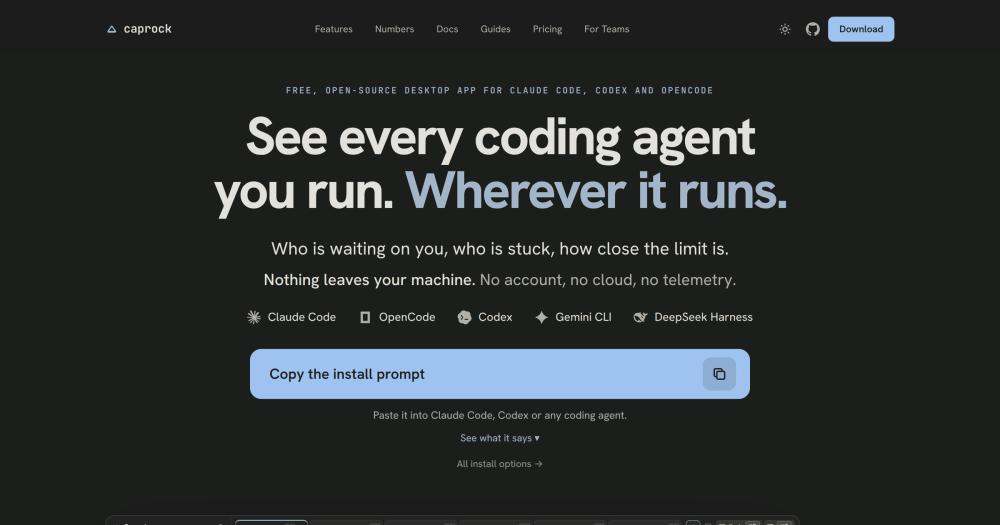
Caprock is a free, open source desktop app for macOS, Windows, and Linux that keeps the record of every Claude Code, Codex, OpenCode, Gemini CLI, Hermes Agent, and DeepSeek's agent session you run. Session history is stored locally in a SQLite file after Claude Code deletes its own transcripts, alongside cost per repository at API list prices, Claude and Codex plan-limit windows, and a pull request pipeline from agent to release. Apache-2.0 licensed. Best for solo developers running multiple agents across multiple repositories who want cost visibility and a permanent session record with no cloud account.

Read the full breakdownHide the full breakdownWho it is for, how it works, trade-offs, the quick start and the FAQ
who it's for

Who Caprock is for#

Developers running multiple agents across several repositories

Caprock shows every active session, what is waiting on approval, your plan windows in real time, and per-repository cost in one window. The Pipeline view tracks each pull request from the first agent commit to the release it shipped in.

Skip if:

You run a single agent on one project and check usage from the provider's own dashboard. Caprock adds the most value when multiple sessions run across multiple repositories.

Developers who want agent history past Claude Code's 30-day cleanup

Caprock imports transcripts still on disk on first install, then records every new session going forward. After Claude Code deletes its own files, the sessions remain searchable in Caprock with their full tool call history.

Skip if:

You already back up transcripts manually or only need short-term session visibility within the default 30-day window.

Developers who approve agent actions from a phone

A phone paired by QR code opens Caprock in its browser from anywhere through an encrypted relay. Sessions waiting on approval come first. You can dictate instructions, approve commands, and watch what an agent shipped without returning to your desk.

Skip if:

You rarely leave your desk while agents are running, or you prefer not to enable the phone relay network feature.

Developers tracking per-repository agent spend for review or reporting

Cost per repository breaks down to per-service in a monorepo, each turn counted toward the directory of the last file the agent touched. caprock report prints a publishable summary at API list prices. caprock export writes the underlying data as TSV, CSV, or JSON for further analysis.

Skip if:

Your goal is aggregating cost across a team or integrating spend data into a billing system. Caprock is a solo tool and does not aggregate usage across multiple users.

the problem

The problem it solves#

Running multiple coding agents across several projects is hard to track. Claude Code deletes its own transcripts after 30 days by default, leaving no long-term record of what an agent did, what it cost, or which pull requests it produced. When a session waits on a permission prompt, nothing surfaces it. When an agent loops on the same tool call, the cost grows without a visible warning.

The cost side is equally opaque. Paid AI coding plans bundle flat fees with usage windows, but the underlying token consumption and what the same work would cost through the API are not surfaced by default. A 5-hour or weekly Claude window can run out before any warning appears. Nothing in the default tooling shows which repository or directory within a monorepo is responsible for the spend.

how Caprock solves it

How it solves it#

Session history kept past Claude Code's 30-day transcript cleanup

Claude Code deletes transcripts after 30 days by default. Caprock captures every session in a local SQLite database, including ones started in your own terminal. On the maker's machine, 67 of 114 transcripts were already deleted after installation, including 10 from deleted worktrees, and all 67 remained searchable in Caprock. New sessions are recorded as they run and kept indefinitely.

Cost per repository and per service in a monorepo

Every agent turn is priced at API list prices, broken down by repository. Within a monorepo, cost is allocated to the directory of the last file the agent touched, so the rows add up to the repository total exactly. This is an estimate of what the same work would cost through the API, not a bill. In August, the maker found he had run $5,898 of Claude Code on a $200 Max plan using this view.

Claude and Codex plan limit windows, live

Caprock shows your Claude 5-hour and weekly usage windows in real time, with the time each resets and a warning before you hit 100%. Codex windows appear beside them so you can switch agents before running out. The menu bar shows your plan limits, today's spend, and the sessions waiting for approval at a glance.

Pull request pipeline from agent commit to release

The Pipeline view shows every pull request with its CI checks per job and operating system, how long each check took, and what the agents spent on that branch. A failed run, a conflict, or a branch behind main surfaces an action from the pull request row. Releases list which pull requests shipped in each version with their agent cost summed.

Phone access by QR code pairing

One QR code scan pairs a phone that opens Caprock in its browser from anywhere, through an end-to-end encrypted relay that sees only ciphertext. Sessions waiting for your approval come first. You can dictate instructions, approve commands, and monitor what an agent shipped without sitting at your computer.

Stuck session and runaway loop detection

When a session calls the same tool with nearly the same input five times within three minutes, a banner goes up. Repeated file reads are excluded; on 64,733 real tool calls they were over half of all alerts. Sessions Caprock started can be paused automatically when a loop is detected.

strengths · trade-offs

Strengths and trade-offs#

Strengths

  • No account, no telemetry, and no cloud dependencyAll data lives in a SQLite file on your disk. Caprock listens only on 127.0.0.1 by default and requires no account. Network features (update checks, GitHub, phone pairing, Telegram) are each off until you turn them on. Nothing leaves your machine unless you enable it. The code is Apache-2.0 on GitHub.
  • Six coding agents unified in one session tableClaude Code, Codex, OpenCode, Gemini CLI, Hermes Agent, and DeepSeek's agent each write their own transcript format. Caprock reads all six into a single table on your disk. caprock export writes that table as TSV, CSV, or JSON lines for a spreadsheet, notebook, or your own data pipeline.
  • Apache-2.0 license; core features free for solo useLive sessions, cost per repository, plan-limit warnings, history, and search are free for solo use and described as staying free. A paid license ($30/year or $100 once) adds eight specific features: auto-pause at a daily budget, pause at the plan limit, Telegram answers, a weekly report, usage queries, failed-tool tracking, session export, and Obsidian import.
  • Captures sessions started in your own terminalCaprock adds a small hook to ~/.claude/settings.json (backed up first) and reads the transcripts Claude Code already writes. Sessions you start in your own terminal appear alongside ones Caprock started. The hook is removed with caprock hooks uninstall; your recorded history stays intact.

Trade-offs

  • -Young project with a small communityThe repo was created in August 2026 and has 36 GitHub stars and 2 forks. Three open issues are listed. The project is actively maintained (last commit was October 2026) but has not yet built a large contributor community or broad third-party documentation.
  • -Cost estimates are at API list prices, not actual billingAll cost figures are calculated from token counts at API list prices. The site labels these an estimate, not a bill. Developers on flat-rate plans like Claude Max pay a subscription fee rather than per-token rates; the estimate shows what the same usage would cost through the API, which may be many times the plan fee.
  • -Windows installer not yet code-signedThe macOS app is signed with a Developer ID and notarized by Apple. The Windows installer is not code-signed yet, which triggers a Windows SmartScreen 'Run anyway' prompt at install time.
  • -Phone access uses an external encrypted relayPhone pairing works through an end-to-end encrypted relay that sees only ciphertext. This is a network feature that is off by default. Unlike the rest of Caprock's local-only data model, phone pairing involves an external connection you enable.
versus alternatives

Caprock vs alternatives#

Caprock vs Conductor

Both tools serve developers running AI coding agents who want visibility beyond the default CLI experience. Conductor is a paid commercial tool in this category.

Caprock's approach is local-first and open source. Session data stays in a SQLite file on your disk; no account is required, and nothing leaves your machine unless you enable a specific network feature. The Apache-2.0 code is on GitHub. The features available without payment include live sessions, cost per repository at API list prices, Claude and Codex plan-limit windows, session history past the 30-day cleanup, session search, and the pull request pipeline from agent commit to release. Eight additional features (auto-pause at a daily budget, Telegram answers, weekly reports, and others) require a paid license at $30 per year or $100 once.

Caprock is the better fit for a solo developer who wants a permanent record of every agent session, per-repository cost visibility, and plan-limit warnings with no cloud account and no subscription for core functionality.

Caprock does not aggregate usage across team members or offer a managed cloud deployment, so a team that needs those should look at a paid tool such as Conductor.

install · quick start

Quick start#

bash
Install the macOS desktop app with Homebrew.

```bash
brew install --cask dspv/tap/caprock-app
```
tech stack · detected from GitHub

What it's built on#

Languages
GoPythonRustTypeScript
Frameworks
React
frequently asked

FAQ#

Does anything leave my machine when I run Caprock?

By default, no. Data stays in a SQLite file on your disk, and Caprock listens only on 127.0.0.1. There is no account or telemetry. Network features (update checks, GitHub, phone pairing, Telegram) are each off until you turn them on. Updating downloads the new app from GitHub's release files; that is the only automatic network activity once you allow it.

Will Caprock see sessions I started before I installed it?

Yes, if those transcripts are still on disk. Claude Code keeps transcripts for 30 days by default. Caprock imports everything still present on first run, then records new sessions going forward. On the maker's machine, 67 of 114 transcripts were already deleted when Caprock was installed, and all 67 remained searchable after import.

Do I have to change how I run my coding agents?

No. Keep running claude or codex in your own terminal. Caprock adds a small hook to ~/.claude/settings.json, backed up first, and reads the transcripts those agents already write. You can remove the hook with caprock hooks uninstall; your recorded session history stays intact.

Is Caprock free to use?

Yes, for solo use. Live sessions, cost per repository, plan-limit warnings, history, and search are free and described as staying free. Eight additional features require a paid license: auto-pause at a daily budget, pause at the plan limit, Telegram answers, a weekly report, usage queries, failed-tool tracking, session export, and Obsidian import. A license costs $30 per year or $100 once.

Which coding agents does Caprock support?

Claude Code, Codex, OpenCode, Gemini CLI, Hermes Agent, and DeepSeek's agent. Each agent writes its own transcript format; Caprock reads all six into a single table on your disk. Sessions started by Caprock and sessions you start in your own terminal both appear in the same view.

also worth a look

Similar open-source tools#

paperclip

Featured

Alternative toGrok Bot

Self-hosted AI agent management with org charts and budgets

  • 107,598 GitHub stars
  • MITLicence MIT

Threadlines

Alternative toConductor

Open-source ADE for Claude Code, Codex, and Cursor in one thread

  • 32 GitHub stars
  • MITLicence MIT

Orgtree

Alternative toConductor

Desktop canvas for persistent multi-agent AI teams, Windows-only

  • 183 GitHub stars
  • MITLicence MIT

Herdr

Alternative toConductor

Agent runtime that keeps terminals alive across machines

  • 45,889 GitHub stars
  • Apache-2.0Licence Apache-2.0

5dive

Alternative toConductor

Run a company of AI agents on a server you own.

  • 73 GitHub stars
  • MITLicence MIT

Hypa

Alternative toConductor

Local-first terminal workspace for AI coding agents

  • 212 GitHub stars
  • FSL-1.1-ALv2Licence FSL-1.1-ALv2
by category

Open source tools in these categories#

481

Developer Tools

REA (Reverse Engineer Anything), superpowers, Skills for Real Engineers
417

AI & Machine Learning

freeCodeCamp, OpenClaw, REA (Reverse Engineer Anything)
104

LLMOps & AI Tooling

Hermes Agent, OpenCode, MarkItDown

Sponsors

Inbox Zero

Alternative toSuperhuman

AI email assistant that drafts replies and clears your inbox

  • 12,826 GitHub stars
  • AGPL-3.0Licence AGPL-3.0
  • #Email

Omnara

Alternative toCClaude Managed Agents

Open-source agent deployment API. Self-host or use Omnara Cloud.

  • 3,235 GitHub stars
  • Apache-2.0Licence Apache-2.0
  • #AI Agents

rakazo

Alternative toGrok Bot

AI teammates you own: your keys, your model, your machine.

  • 5,914 GitHub stars
  • Apache-2.0Licence Apache-2.0
  • #AI Agents
Advertise your product

New open source projects by email

The projects we add and every new guide. Free, unsubscribe any time.

Find open source alternatives to paid software

/
  • Claude Code to OpenCode
  • Jira to Windshift
  • Notion to AppFlowy
  • Slack to Mattermost
  • Linear to GitLab
  • Wispr Flow to Handy
  • Arc to Zen Browser
  • CapCut to Concat
  • Grok Bot to rakazo
  • Superhuman to Inbox Zero
  • Airtable to AITable
  • Muse to OpenClaw
  • Railway to Coolify
  • GitHub Copilot to Cline
  • Datadog to Netdata
  • Microsoft Teams to Rocket.Chat
  • Confluence to Docmost
  • Pinecone to Qdrant
  • Zapier to n8n
  • Devin AI to OpenHands
  • Firebase to Supabase
  • 1Password to KeePassXC
  • Contentful to Strapi
  • Adobe Premiere Pro to Shotcut