Open Source Alternatives
  • Alternatives
  • Categories
    Categories by size1,102 projects
    • Developer Tools555
    • AI & Machine Learning470
    • Business & Productivity268
    • Web Development208
    • Security & Monitoring171
    • Communication & Collaboration153
    • IT Management145
    • Cloud & Hosting127
    • LLMOps & AI Tooling122
    • Data & Analytics118
    Browse all 21 categoriesProduct & Project Management, DevOps & CI/CD and 9 more
  • Blog
  • Advertise
SearchNotion, Slack, password manager.../
Submit
Open Source Alternatives
  • Alternatives
    • Developer Tools555
    • AI & Machine Learning470
    • Business & Productivity268
    • Web Development208
    • Security & Monitoring171
    • Communication & Collaboration153
    • Browse all 21 categories
  • Blog
  • Advertise
Submit your project

New open source projects by email

The projects we add and every new guide. Free, unsubscribe any time.

Open Source Alternatives LogoOpen Source Alternatives

Handpicked Open Source Alternatives to Paid Softwares

Product

  • Categories
  • Tag
  • Advertise

Resources

  • Blog
  • Collection
  • Submit

Company

  • Privacy Policy
  • Terms of Service
  • Refund Policy
  • Sitemap

Alternatives

  • Claude Code
  • Jira
  • Notion
  • Slack
  • Linear
  • Wispr Flow
  • All alternatives
© 2026 Open Source Alternatives. All rights reserved.
Open SourceAlternatives
Home/Categories/No-Code & Low-Code/Lowcoder
icon of Lowcoder

Lowcoder

Open source alternative to Retool, UI Bakery, Jet Admin, Superblocks and DronaHQ

  • 1.6K stars
  • AGPL-3.0
  • Active this week
  • Last commit today

Last verified Nov 5, 2026

Build internal tools and customer-facing apps with 120+ drag-and-drop components, self-hosting on Docker, and an AGPL-3.0 license.

Visit websiteGitHub1.6K starsDeploy on Hostinger
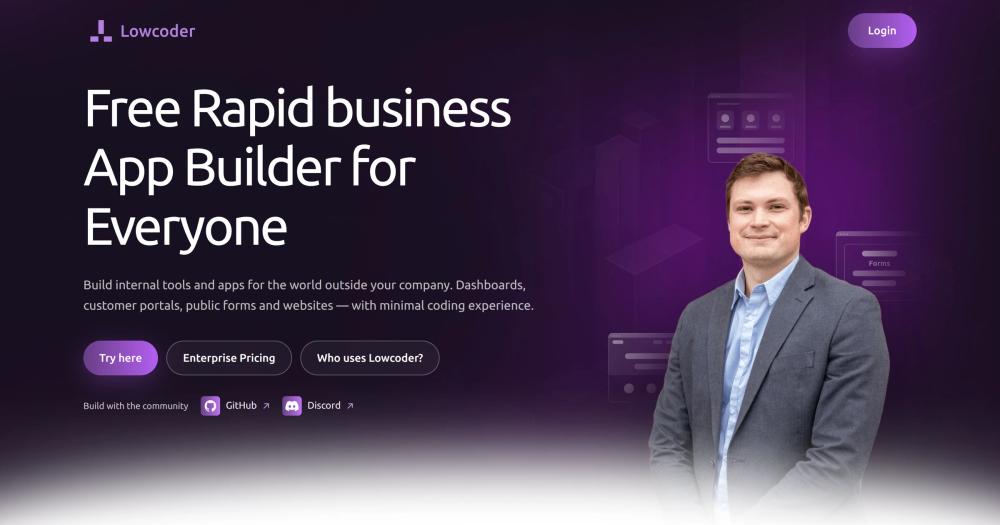
image of Lowcoder
TL;DR

Lowcoder is an AGPL-3.0 open source low-code tool for building internal tools and customer-facing applications, backed by a visual builder with 120+ components and 60+ data source connectors. It replaces paid commercial services like Retool and Superblocks, with no per-user licensing in the enterprise tier and full self-hosting on Docker or Kubernetes. Best for engineering teams, IT managers, and software agencies that need to avoid per-seat pricing as their user base grows.

Read the full breakdownHide the full breakdownWho it is for, how it works, trade-offs and the FAQ
who it's for

Who Lowcoder is for#

Engineering teams building internal admin panels

Connect existing PostgreSQL, MySQL, or MongoDB databases, place table and form components, configure filters and action buttons, and ship a working admin panel in hours. Changes take effect without a deploy step or build cycle, so iterating on feedback is fast.

Skip if:

If your admin requirements are met by an existing BI tool or a simple CRUD interface, Lowcoder's setup overhead may outweigh its value for a one-off panel.

IT managers replacing per-seat SaaS with self-hosted apps

Build dashboards, CRM views, inventory tools, and ticketing interfaces on your own infrastructure. The per-instance enterprise pricing means adding more users does not increase the license bill, making Lowcoder cheaper than per-seat tools as team size grows.

Skip if:

If your organization resists managing container infrastructure, the operational overhead of running Lowcoder may outweigh the savings over per-seat commercial tools.

Software agencies building customer portals

Design customer-facing forms, onboarding workflows, and self-service portals. The native embedding SDK lets you drop a Lowcoder app into a client's existing website without an iFrame, so the portal keeps the host site's styling and URL structure.

Skip if:

If a client needs a fully bespoke UI with no shared component framework, hand-coded React will give tighter control than any visual builder.

University and campus IT teams

Build student administration tools, enrollment forms, and cross-department workflows on a single visual builder. Southern Methodist University uses Lowcoder in production for campus-wide administrative and public-facing apps under a tool they call Webframe.

Skip if:

If your institution has procurement rules around AGPL-licensed software or requires vendor support SLAs, review Lowcoder's enterprise contract options before adopting at scale.

the problem

The problem it solves#

Building internal tools is expensive when done from scratch and costly when rented from commercial services. Retool, Superblocks, and similar tools charge per seat, so a tool used by 50 internal staff quickly runs into thousands of dollars per month. For teams with data privacy requirements, the cloud-only constraint of most commercial services is a separate blocker: sensitive operational data cannot leave the organization's infrastructure.

The technical effort to build even a basic admin dashboard without a low-code tool is high. Frontend developers must wire up databases, design component layouts, handle state, and manage updates manually. Most internal tools don't justify that investment, so teams either build shortcuts that break, or pay commercial licensing they outgrow.

how Lowcoder solves it

How it solves it#

120+ Built-in UI Components

The component library includes form inputs, tables, charts, kanban boards, and specialized widgets for rapid app development. Components are configured visually without writing layout code, and custom components can be built as plugins and published to npm under the lowcoder-comp namespace for community sharing.

60+ Data Source Connectors

Connects to PostgreSQL, MySQL, MongoDB, Redis, Elasticsearch, REST APIs, SMTP, and more. Connections are configured in the visual builder and query results bind directly to component properties. WebSocket data sources enable real-time streaming updates so apps reflect live data without manual refreshes.

Native Website Embedding Without iFrame

Lowcoder apps embed directly into external HTML pages and React apps using the native SDK, without an iFrame wrapper. The embedded app can share CSS context with the host page and communicate through defined JavaScript interfaces. Most low-code tools use iFrame embedding, which creates hard style and communication boundaries.

Video Meeting and Collaboration Components

WebRTC-based video meeting components let teams build conferencing tools inside a Lowcoder app. Meeting sessions sit alongside other app panels, so users can discuss a case, update its records, and take action without switching to a separate tool.

Role-Based Access Control

RBAC governs who can view, edit, or administer apps and data sources within a workspace. Permissions are managed per workspace through member groups, so teams can scope access to the right people without sharing credentials or exposing configuration.

Reusable Modules and Query Library

Component groups that repeat across apps are saved as modules and re-embedded without copying configuration. The query library stores reusable data queries the same way, reducing duplication when multiple apps connect to the same databases or APIs.

strengths · trade-offs

Strengths and trade-offs#

Strengths

  • Per-Instance Enterprise PricingLowcoder's enterprise edition is priced per server instance at €459/month or €4,990/year, not per user. A team of 50 internal users pays the same as a team of five. Retool and Superblocks both use per-user billing, where the cost scales with every person who needs access to the tool.
  • Full AGPL-3.0 Source AccessThe entire codebase, including the enterprise edition, is published under AGPL-3.0 on GitHub (1,627 stars, 317 forks). Teams can audit the code, modify it, and run it on their own infrastructure. Internal commercial and team use is permitted without restriction under AGPL-3.0.
  • Active and Maintained RepositoryThe repository received its last push on 2026-11-04. The project continues from the abandoned Openblocks codebase and has maintained regular development. The Discord community and GitHub Issues are the primary support channels.
  • Flexible Layered Layout SystemUnlike tools that use a fixed column grid, Lowcoder supports layer-based layouts closer to design software. This allows precise positioning and styling to match company brand guidelines. Global themes apply changes across all apps at once.

Trade-offs

  • -AGPL-3.0 Restricts Reselling as a Hosted ServiceAGPL-3.0 permits internal use with no restriction: teams can run Lowcoder on their own servers, modify it, and use it commercially for their own organization. The restriction applies when you offer Lowcoder as a managed hosted service to external customers: that triggers the requirement to publish source changes. Agencies planning to resell a Lowcoder-based product need to review this with counsel or use the enterprise contract.
  • -206 Open Issues on GitHubAs of 2026-11-05, the repository carries 206 open issues. Lowcoder covers many features across a wide surface area (video meetings, native embedding, mobile publishing, streaming data), so teams should review the open issue list before committing to production use in their specific area.
  • -Self-Hosting Requires Container InfrastructureThe documented deployment path is Docker Compose or Helm Charts. Teams without container infrastructure experience need to set that up before running Lowcoder in production. The free community cloud at app.lowcoder.cloud avoids this overhead but moves data to a third-party host.
versus alternatives

Lowcoder vs alternatives#

Lowcoder vs Retool

Both target internal tool development and share a drag-and-drop builder, but differ sharply on hosting model and pricing. Retool is a proprietary service with self-hosting available on paid tiers only; Lowcoder is AGPL-3.0 open source with self-hosting as the primary deployment path and no per-user licensing.

FeatureLowcoderRetool
LicenseAGPL-3.0Proprietary
Self-hostingYes (Docker, Helm)Yes (paid tiers)
Pricing modelPer instancePer user
Native site embeddingYes (no iFrame)No
Video meeting componentsYesNo

Lowcoder is the better choice when your team has a large internal user base, when data privacy rules prevent sending queries through a third-party cloud, or when you need to embed an app natively in a customer-facing site. Retool is worth considering when you need its broader integration ecosystem and a managed cloud with uptime guarantees that Lowcoder does not yet match.

Lowcoder vs Superblocks

Superblocks is a newer commercial tool for internal apps and automations, cloud-first with self-hosting on paid plans. Lowcoder differs in its AGPL-3.0 license, per-instance pricing, and broader scope that includes customer-facing apps and native website embedding.

FeatureLowcoderSuperblocks
LicenseAGPL-3.0Proprietary
Self-hostingYes (free)Paid plans
Component count120+Fewer
Native embeddingYes (no iFrame)No

Lowcoder is the better fit when you need self-hosting and cannot absorb per-user licensing. Superblocks is worth considering when automation workflow tooling is a core need and your team prefers a fully managed service with dedicated support.

Lowcoder vs UI Bakery

UI Bakery is a no-code/low-code internal app builder with a hosted cloud and an on-premise paid option, but it is a proprietary commercial service, not open source.

FeatureLowcoderUI Bakery
LicenseAGPL-3.0Proprietary
Self-hostingYes (free)Yes (paid)
Component count120+Comparable
Public appsYesLimited

Lowcoder is the better fit when source access and free self-hosting are requirements, or when you need to build customer-facing apps alongside internal tools. UI Bakery is worth considering for teams that want a polished managed cloud with vendor support contracts.


tech stack · detected from GitHub

What it's built on#

Languages
JavaJavaScriptTypeScript
Tooling
Rollup
frequently asked

FAQ#

Is Lowcoder free to use?

The community edition is free and runs on your own infrastructure with no seat limits. A free community cloud is also available at app.lowcoder.cloud. The enterprise edition starts at €459 per instance per month or €4,990 per year, priced per instance rather than per user. AI and support services are billed separately.

What license does Lowcoder use?

Lowcoder is AGPL-3.0 licensed. You can run it on your own servers, modify it, and use it commercially for internal teams without restriction. If you modify the source and offer it as a hosted managed service to external customers, AGPL-3.0 requires publishing those changes. The enterprise edition is also AGPL-3.0, not a separate proprietary tier.

How does Lowcoder compare to Retool?

Lowcoder is AGPL-3.0 open source with per-instance enterprise pricing; Retool is a proprietary service with per-user billing. Lowcoder supports native website embedding without an iFrame and includes video meeting components that Retool does not offer. Retool has a more mature integration ecosystem and a managed cloud with uptime guarantees that Lowcoder does not yet match.

Can Lowcoder apps be embedded in external websites?

Yes. Lowcoder has a React-based native embedding SDK that lets you embed an app directly in any HTML page without an iFrame. The embedded app can communicate with the host page through defined JavaScript interfaces. This differs from most low-code tools, which rely on iFrame embedding and face hard CSS and communication boundaries.

How do I self-host Lowcoder?

Lowcoder supports Docker Compose for single-server deployments and Helm Charts for Kubernetes environments. The official documentation at docs.lowcoder.cloud describes a five-minute Docker install path. A free community cloud is also available for teams that prefer not to manage their own infrastructure.

also worth a look

Similar open-source tools#

ToolJet

Alternative toRetool

Build internal tools with a drag-and-drop UI and 50+ connectors

  • 41,178 GitHub stars
  • AGPL-3.0Licence AGPL-3.0

Cloudflare Os

Alternative toDust

Open source AI workspace with sandboxed apps and Gatekeeper security

  • 11,663 GitHub stars
  • Apache-2.0Licence Apache-2.0

NocoDB

Alternative toAirtable

Turn any database into a no-code spreadsheet. Self-hostable.

  • 65,400 GitHub stars

Windmill

Alternative toRetool

Developer platform for scripts, automations, and internal tools

  • 18,370 GitHub stars
  • AGPL-3.0Licence AGPL-3.0

Totum

Alternative toRetool

Self-hosted low-code platform for internal business tools

  • 981 GitHub stars
  • MITLicence MIT

Appsmith

Alternative toRetool

Build internal tools with a low-code drag-and-drop UI

  • 41,157 GitHub stars
  • Apache-2.0Licence Apache-2.0
by category

Open source tools in these categories#

40

No-Code & Low-Code

n8n, dify, Langflow
43

Web & App Development

Flutter, Rust, Nvm
555

Developer Tools

REA (Reverse Engineer Anything), Skills for Real Engineers, superpowers
268

Business & Productivity

OpenClaw, Excalidraw, RustDesk
Hostinger

Self-host Lowcoder on a Hostinger VPS

Keep it running 24/7, even when your laptop is off. A Hostinger VPS gives it a server of its own.

  1. 01

    Choose a plan

    Starts from $6.49/mo

  2. 02

    Apply

    Extra 10% off yearly plans

  3. 03

    Install Lowcoder

    On a server that stays on

  4. 04

    Start building

    Focus on the app, not the server

Deploy on Hostinger

Sponsors

Inbox Zero

Alternative toSuperhuman

AI email assistant that drafts replies and clears your inbox

  • 12,889 GitHub stars
  • AGPL-3.0Licence AGPL-3.0
  • #Email

rakazo

Alternative toGrok Bot

AI teammates you own: your keys, your model, your machine.

  • 7,028 GitHub stars
  • Apache-2.0Licence Apache-2.0
  • #AI Agents

SnitchFeed

Live monitoring on LinkedIn, X, Reddit & more. Agentic social listening for startups.

Marketing & Growth

Advertise your product

New open source projects by email

The projects we add and every new guide. Free, unsubscribe any time.

Find open source alternatives to paid software

/
  • Claude Code to OpenCode
  • Jira to Windshift
  • Notion to AppFlowy
  • Slack to Mattermost
  • Linear to GitLab
  • Wispr Flow to Handy
  • Arc to Zen Browser
  • CapCut to Concat
  • Grok Bot to rakazo
  • Superhuman to Inbox Zero
  • Airtable to AITable
  • Muse to OpenClaw
  • Railway to Coolify
  • GitHub Copilot to Cline
  • Datadog to Netdata
  • Confluence to Wiki.js
  • Microsoft Teams to Rocket.Chat
  • Firebase to Supabase
  • Pinecone to Qdrant
  • Zapier to n8n
  • 1Password to KeePassXC
  • Devin AI to OpenHands
  • Asana to Leantime
  • Contentful to Strapi