

Who Mengram is for#
Agent builders adding durable user memory
Mengram fits teams that need agents to remember preferences, prior events, and procedures across sessions.
Skip if:
Your agent only needs short-lived context inside a single chat session.
RAG teams moving beyond document recall
Mengram can help teams model experience and procedures rather than only retrieving chunks from a knowledge base.
Skip if:
You only need keyword search or a simple vector database.
The problem it solves#
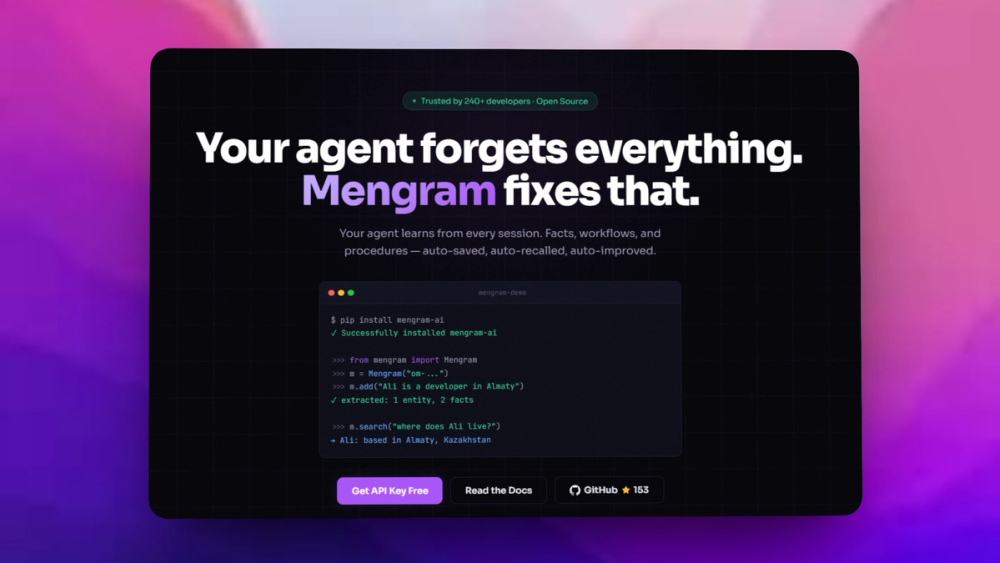
Agents forget too much between runs. Teams repeatedly re-explain user preferences, project rules, failures, and procedures because ordinary prompts and basic vector search do not capture experience well.
Useful agent memory needs more than saved snippets. It should represent facts, episodes, and procedures in a way that can improve future actions without turning every session into manual note-taking.
How it solves it#
Semantic, episodic, and procedural memory
Mengram explicitly targets several memory types, giving agent builders more structure than a single vector store.
Agent framework integrations
Repository metadata mentions Python and JavaScript SDKs plus LangChain, CrewAI, OpenClaw, and MCP integrations.
Failure-driven procedure learning
The project description calls out procedures that learn from failures, which fits agents that need to improve workflow execution over time.
Strengths and trade-offs#
Strengths
- Deeper than basic RAG memoryMengram's memory model is more specific than storing documents for retrieval, making it relevant for agents that need user, episode, and process memory.
- Broad agent ecosystem fitThe SDK and framework topics make Mengram easier to evaluate across common agent stacks instead of tying it to one runtime.
Trade-offs
- -Memory quality needs governanceAgent memory can preserve wrong assumptions or sensitive context if teams do not design retention, deletion, and validation rules carefully.
What it's built on#
- Languages
- JavaScriptPythonTypeScript
- Databases
- pgvector
- Tooling
- esbuild
FAQ#
What kinds of memory does Mengram support?
The repository description names semantic, episodic, and procedural memory for AI agents.
Does Mengram integrate with agent frameworks?
Yes. Repository metadata mentions Python and JavaScript SDKs plus LangChain, CrewAI, OpenClaw, and MCP integrations.
Is Mengram open source?
Yes. The GitHub repository reports Apache-2.0 licensing.
Similar open-source tools#

claude-mem
Stop re-explaining your codebase to every new agent session

turbovec
Rust vector index with TurboQuant compression, no managed service

Supermemory
Add persistent user memory to any LLM app via API, Apache 2.0

Qdrant
Self-hosted vector database for AI similarity search and RAG

Weaviate
AI-native vector database for semantic search and AI apps

cognee
Persistent memory for AI agents across sessions