Open Source Alternatives
  • Alternatives
  • Categories
    Categories by size991 projects
    • Developer Tools507
    • AI & Machine Learning435
    • Business & Productivity226
    • Web Development202
    • Security & Monitoring149
    • Communication & Collaboration135
    • IT Management134
    • Cloud & Hosting118
    • LLMOps & AI Tooling111
    • Product & Project Management109
    Browse all 21 categoriesData & Analytics, Design & Creative and 9 more
  • Blog
  • Advertise
SearchNotion, Slack, password manager.../
Submit
Open Source Alternatives
  • Alternatives
    • Developer Tools507
    • AI & Machine Learning435
    • Business & Productivity226
    • Web Development202
    • Security & Monitoring149
    • Communication & Collaboration135
    • Browse all 21 categories
  • Blog
  • Advertise
Submit your project

New open source projects by email

The projects we add and every new guide. Free, unsubscribe any time.

Open Source Alternatives LogoOpen Source Alternatives

Handpicked Open Source Alternatives to Paid Softwares

Product

  • Categories
  • Tag
  • Advertise

Resources

  • Blog
  • Collection
  • Submit

Company

  • Privacy Policy
  • Terms of Service
  • Refund Policy
  • Sitemap

Alternatives

  • Claude Code
  • Jira
  • Notion
  • Slack
  • Linear
  • Wispr Flow
  • All alternatives
© 2026 Open Source Alternatives. All rights reserved.
Open SourceAlternatives
Home/Categories/Backend Development/Srs
icon of Srs

Srs

Open source alternative to Ant Media Server, Wowza Streaming Engine and Nimble Streamer

  • 29.4K stars
  • MIT
  • Active this week
  • Last commit today

Last verified Oct 31, 2026

Run a self-hosted real-time media server with RTMP, WebRTC, HLS, SRT, and MPEG-DASH support, built on a coroutine architecture. MIT licensed.

Visit websiteGitHub29.4K starsDeploy on Hostinger
image of Srs
TL;DR

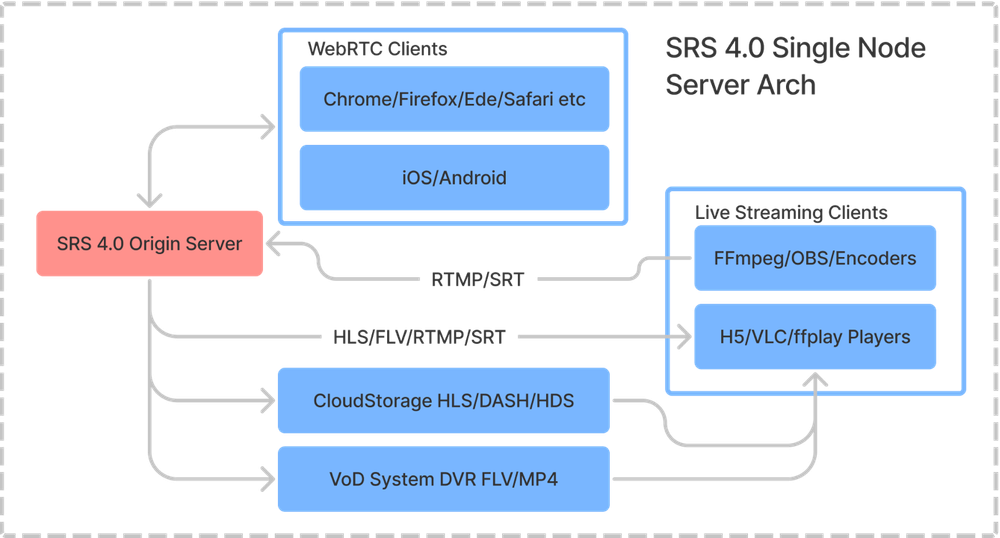
Srs (Simple Realtime Server) is an open source C++ media server that handles RTMP, WebRTC, HLS, HTTP-FLV, SRT, MPEG-DASH, and GB28181 in a single deployable binary. It replaces commercial streaming engines like Wowza Streaming Engine and Ant Media Server with MIT-licensed, self-hosted infrastructure that has no per-stream fees. Built on coroutine technology and Docker-native, SRS runs on any Linux or macOS server and deploys on Kubernetes without vendor integration. Best for engineering teams building live streaming platforms, CDN origin servers, WebRTC relay systems, and on-premises video infrastructure.

Read the full breakdownHide the full breakdownWho it is for, how it works, trade-offs, the quick start and the FAQ
who it's for

Who Srs is for#

Platform engineers building live streaming infrastructure

SRS handles RTMP ingest from encoders like OBS and FFmpeg, packages to HLS and HTTP-FLV for delivery, and re-streams to WebRTC for browser playback in a single process. Teams building platforms for user-generated live content avoid assembling and maintaining multiple media processing services.

Skip if:

Your streaming volumes are low enough that a managed cloud CDN or a hosted streaming API is cheaper than the engineering cost of self-hosting a media server.

Engineering teams replacing Wowza or Ant Media Server

SRS covers the same protocol matrix as Wowza Streaming Engine and Ant Media Server: RTMP, WebRTC, HLS, SRT, and MPEG-DASH. Teams migrating off a paid streaming platform can replace the media server layer with SRS while keeping their existing ingest and delivery architecture.

Skip if:

Your existing deployment relies on vendor-specific transcoding pipelines, hosted cloud infrastructure, or a graphical management console that SRS does not provide.

Surveillance and security system integrators

SRS supports GB28181, the Chinese national standard for IP surveillance cameras. Integrators building systems with cameras that speak GB28181 can use SRS as the platform server without a separate video management system for the protocol translation layer.

Skip if:

You need full video management system features like motion detection, long-term storage management, and NVR interfaces. SRS handles the streaming layer only.

WebRTC developers building conferencing or broadcast tools

SRS natively bridges RTMP and WebRTC, converting OBS or FFmpeg streams to WebRTC for real-time browser playback, or relaying WebRTC streams as RTMP for recording and distribution. Built-in WHIP and WHEP support covers modern WebRTC ingest and playback standards.

Skip if:

You need a full conferencing platform with scheduling, recording management, and participant controls. SRS is the media transport layer only; application logic lives above it.

the problem

The problem it solves#

Running a live streaming or WebRTC service means picking a media server. The commercial options charge per concurrent stream or per server, and both Wowza Streaming Engine and Ant Media Server require paid licenses before you can test at any meaningful scale. Even modest deployments cost thousands of dollars a year, and the license terms typically prohibit running a modified version as a managed service.

Building from scratch means assembling separate services for RTMP ingest, HLS packaging, WebRTC signaling, and SRT relay. Most event-loop-based open source servers are hard to extend because adding a new protocol means threading async callbacks through layers of existing code. Teams end up with fragile pipelines that break under load or fail silently when a codec mismatch occurs.

how Srs solves it

How it solves it#

Multi-Protocol Ingest and Delivery

SRS accepts RTMP, WebRTC (WHIP/WHEP), HLS, HTTP-FLV, HTTP-TS, SRT, MPEG-DASH, and GB28181 in the same process. No separate services or adapters are needed to bridge protocols: a single SRS instance can accept an RTMP stream from OBS and relay it as HLS, WebRTC, and SRT simultaneously.

Coroutine-Based Architecture

Built on the State Threads library, SRS uses coroutines instead of async callbacks. Each connection runs in its own coroutine context, making the server easier to extend than event-loop alternatives and more predictable under load spikes.

Multi-Codec Support

H.264, H.265 (HEVC), AV1, VP9, AAC, Opus, and G.711 are supported natively. This covers the codec matrix for modern WebRTC deployments, low-bandwidth surveillance streams, and broadcast contribution workflows in a single server binary.

Built-In Prometheus Telemetry

SRS exports metrics in Prometheus format without a sidecar process. CPU usage, client counts, stream bitrates, and protocol breakdowns are available to standard observability stacks without custom integration work.

Multi-Architecture Docker Images

Official Docker images cover x86_64, ARMv7, AArch64, Apple M1, RISC-V, LoongArch, MIPS, and Windows x64. The same image tag runs on a Raspberry Pi, an Apple Silicon Mac, and a cloud VM without separate build steps.

Kubernetes and Cloud-Native Deployment

SRS supports horizontal scaling via origin-edge clustering and integrates with standard container orchestration tooling. The project documents Kubernetes deployment with cloud-native telemetry, making it usable within existing infrastructure pipelines.

strengths · trade-offs

Strengths and trade-offs#

Strengths

  • MIT License with No Commercial RestrictionsSRS is MIT licensed, which means you can run it commercially, modify it, embed it in a product, or include it in a managed service without royalty payments. Wowza Streaming Engine and Ant Media Server both require paid licenses for commercial use at scale; SRS imposes none of those restrictions.
  • Single-Process Multi-Protocol CoverageA single SRS process handles RTMP, WebRTC, HLS, SRT, and MPEG-DASH without an adapter layer. No separate services are needed to bridge ingest and delivery protocols, which reduces operational complexity compared to assembling multiple specialized servers.
  • Actively Maintained with Rapid Release CadenceThe project released v8.0-d3 on October 30, 2026, and maintains three parallel release tracks: a stable series (v6), an alpha series (v7), and a dev series (v8). Only 7 open issues on a codebase with over 29,000 GitHub stars indicates strong maintenance hygiene.
  • Wide Architecture Support Without Custom BuildsOfficial Docker images cover x86_64, ARMv7, AArch64, Apple M1, RISC-V, LoongArch, MIPS, and Windows x64 from the same registry. Scaling from a Raspberry Pi edge node to a cloud cluster uses the same image and identical deployment steps.

Trade-offs

  • -C++ Codebase Requires Expertise to ModifySRS is written in C++, which limits the pool of contributors and teams who can debug it themselves. Building custom protocol extensions or patching unusual behavior requires C++ proficiency. Teams without that background depend on the upstream project for bug fixes in edge-case scenarios.
  • -No Vendor Support or SLAThere is no paid support tier for SRS. Debugging production issues means reading the documentation, searching GitHub Issues, or posting in the community Discord and Telegram groups. Teams running SRS in regulated or revenue-critical environments should factor in the absence of a vendor SLA.
  • -Self-Managed Infrastructure OverheadRunning SRS in production means managing server provisioning, network configuration, TLS termination, and capacity planning yourself. Wowza Streaming Engine and Ant Media Server include hosted deployment options; SRS does not offer a managed cloud path.
versus alternatives

Srs vs alternatives#

SRS vs Wowza Streaming Engine

Both servers handle RTMP, WebRTC, HLS, and SRT, but their licensing and deployment models differ fundamentally. Wowza Streaming Engine is a proprietary product sold on an annual per-server subscription; SRS is MIT-licensed C++ you deploy and own.

FeatureSRSWowza Streaming Engine
LicenseMITProprietary
Self-hostingYesYes
Hosted cloud optionNoYes
WebRTC (WHIP/WHEP)YesYes
SRTYesYes
MPEG-DASHYesYes
GB28181YesNo
Management consoleNo (HTTP API)Yes

SRS is the better choice when you need self-hosted infrastructure without annual licensing costs, GB28181 for IP surveillance cameras, or the ability to build on and redistribute the server source. Wowza Streaming Engine is worth considering when your team requires a graphical management console, a hosted cloud streaming service, and enterprise support with contractual SLAs.

SRS vs Ant Media Server

Ant Media Server offers an open source community edition alongside a paid enterprise edition. SRS has a single MIT-licensed release with no feature gates between tiers.

FeatureSRSAnt Media Server
LicenseMITCommunity open source / Enterprise proprietary
Self-hostingYesYes
WebRTCYes (WHIP/WHEP)Yes
SRTYesYes
GB28181YesNo
ArchitectureC++ coroutineJava

SRS is the better choice when you need a fully MIT-licensed server with no paid enterprise tier, GB28181 surveillance camera support, or a lower-memory C++ binary for edge deployments. Ant Media Server is worth considering when your team prefers vendor-backed enterprise support and does not require GB28181.

SRS vs Nimble Streamer

Nimble Streamer is a proprietary streaming server with a freeware base option. SRS covers the same core protocol set under a single MIT license with no module purchases.

FeatureSRSNimble Streamer
LicenseMITProprietary
RTMPYesYes
WebRTCYes (WHIP/WHEP)Yes
SRTYesYes
HLSYesYes
MPEG-DASHYesYes
GB28181YesNo
Management UINo (HTTP API)Yes

SRS is the better choice when you want full protocol coverage under a single MIT license with no per-module costs and need GB28181 support. Nimble Streamer is worth considering when you need a proprietary management interface and commercial support options, and do not require GB28181 or the ability to modify and redistribute server source.

install · quick start

Quick start#

bash
Self-hosting SRS uses a single Docker command with ports for RTMP, HTTP API, HTTP server, and WebRTC UDP.

```bash
docker run --rm -it -p 1935:1935 -p 1985:1985 -p 8080:8080 \
    -p 8000:8000/udp -p 10080:10080/udp ossrs/srs:6
```
tech stack · detected from GitHub

What it's built on#

Languages
C++GoJavaScriptPython
frequently asked

FAQ#

Is SRS free for commercial use?

Yes. SRS is MIT licensed, which permits commercial use, modification, and distribution without royalty payments. You can run SRS as part of a revenue-generating service, embed it in a product, or include it in a managed service. The MIT license places no restrictions on commercial use.

How do I start SRS with Docker?

Run the official Docker image with the required ports exposed: docker run --rm -it -p 1935:1935 -p 1985:1985 -p 8080:8080 -p 8000:8000/udp -p 10080:10080/udp ossrs/srs:6. Port 1935 is RTMP, 1985 is the HTTP API, 8080 is the HTTP server and player, and 8000/10080 UDP handle WebRTC transport. Once running, open http://localhost:8080 to verify and push an RTMP stream from OBS or FFmpeg.

Does SRS support WebRTC?

Yes. SRS supports WebRTC natively, including WHIP for ingest and WHEP for playback. It bridges RTMP and WebRTC bidirectionally: an OBS stream comes in as RTMP and plays back in a browser over WebRTC, or a browser WebRTC stream goes out as RTMP for recording. UDP ports 8000 and 10080 handle the WebRTC media transport.

What is the difference between SRS and Oryx?

SRS is the core C++ media server. Oryx (also from the ossrs project) is an all-in-one video service layer built on top of SRS: it adds a web UI, preset configurations for live streaming and WebRTC, and a simplified setup experience for teams who do not want to configure SRS directly. SRS is for teams building custom infrastructure; Oryx is for teams who want an out-of-the-box streaming service.

What architectures and operating systems does SRS support?

SRS runs on Linux and macOS across x86_64, ARMv7, AArch64, Apple M1, RISC-V, LoongArch, and MIPS architectures, and natively on Windows x64. Official Docker images are published for the same architecture matrix. This means the same image and deployment steps work on a Raspberry Pi edge node, an Apple Silicon Mac, and a cloud VM.

also worth a look

Similar open-source tools#

FckSignups

InCustomer Support

Open-source tools that work instantly, no signup required

  • 4,531 GitHub stars
  • GPL-3.0Licence GPL-3.0

All In One

Alternative toDropbox

Full Nextcloud stack managed by one Docker container with auto-TLS.

  • 10,764 GitHub stars
  • AGPL-3.0Licence AGPL-3.0

Frankenphp

Alternative toLiteSpeed Web Server

PHP app server with automatic HTTPS, HTTP/3, and worker mode.

  • 11,501 GitHub stars
  • MITLicence MIT

Shenyu

Alternative toKong Konnect

Java-native API gateway for HTTP, gRPC, Dubbo, and WebSocket services

  • 8,908 GitHub stars
  • Apache-2.0Licence Apache-2.0

Unkey

Alternative toKong Konnect

Unified API keys, gateways, and observability for developers.

  • 5,480 GitHub stars
  • FSL-1.1-ALv2Licence FSL-1.1-ALv2

Vela

Alternative toGoogle Maps

OpenStreetMap and Google data, no account, no Play Services

  • 2,249 GitHub stars
  • GPL-3.0Licence GPL-3.0
by category

Open source tools in these categories#

73

Backend Development

dify, graphify, Rust
135

Communication & Collaboration

freeCodeCamp, iptv, Excalidraw
118

Cloud & Hosting

RuView, dify, rtk
Hostinger

Self-host Srs on a Hostinger VPS

Keep it running 24/7, even when your laptop is off. A Hostinger VPS gives it a server of its own.

  1. 01

    Choose a plan

    Starts from $6.49/mo

  2. 02

    Apply

    Extra 10% off yearly plans

  3. 03

    Install Srs

    On a server that stays on

  4. 04

    Start building

    Focus on the app, not the server

Deploy on Hostinger

Sponsors

Inbox Zero

Alternative toSuperhuman

AI email assistant that drafts replies and clears your inbox

  • 12,855 GitHub stars
  • AGPL-3.0Licence AGPL-3.0
  • #Email

Omnara

Alternative toCClaude Managed Agents

Open-source agent deployment API. Self-host or use Omnara Cloud.

  • 3,325 GitHub stars
  • Apache-2.0Licence Apache-2.0
  • #AI Agents

rakazo

Alternative toGrok Bot

AI teammates you own: your keys, your model, your machine.

  • 6,242 GitHub stars
  • Apache-2.0Licence Apache-2.0
  • #AI Agents
Advertise your product

New open source projects by email

The projects we add and every new guide. Free, unsubscribe any time.

Find open source alternatives to paid software

/
  • Claude Code to OpenCode
  • Jira to Windshift
  • Notion to AppFlowy
  • Slack to Mattermost
  • Linear to GitLab
  • Wispr Flow to Handy
  • Arc to Zen Browser
  • CapCut to Concat
  • Grok Bot to rakazo
  • Superhuman to Inbox Zero
  • Airtable to AITable
  • Muse to OpenClaw
  • Railway to Coolify
  • GitHub Copilot to Cline
  • Datadog to Netdata
  • Microsoft Teams to Rocket.Chat
  • Confluence to Docmost
  • Pinecone to Qdrant
  • Zapier to n8n
  • Devin AI to OpenHands
  • Firebase to Supabase
  • 1Password to KeePassXC
  • Contentful to Strapi
  • Adobe Premiere Pro to Shotcut