

Who TradingAgents is for#
Quant researchers testing agent debates
A quant researcher can run the same ticker and date through bullish, bearish, technical, sentiment, and risk agents to compare how each role affects the final recommendation.
Skip if:
You need audited live-trading infrastructure with compliance approvals, broker routing, and production risk controls already included.
Fintech product teams prototyping research copilots
A fintech team can use TradingAgents as a reference architecture for an explainable research assistant, then adapt prompts, model providers, and portfolio constraints to its own product.
Skip if:
Your team cannot maintain Python services, API keys, model configuration, and data-vendor integrations.
Academic labs studying financial AI agents
Finance and AI researchers can inspect a real multi-agent trading workflow, cite the paper, and run controlled experiments around model choice, debate rounds, and ticker history.
Skip if:
Your study requires certified investment recommendations or licensed proprietary market data bundled with the tool.
Individual algo traders running paper tests
A technical trader can run local experiments through the CLI, review generated analyst reports, and use the decision log to compare later outcomes against prior recommendations.
Skip if:
You want a no-code retail trading app that connects directly to a brokerage account.
The problem it solves#
Quant teams and fintech builders often need to test market hypotheses across fundamentals, news, sentiment, technical signals, and portfolio risk, but paid market intelligence products package that work inside proprietary content, search, analytics, and workflow environments. That makes it hard to customize the research process itself, audit each agent role, or compare how different LLMs handle the same ticker.
TradingAgents addresses the research workflow gap for teams that can bring their own data, model keys, and engineering discipline. It is not a financial advice tool or a ready-made broker app; it is a framework for building, inspecting, and stress-testing multi-agent trading decisions before any production use.
How it solves it#
Multi-agent trading graph
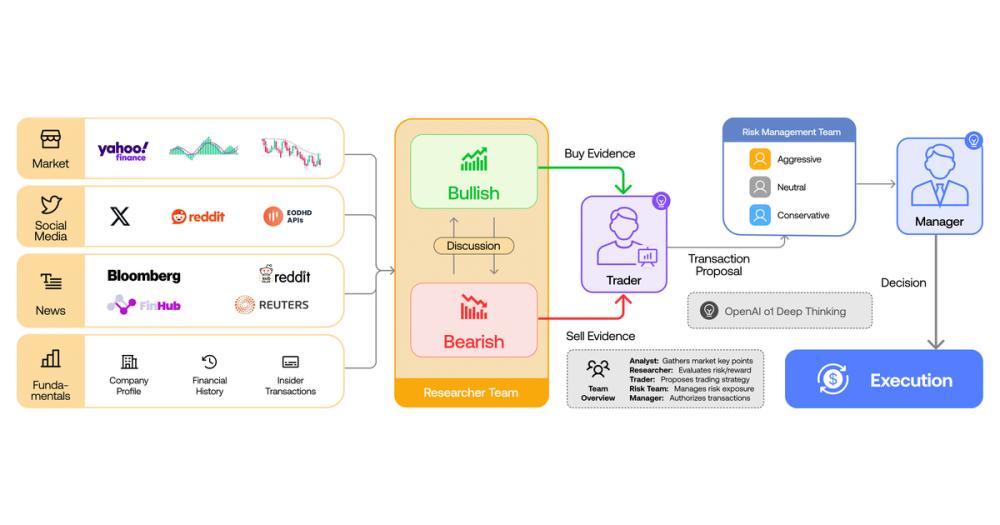
TradingAgents models a trading firm as a LangGraph workflow with analyst, researcher, trader, risk management, and portfolio manager roles. Each role contributes a separate report or decision step, so teams can inspect how a ticker analysis moves from evidence to final recommendation.
Specialized analyst team
The framework includes fundamentals, sentiment, news, and technical analyst agents. The sentiment analyst aggregates news headlines, StockTwits, and Reddit chatter, while the technical analyst uses indicators such as MACD and RSI to frame price action.
Bull and bear research debate
Researcher agents argue bullish and bearish cases before a trader forms the transaction proposal. This debate structure helps expose competing assumptions instead of collapsing the workflow into a single prompt response.
Portfolio and risk review
Risk management agents review volatility, liquidity, and other risk factors before a portfolio manager approves or rejects the proposed transaction. Approved proposals route to a simulated exchange, which keeps experiments separate from live brokerage execution.
Multi-provider model support
TradingAgents supports OpenAI, Google, Anthropic, xAI, DeepSeek, Qwen, GLM, MiniMax, OpenRouter, Ollama, and Azure OpenAI. Teams can run cloud models, enterprise providers, or local Ollama models while keeping the same agent workflow.
Strengths and trade-offs#
Strengths
- Apache-2.0 code you can inspectTradingAgents is Apache-2.0 licensed, so teams can fork, modify, and run the framework without a proprietary terminal contract. That matters when the research process itself needs auditability, custom prompts, or internal review.
- Inspectable orchestration layerLSEG Workspace and AlphaSense focus on packaged data, search, analytics, and enterprise workflows. TradingAgents exposes the agent roles, debate flow, decision log, and configuration, which helps researchers inspect the orchestration layer behind a recommendation.
- Flexible model and deployment choicesThe same workflow can run against major hosted LLM providers, enterprise Azure OpenAI setups, OpenRouter, or local Ollama models. That flexibility helps teams compare model behavior without rebuilding the trading graph.
- Built for research iterationThe CLI lets users choose tickers, dates, LLM providers, and research depth, then watch results stream as agents run. Checkpoint resume and a persistent decision log support repeatable experiments across interrupted or repeated ticker analyses.
Trade-offs
- -Research framework, not trading adviceThe project explicitly says TradingAgents is designed for research purposes and is not financial, investment, or trading advice. Performance can vary with model choice, temperature, trading period, data quality, and other non-deterministic factors.
- -Requires external data and model keysUseful runs require API keys for at least one LLM provider and, for many setups, market data such as Alpha Vantage. Self-hosting the code does not remove usage costs from model calls, data vendors, or infrastructure.
- -Not a full market data terminalTradingAgents does not replace the licensed content libraries, managed search, analyst-ready interfaces, or vendor support that paid market intelligence products provide. It is strongest when you already have data sources and want an open agent layer.
- -Setup expects developer ownershipThe documented install path uses Git, Python packaging, environment variables, and optional Docker or Ollama configuration. Non-technical traders looking for a polished hosted app will need engineering help or a different product.
TradingAgents vs alternatives#
TradingAgents vs LSEG Workspace and AlphaSense
LSEG Workspace and AlphaSense are paid research products built around licensed content, search, and analytics. TradingAgents is an Apache-2.0 Python framework for inspecting a multi-agent trading research process.
| Criterion | TradingAgents | LSEG Workspace / AlphaSense |
|---|---|---|
| License | Apache-2.0 | Proprietary |
| Self-hosting | Runs from source or Docker | Managed commercial products |
| Primary value | Customizable agent workflow | Licensed content, search, analytics, and enterprise workflows |
| Model control | Choose hosted, enterprise, OpenRouter, or Ollama models | Vendor-controlled AI features |
| Support | Community and self-managed engineering | Commercial support |
TradingAgents is the better fit when your team wants to customize the research logic itself. You can inspect analyst roles, tune debate rounds, swap model providers, run local Ollama models, and keep a decision log across ticker analyses.
LSEG Workspace or AlphaSense remains the better choice when the job depends on licensed content, managed search, vendor support, or an analyst-ready interface. TradingAgents should sit beside those data sources or replace a custom agent prototype, not pretend to be a full proprietary market intelligence terminal.
Quick start#
git clone https://github.com/TauricResearch/TradingAgents.git
cd TradingAgents

conda create -n tradingagents python=3.13
conda activate tradingagents

pip install .
```

```bash
cp .env.example .env  # add your API keys
docker compose run --rm tradingagents
```

```bash
docker compose --profile ollama run --rm tradingagents-ollamaWhat it's built on#
- Languages
- Python
- Cache
- Redis
FAQ#
Is TradingAgents free to use?
Yes, TradingAgents is Apache-2.0 licensed and free to run from source. You still need to pay for any external LLM, market data, or infrastructure services you connect to it.
Can TradingAgents place live trades?
TradingAgents is documented as a research framework, not a live brokerage system. The README describes approved proposals being sent to a simulated exchange, so production trading would require separate broker integration, controls, and review.
Which model providers does TradingAgents support?
TradingAgents supports major hosted LLM providers, OpenRouter, Azure OpenAI, and local Ollama models. The README lists the current provider catalog, and the CLI lets users choose separate deep-thinking and quick-thinking models.
Can TradingAgents run with local models?
Yes, TradingAgents supports Ollama for local models. The README documents OLLAMA_BASE_URL for local or remote Ollama endpoints and includes a Docker Compose profile for Ollama runs.
Is TradingAgents a replacement for LSEG Workspace or AlphaSense?
TradingAgents can replace part of the research orchestration workflow, but it does not replace proprietary data terminals or premium research libraries. It is best when you want open, inspectable agent logic and already have access to the data sources you need.
Similar open-source tools#

OpenBB
Open source AI research workspace for financial analysis

daily_stock_analysis
AI-driven stock analysis for A, HK, and US markets

FckSignups
Open-source tools that work instantly, no signup required

fmt
Fast, type-safe C++ formatting that replaces printf and iostreams

rakazo
AI teammates you own: your keys, your model, your machine.

paperclip
Self-hosted AI agent management with org charts and budgets