

Who agentswarms is for#
Data engineers building AI-powered analytics
Teams with data in Snowflake, BigQuery, or Postgres can connect those sources directly and build agents that reason over that data using the same governed definitions as their BI dashboards. ETL pipelines and the built-in lakehouse replace a separate orchestration and storage layer.
Skip if:
Your data team has no plans to expose AI-powered analysis to non-technical users. A lighter agent framework like Flowise or Dify handles pure agent tasks without the full BI and data infrastructure.
Developers prototyping multi-agent workflows
The swarm canvas lets you design, run, and debug multi-agent pipelines without writing orchestration boilerplate. Agent nodes, router nodes, condition branches, human approval steps, and tool calls are assembled visually and can be exported to LangChain or LlamaIndex for production.
Skip if:
You need a production runtime that scales to thousands of concurrent requests. AgentSwarms markets the learning and POC path explicitly; for high-scale inference, a dedicated serving layer is still needed.
Teams learning agentic AI alongside building
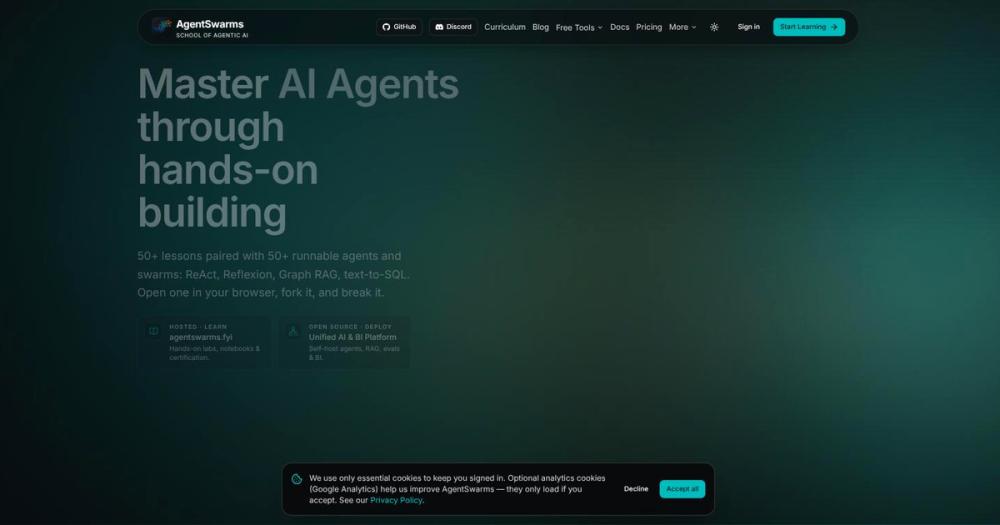
The hosted platform at agentswarms.fyi includes 8 curriculum tracks, 50+ lessons, and 97 TypeScript notebooks covering LangChain, LlamaIndex, OpenAI Agents SDK, and Vercel AI SDK, plus failure-mode labs where you diagnose and repair deliberately-broken swarms. The self-hosted platform and the learning curriculum use the same visual builder.
Skip if:
Your team is already past the learning phase and needs a pure deployment tool. The curriculum is irrelevant if your focus is running production workloads rather than building understanding.
Analysts who want AI on their own data warehouse
The AI Analyst surface lets analysts ask questions in plain language and get answers with the SQL shown as the source. Every number traces back to the query that produced it, so results are verifiable rather than opaque. Charts from queries can be pinned to multi-page dashboards.
Skip if:
Your BI tool (Metabase, Grafana, Tableau) already handles analytical queries well and you only need light AI augmentation. A specialized AI-on-data layer may serve that gap without replacing the whole BI stack.
The problem it solves#
Building AI agents that reason over company data requires stitching together an agent framework, a vector store, a data warehouse, a BI tool, and an access-control layer from five different vendors. Each system speaks its own metadata format, so the same business metric appears differently to the agent than to the dashboard, row-level permissions defined in the BI layer do not carry into the agent's queries, and every question a user asks has no auditable trace back to the data it used.
The cost of that fragmentation compounds. Teams running Relevance AI, Snowflake, and Power BI independently maintain three access-control models, three audit logs, and three billing relationships. When an agent reports a revenue number that does not match the dashboard, debugging that mismatch requires digging through three disconnected systems. Most teams either accept the discrepancy or stop building the agent layer entirely.
How it solves it#
Multi-agent swarm canvas
Design and run multi-agent workflows as a graph. Each node is a step: agent, router, condition, loop, human approval, or tool call. Workflows run from the canvas, from the API, or on a schedule. Published snapshots keep serving until you promote a new draft, so the canvas and production runs stay on separate tracks.
Hybrid RAG knowledge bases
Connect uploads, crawled websites, GitHub repos, and SaaS sources including Google Drive, Notion, SharePoint, Dropbox, and Confluence on a sync schedule. Each collection supports hybrid search, parent-child and Q&A indexing, and per-source access scopes. Storage uses pgvector or Qdrant per collection with two-level dedup.
39-connector data layer
Query 22 databases and warehouses (PostgreSQL, MySQL, Snowflake, BigQuery, Databricks, Redshift, ClickHouse, and more) in place with read-only encrypted credentials. Sync 17 SaaS apps (Stripe, Shopify, HubSpot, Salesforce, Jira, Zendesk, and others) into datasets with change-following incremental loads.
AI Analyst with cited SQL
Ask questions in plain language and get answers with every number cited to the SQL that produced it. The analyst plans each question into steps, writes and runs the query, checks its own work, and exports findings as a branded PDF. Charts from individual steps can be pinned to dashboards or edited and re-run.
No-code ML on your lakehouse tables
Pick a table and a prediction goal (classify, forecast, cluster, detect anomalies, recommend) and a sandboxed trainer profiles the data, tries multiple algorithms under a time budget, and keeps the best model with its metrics and a model card. Trained models score rows back into the lakehouse on a schedule or via a scoped public API, and can function as agent tools.
Visual ETL pipeline builder
Move data between systems on a canvas or write ETL in Python. Steps run on a sandboxed kernel where credentials reach process memory only, never the code or container environment. Scheduled jobs include retries, overlap guards, and incremental watermarks. Every successful load triggers a catalog re-crawl so new tables appear for BI, the analyst, and agents.
Strengths and trade-offs#
Strengths
- One semantic layer for agents and BITable definitions, row filters, column masks, and access rules are enforced once and govern the agent, the analyst, the ETL, and the dashboard alike. An agent asked about revenue uses the same definition your finance team governs in the catalog. A row filter on a warehouse table binds both the dashboard and the agent query.
- Any model, any warehouseModel routing covers OpenRouter, OpenAI, Anthropic, Gemini, Bedrock, Azure, OCI, Qwen, Grok, Groq, Ollama, and vLLM. Warehouse connections span Snowflake, BigQuery, Databricks, Redshift, Trino, ClickHouse, Oracle, SQL Server, Postgres, and MySQL. No part of the system is locked to a single provider.
- Columnar lakehouse you ownTables are stored as zstd Parquet in your own S3-compatible bucket with a Postgres catalog. Compute stays stateless, snapshots give time travel, and nothing is locked in. You can query the same tables from the built-in engine, a Spark cluster, or direct SQL without moving the data.
- Swarm runs survive restartsDeployed swarm runs checkpoint as they execute. A process restart resumes from the last checkpoint rather than starting over. Human-approval steps park the run until someone decides, and schedules keep serving the last published snapshot until you promote a new draft.
Trade-offs
- -Elastic License 2.0 restricts managed service useThe ELv2 license allows self-hosting, internal commercial use, and modification, but prohibits offering the software as a managed or hosted service to third parties. Teams building a product that charges end users for access to AgentSwarms as the underlying engine cannot do so under the ELv2. A self-hoster running it for their own team or company has no restrictions beyond that.
- -Young project with 26 open issuesThe repository was created in July 2026 and had 26 open issues at time of indexing. For a platform spanning agents, ETL, a lakehouse, BI, and ML, the surface area is wide relative to the project's age. Production teams should evaluate issue severity and documentation gaps before committing AgentSwarms as their primary data platform.
- -Supabase required as the backendSelf-hosting requires a Supabase project, either hosted or self-hosted. Teams that want a fully independent deployment with no external service dependency need to run their own Supabase instance. The hosted Supabase tier has usage costs above its free tier.
agentswarms vs alternatives#
AgentSwarms vs Relevance AI
Both tools target teams building AI agents, but Relevance AI is a managed cloud product with no self-hosted path; AgentSwarms runs on your own infrastructure under the Elastic License 2.0, keeping data and model keys local.
| Feature | AgentSwarms | Relevance AI |
|---|---|---|
| License | Elastic License 2.0 | Proprietary |
| Self-hosting | Yes (Docker / Kubernetes) | No |
| Built-in BI | Yes (dashboards, 26 chart types) | No |
| Data lakehouse | Yes (Parquet, own bucket) | No |
| ETL pipelines | Yes (visual canvas + Python) | No |
| LLM providers | OpenAI, Anthropic, Gemini, Ollama, 8+ | Select providers only |
AgentSwarms is the stronger choice when you need agents, data warehousing, and BI to share a governed semantic layer on your own infrastructure. Relevance AI suits teams that want a managed SaaS with no infrastructure overhead and can accept vendor lock-in.
AgentSwarms vs Microsoft Fabric + Copilot Studio
Microsoft Fabric combines a data lakehouse, ETL, BI (Power BI), and an AI analyst in one managed cloud platform; Copilot Studio adds conversational agents on top. AgentSwarms covers a similar surface area but runs on infrastructure you own without requiring a Microsoft 365 or Azure subscription.
| Feature | AgentSwarms | Microsoft Fabric + Copilot |
|---|---|---|
| License | Elastic License 2.0 | Proprietary |
| Self-hosting | Yes | No |
| Vendor dependency | Supabase (self-hostable) | Azure |
| LLM routing | 12+ providers | Azure OpenAI, limited |
| Cost | Infrastructure only | Per-capacity licensing |
| Notebook environment | TypeScript + Python | Fabric Jupyter only |
Microsoft Fabric is the right choice for organizations already in the Microsoft stack that need enterprise support, compliance certifications, and managed scalability. AgentSwarms is better for teams that need cost control, multi-cloud model routing, and the ability to inspect or modify every layer of the stack.
Quick start#
Self-hosting uses Docker or Kubernetes with a Supabase backend after cloning the repository.
```bash
git clone https://github.com/AgentSwarms-fyi/agentswarms
```What it's built on#
- Languages
- JavaScriptPythonTypeScript
- Frameworks
- LangChainLangGraphReact
- Databases
- MySQLPostgreSQL
FAQ#
Is AgentSwarms free to use?
The self-hosted version is licensed under the Elastic License 2.0, which permits free self-hosting for internal use including commercial team environments. The hosted learning platform at agentswarms.fyi was free during beta with a generous AI usage credit and no credit card required. The ELv2 is not an OSI-approved open source license, but it does allow running, modifying, and distributing the software on your own infrastructure without licensing fees.
What is the Elastic License 2.0, and what can I do with AgentSwarms under it?
The ELv2 is a fair-code license that permits self-hosting, internal commercial use, modification, and redistribution on your own infrastructure. The one restriction is that you cannot offer the software itself as a managed or hosted service to third parties where they access its features. Building your own products that use AgentSwarms internally is permitted; selling access to a managed AgentSwarms instance is not. License key functionality must not be disabled or circumvented.
Which LLM providers does AgentSwarms support?
AgentSwarms supports OpenRouter, OpenAI, Anthropic, Gemini, Bedrock, Azure OpenAI, OCI, Qwen, Grok, Groq, Ollama, and vLLM. Model keys are stored on your own infrastructure and brokered by the platform so they do not appear inside notebooks or the container environment.
Does AgentSwarms replace my existing BI tool?
AgentSwarms includes a BI workspace with multi-page dashboards, 26 chart types, cross-filtering, drill-through, and scheduled refresh, plus an AI Analyst that writes and shows its SQL. For teams that want agents and BI from one self-hosted system, it can replace tools like Power BI or Tableau. Teams already invested in a mature BI stack may prefer to connect those tools to AgentSwarms data sources rather than migrate dashboards.
How does self-hosting work, and what infrastructure do I need?
Self-hosting runs on Docker or Kubernetes with a Supabase project as the backend. Supabase can be the managed hosted service or a self-hosted instance on your own servers. Model API keys and data warehouse credentials live on your own infrastructure. The README describes deployment from a single Docker command after cloning the repository.
Similar open-source tools#

FckSignups
Open-source tools that work instantly, no signup required

dify
Visual AI workflow builder with RAG, agents, and self-hosting

MiroFish
Multi-agent simulation engine that predicts real-world outcomes

hyperresearch
Deep research agent with a persistent vault for Claude Code

open-science
Open-source AI workbench for reproducible scientific research

fmt
Fast, type-safe C++ formatting that replaces printf and iostreams