

Who Comp AI CRM is for#
Small technical sales teams
Run your whole pipeline on your own Postgres, and let the research agent keep contacts and companies current from your inbox rather than asking reps to do data entry.
Skip if:
Skip if you need multi team permissions, a mature mobile app, or a large third party app marketplace on day one.
Teams with strict data boundaries
Keep customer records and email derived evidence on infrastructure you control, with an agent sandbox that has no network egress and no database credentials.
Skip if:
Skip if you would rather a vendor carry the operational and compliance burden of running the system for you.
The problem it solves#
A CRM is only as good as the facts inside it, and those facts arrive by hand. Reps are asked to look somebody up, decide who they are, and type it into a form, so the pipeline fills with blank fields. The AI CRMs bolt a chat box onto that same form, leaving the actual research to a person, and the ones that do automate it guess, producing confidently wrong records nobody can spot.
How it solves it#
The agent is the product
The research agent is its own deployment built on eve, Vercel's filesystem first framework for durable agents, with 18 authored tools and 4 markdown skills versioned like code. It runs on its own schedule against its own work queue, so it keeps going after you close the browser.
Evidence ledger, no confidence scores
No tool accepts a confidence score. Tools report what they observed, such as a signature block in your own email history or a matched GitHub account identity, and a ledger prices the evidence. Strong evidence writes to the record; weak evidence becomes a suggestion a human settles.
An Agent tab on every record
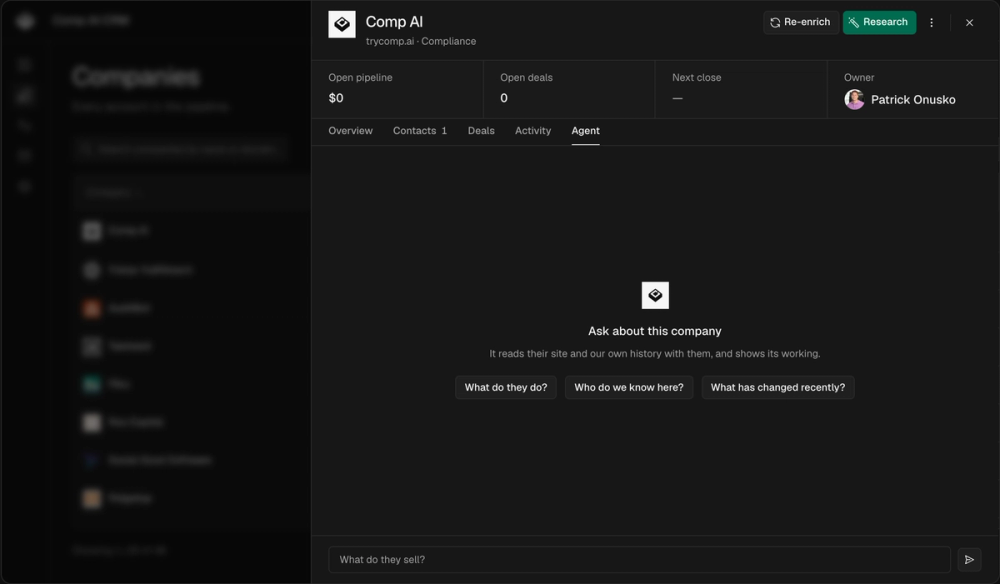
Every contact, company, and deal has an Agent tab showing the steps as they are taken, the leads discarded and why, and questions answered in place when the agent cannot decide between two people. Conversations are durable and survive a reload.
Sandbox with deny all egress
The agent gets bash, grep, glob, and a workspace so it can keep a dossier and diff profiles over time. The sandbox is never given DATABASE_URL and has no network, so a customer's email body has no path out through a shell command.
Your inbox is the first data source
Gmail and Calendar sync make your own threads, meetings, and signature blocks the primary evidence, which is free and hard to beat. Web research with citations, LinkedIn identity lookups, and company brand data are each optional keys layered on top.
Self-hosted on a modern TypeScript stack
A Turborepo monorepo on Bun: Next.js App Router with shadcn/ui, a NestJS API exposing tRPC so the front end is type safe from the Prisma row to the table cell, and Postgres with optional Redis. Four environment values get a local install running.
Strengths and trade-offs#
Strengths
- Enrichment you can auditBecause the agent separates what it observed from what it inferred and shows its working on every record, a blank field stays blank rather than becoming a plausible guess. A confidently wrong fact about a customer is worse than a missing one, and the design takes that seriously.
- MIT licensed and fully self-hostedThe whole system is MIT licensed with no open core holdback, and it runs on your own Postgres and your own deployments. Customer records, email derived evidence, and agent reasoning all stay on infrastructure you control.
- Works with no API keys at allEvery outside data source is optional. With no keys configured the agent still reads your own threads, meetings, and signature blocks, and it is told at session start which sources this install has so it plans around what it actually has.
Trade-offs
- -Very young projectThe repository was created at the end of July 2026 and v1.0.0 was cut days later, with a small core contributor group. It has drawn attention quickly, but it has not yet been run in production by many teams, and there is no hosted option to fall back on.
- -Single tenant, Google-first sign-inThere are no organizations; the design is deliberately one install per company. Sign-in is Google only out of the box, governed entirely by an ALLOWED_SIGN_IN allow list, with other identity providers added through Settings and SSO afterwards.
- -Built around Vercel infrastructureProduction leans on Vercel Sandbox for the agent's shell, the Vercel AI Gateway for model access, and Vercel Blob for mirrored profile pictures. Running it elsewhere is possible, Docker or microsandbox works locally, but you take on substituting those pieces yourself.
Comp AI CRM vs alternatives#
Comp AI CRM vs Salesforce and HubSpot CRM
Salesforce and HubSpot CRM both now sell AI assistants layered on top of a records database, billed per seat, with the enrichment logic closed. Comp AI CRM starts from the agent instead: it runs on your own infrastructure, shows its working on every record, and refuses to write a fact it cannot evidence.
Choose Salesforce or HubSpot CRM if you need a mature app marketplace, a proven mobile experience, multi team permissions, or a vendor to call. Choose Comp AI CRM if you are a small technical team that wants an auditable research agent, MIT licensed code, and your customer data on infrastructure you control.
Quick start#
git clone https://github.com/trycompai/crm.git && cd crm
cp .env.example .env          # set BETTER_AUTH_SECRET, ALLOWED_SIGN_IN, Google OAuth
bun install
docker compose up -d          # Postgres on :5432
bun run db:deploy             # apply migrations
bun run dev # app on :3000, API on :3001What it's built on#
- Languages
- PythonTypeScript
- Frameworks
- NestJSNext.jsReact
FAQ#
Is Comp AI CRM open source?
Yes. Comp AI CRM is MIT licensed and the full source is on GitHub at github.com/trycompai/crm.
Can I self-host Comp AI CRM?
Yes, and self-hosting is the only way to run it today. Locally you need Bun and Docker: clone the repo, bring up Postgres with Docker Compose, apply migrations, and set four values in the root .env file. In production it is three independent deployments, the Next.js app, the NestJS API, and the agent, plus a Postgres database.
What makes it an agentic CRM rather than a CRM with AI added?
The agent is a separate deployment with its own schedule and work queue, not a chat box on a form. It decides what to look at next, books its own follow ups, spends a research budget, and keeps running after you close the browser. Records fill themselves in as a result of that work.
How does it avoid inventing facts about people?
No tool accepts a confidence score, because a model asked to grade its own certainty will do so in whichever direction makes it look useful. Tools report only what they observed, and an evidence ledger prices those observations. Strong evidence writes to the record, weak evidence becomes a suggestion for a human to settle.
Does it need paid data enrichment APIs?
No. Every outside source is optional and it is designed to run with none of them. Without any keys the agent reads your own threads, meetings, and signature blocks through Gmail and Calendar sync. Optional keys add web research with citations, LinkedIn identity lookups, and company brand data.
What does Comp AI CRM replace?
It is an open source alternative to Salesforce and HubSpot CRM for small technical teams who want to self-host their pipeline and audit how every enriched field was arrived at, without a per seat bill.
Who builds Comp AI CRM?
It is built by Comp AI, the team behind trycomp.ai, and developed in the open at github.com/trycompai/crm.
Similar open-source tools#

Twenty
Open source CRM with custom data models and AI-native workflows

EspoCRM
Self-hosted open source CRM for contacts and pipelines

MiroFish
Multi-agent simulation engine that predicts real-world outcomes

DeskcommCRM
AI agents for WhatsApp sales, fully audited, no per-user pricing

FckSignups
Open-source tools that work instantly, no signup required

OpenClaw
Self-hosted AI assistant for WhatsApp, Telegram, and more