
Open Source Alternatives
  • Alternatives
  • Categories
    Categories by size1,022 projects
    • Developer Tools524
    • AI & Machine Learning452
    • Business & Productivity235
    • Web Development203
    • Security & Monitoring152
    • Communication & Collaboration138
    • IT Management136
    • Cloud & Hosting120
    • LLMOps & AI Tooling117
    • Data & Analytics112
    Browse all 21 categoriesProduct & Project Management, Design & Creative and 9 more
  • Blog
  • Advertise
SearchNotion, Slack, password manager.../
Submit
Open Source Alternatives
  • Alternatives
    • Developer Tools524
    • AI & Machine Learning452
    • Business & Productivity235
    • Web Development203
    • Security & Monitoring152
    • Communication & Collaboration138
    • Browse all 21 categories
  • Blog
  • Advertise
Submit your project

New open source projects by email

The projects we add and every new guide. Free, unsubscribe any time.

Open Source Alternatives LogoOpen Source Alternatives

Handpicked Open Source Alternatives to Paid Softwares

Product

  • Categories
  • Tag
  • Advertise

Resources

  • Blog
  • Collection
  • Submit

Company

  • Privacy Policy
  • Terms of Service
  • Refund Policy
  • Sitemap

Alternatives

  • Claude Code
  • Jira
  • Notion
  • Slack
  • Linear
  • Wispr Flow
  • All alternatives
© 2026 Open Source Alternatives. All rights reserved.
Open SourceAlternatives
Home/Categories/AI & Machine Learning/Deepagents
icon of Deepagents

Deepagents

Open source alternative to LangGraph Platform

  • 30.9K stars
  • MIT
  • Active this week
  • Last commit today

Last verified Nov 3, 2026

Build multi-step AI agents with built-in planning, a virtual filesystem, subagent spawning, persistent memory, and human-in-the-loop support.

Visit websiteGitHub30.9K stars
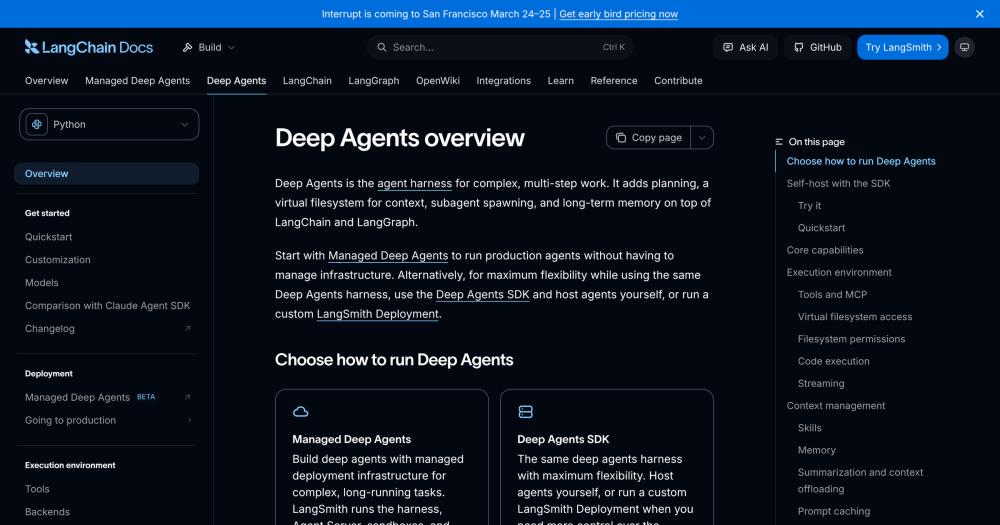
image of Deepagents
TL;DR

Deepagents Deep Agents is an MIT-licensed agent library for Python and TypeScript, published by LangChain on top of LangGraph. It replaces custom scaffolding by bundling context management, subagent delegation, a virtual filesystem, and persistent memory. Available as a self-hosted SDK or Managed Deep Agents on LangSmith's infrastructure. Best for developers building production AI agents in the LangChain ecosystem who want the full stack without assembling its components from scratch.

Read the full breakdownHide the full breakdownWho it is for, how it works, trade-offs, the quick start and the FAQ
who it's for

Who Deepagents is for#

Developers building multi-step research or coding agents

Deep Agents provides file read/write, subagent delegation, and context management out of the box, so a research or coding agent can read files, spawn specialist subagents for subtasks, summarize accumulated context, and pause for human review before executing changes. Deep Agents Code is a pre-built terminal coding agent built on the same stack.

Skip if:

Skip if the task is a single-turn tool call or a simple retrieval pipeline. For short workflows without multi-step delegation, LangChain's create_agent is a lighter starting point.

Teams self-hosting AI agents on their own infrastructure

The MIT-licensed SDK runs in any Python or TypeScript process or container. Teams configure their own backend, store, and checkpointer with no licensing restrictions on commercial or internal-tooling use. The open source codebase gives full control over every runtime decision.

Skip if:

Skip if your team prefers fully managed infrastructure. Managed Deep Agents on LangSmith handles the agent server, sandboxes, and scheduling with no self-hosting required.

AI engineers integrating MCP servers into agent workflows

Deep Agents fully supports MCP, letting agents connect to any MCP-compatible database, API, or file system through the standard interface. Pass any MCP server's tools via the tools= parameter with no custom adapter. Filesystem permissions and subagent access controls layer on top.

Skip if:

Skip if your tools are already custom Python functions that do not benefit from MCP's standard interface.

the problem

The problem it solves#

Building production-grade AI agents on LangGraph requires solving several scaffolding problems before writing any agent-specific logic: how to manage context across long multi-step runs when the model's context window fills, how to safely delegate subtasks to specialized subagents with isolated context, how to read and write files across different backends, and how to pause for human approval before executing irreversible tool calls.

Most teams end up writing the same scaffolding layer independently for each project. The code proliferates, diverges between codebases, and becomes a maintenance burden that grows in proportion to the number of agent projects in production.

how Deepagents solves it

How it solves it#

Virtual Filesystem

Configurable file access layer backed by pluggable backends: in-memory, local disk, LangGraph store, or composite routing. Agents read, write, edit, list, glob, and grep files with declarative permission rules that control path-level access for both the main agent and any subagents.

Subagent Delegation

Spawn general or specialized subagents with isolated context windows to run parallel tasks without polluting the parent agent's context. Any LangGraph CompiledStateGraph can plug in as a subagent, so custom graph workflows compose alongside the defaults.

Context Management

Summarizes long conversation histories and offloads large tool outputs to disk so agents run across hundreds of turns without hitting model context limits. Pairs with prompt caching and pluggable store backends for cross-session memory.

Human-in-the-Loop Steering

Pause execution at any tool call, surface the pending action to a human reviewer, and resume, edit, or reject before the tool runs. Built on LangGraph's interrupt mechanism and compatible with any streaming interface.

Model-Agnostic LLM Support

Works with any LLM that supports tool calling: frontier APIs (OpenAI, Anthropic, Google), open-weight models hosted on Fireworks or Baseten, and local models via Ollama, vLLM, or llama.cpp. Switch models by changing the model= parameter.

MCP Server Integration

Pass tools from any Model Context Protocol server with the tools= parameter. Connects agents to databases, APIs, file systems, and more through the standard MCP interface without custom adapter code.

strengths · trade-offs

Strengths and trade-offs#

Strengths

  • MIT License with Full Self-HostingThe SDK is MIT-licensed, so teams run it on their own infrastructure without licensing fees and use it commercially without restriction. Unlike LangGraph Platform's managed service, there is no per-execution cost and teams own the full runtime.
  • 30k+ Stars and Active Development30,917 GitHub stars and 4,344 forks, with the last push on 2026-11-03, confirm active investment from the LangChain team. Created in July 2025, the trajectory shows fast adoption since launch.
  • LangGraph Runtime UnderneathBuilt on LangGraph's durable execution, streaming, and checkpointing, so Deep Agents inherits production deployment primitives. Persistence, typed event streams, and interrupt-based human approval all come from the same battle-tested runtime.
  • Composable Middleware ArchitectureEvery capability layer (filesystem, memory, subagents, context management) is a middleware component that can be overridden or replaced without forking the project. Custom backends, stores, and checkpointers plug in via the same interface.

Trade-offs

  • -Requires Python or TypeScript RuntimeThe SDK adds an installation step versus a no-config managed deployment. Teams without Python or TypeScript infrastructure, or those preferring a zero-configuration cloud path, will need Managed Deep Agents or a custom LangSmith Deployment instead.
  • -183 Open Issues from Rapid GrowthThe tracker carries 183 open issues, reflecting a project growing quickly since its July 2025 launch. Newer features carry version-gated requirements (the delete tool requires deepagents>=0.7) and sandboxed execution needs additional backend configuration.
  • -Sandboxed Code Execution Requires Additional SetupShell access and the REPL are tied to sandbox backends. The default in-memory backend omits the execute tool. Teams that need agent-driven shell execution must provision and configure a sandbox separately before those capabilities are available.
versus alternatives

Deepagents vs alternatives#

Deep Agents vs LangGraph Platform

Deep Agents and LangGraph Platform both build on LangGraph's graph runtime, but they serve different deployment models. Deep Agents is an open source SDK you run on your own infrastructure; LangGraph Platform is LangSmith's commercial managed service for LangGraph-based agents.

FeatureDeep AgentsLangGraph Platform
LicenseMITProprietary
Self-hostingYes (SDK)No (managed only)
Managed optionManaged Deep AgentsYes
Agent libraryBatteries-included SDKPlatform-native
PricingFree (self-hosted)Usage-based, paid
MCP supportYesVia LangGraph tools

Deep Agents is the better choice when your team needs full control over the agent runtime, has existing Python or TypeScript infrastructure, or requires the MIT license for commercial or internal use without per-execution fees.

LangGraph Platform is worth considering when your team wants fully managed hosting with no devops overhead, and the usage-based cost model fits the budget. LangGraph Platform handles the agent server, scheduling, and scaling on LangSmith's infrastructure; Deep Agents' Managed option covers the same hosting need if you want to stay in the Deep Agents ecosystem.

install · quick start

Quick start#

bash
Install the Deep Agents Python SDK with pip to run agents in any Python project.

```bash
pip install deepagents
```
tech stack · detected from GitHub

What it's built on#

Languages
PythonTypeScript
Frameworks
FastAPILangChainLangGraph
frequently asked

FAQ#

Is Deep Agents free to use?

Yes. The SDK is MIT-licensed and free to run on your own infrastructure with no licensing fees. Managed Deep Agents, which runs on LangSmith's infrastructure, is a paid service. For most development and self-hosted production workloads, the open source SDK covers the full feature set.

How is Deep Agents different from LangGraph or LangChain's create_agent?

LangGraph is the graph execution runtime. LangChain's create_agent is a minimal agent built on top of it. Deep Agents is a more opinionated build on top of create_agent, with filesystem access, subagent spawning, context management, and persistent memory bundled in. All three layers compose: a LangGraph CompiledStateGraph can be passed in as a subagent to a Deep Agent.

Does Deep Agents work with open-weight or local models?

Yes. Any model that supports tool calling works, including frontier APIs (OpenAI, Anthropic, Google), open-weight models hosted on Fireworks, Baseten, or similar providers, and local models via Ollama, vLLM, or llama.cpp. Use any LangChain chat model.

Can I restrict what files or directories an agent can access?

Yes. The virtual filesystem supports declarative permission rules that control which paths the agent can read or write, evaluated in declaration order with first-match-wins semantics. You can restrict agents to specific directories, protect sensitive files like .env, and give subagents narrower access than the parent agent.

Is there a JavaScript or TypeScript version of Deep Agents?

Yes. A JavaScript/TypeScript library, deepagents.js, is available at github.com/langchain-ai/deepagentsjs. The Python SDK and the JS SDK share the same design and architecture; check the deepagents.js repository for current feature parity.

also worth a look

Similar open-source tools#

Hermes Agent

Featured

Alternative toGrok Bot

Self-hosted AI agent: persistent memory, multi-channel chat, model choice.

  • 259,499 GitHub stars
  • MITLicence MIT

Nanochat

InAI & Machine Learning

Minimal LLM training toolkit for GPT-scale models under $100.

  • 59,895 GitHub stars
  • MITLicence MIT

Mlx Serve

Alternative toLM Studio

Local LLM server for Apple Silicon, faster than LM Studio

  • 2,206 GitHub stars
  • MITLicence MIT

TensorFold

InAI & Machine Learning

Local LLM inference for Apple Silicon and NVIDIA GPUs, no Python.

  • 1,567 GitHub stars
  • Apache-2.0Licence Apache-2.0

Skillshare

InDeveloper Tools

AI coding setup manager for skills, agents, MCP, and hooks

  • 2,872 GitHub stars
  • MITLicence MIT

Agent Desktop

InAI & Machine Learning

Desktop computer use for AI agents via OS accessibility tree

  • 3,850 GitHub stars
  • Apache-2.0Licence Apache-2.0
by category

Open source tools in these categories#

453

AI & Machine Learning

freeCodeCamp, REA (Reverse Engineer Anything), OpenClaw
118

LLMOps & AI Tooling

Hermes Agent, OpenCode, MarkItDown
525

Developer Tools

REA (Reverse Engineer Anything), superpowers, Skills for Real Engineers

Sponsors

Inbox Zero

Alternative toSuperhuman

AI email assistant that drafts replies and clears your inbox

  • 12,889 GitHub stars
  • AGPL-3.0Licence AGPL-3.0
  • #Email

rakazo

Alternative toGrok Bot

AI teammates you own: your keys, your model, your machine.

  • 6,568 GitHub stars
  • Apache-2.0Licence Apache-2.0
  • #AI Agents

SnitchFeed

Live monitoring on LinkedIn, X, Reddit & more. Agentic social listening for startups.

Marketing & Growth

Advertise your product

New open source projects by email

The projects we add and every new guide. Free, unsubscribe any time.

Find open source alternatives to paid software

/
  • Claude Code to OpenCode
  • Jira to Windshift
  • Notion to AppFlowy
  • Slack to Mattermost
  • Linear to GitLab
  • Wispr Flow to Handy
  • Arc to Zen Browser
  • CapCut to Concat
  • Grok Bot to rakazo
  • Superhuman to Inbox Zero
  • Airtable to AITable
  • Muse to OpenClaw
  • Railway to Coolify
  • GitHub Copilot to Cline
  • Datadog to Netdata
  • Microsoft Teams to Rocket.Chat
  • Confluence to Docmost
  • Pinecone to Qdrant
  • Zapier to n8n
  • Devin AI to OpenHands
  • Firebase to Supabase
  • 1Password to KeePassXC
  • Contentful to Strapi
  • Adobe Premiere Pro to Shotcut