Open Source Alternatives
  • Alternatives
  • Categories
    Categories by size1,093 projects
    • Developer Tools550
    • AI & Machine Learning470
    • Business & Productivity263
    • Web Development206
    • Security & Monitoring169
    • Communication & Collaboration151
    • IT Management144
    • Cloud & Hosting127
    • LLMOps & AI Tooling122
    • Data & Analytics117
    Browse all 21 categoriesProduct & Project Management, DevOps & CI/CD and 9 more
  • Blog
  • Advertise
SearchNotion, Slack, password manager.../
Submit
Open Source Alternatives
  • Alternatives
    • Developer Tools550
    • AI & Machine Learning470
    • Business & Productivity263
    • Web Development206
    • Security & Monitoring169
    • Communication & Collaboration151
    • Browse all 21 categories
  • Blog
  • Advertise
Submit your project

New open source projects by email

The projects we add and every new guide. Free, unsubscribe any time.

Open Source Alternatives LogoOpen Source Alternatives

Handpicked Open Source Alternatives to Paid Softwares

Product

  • Categories
  • Tag
  • Advertise

Resources

  • Blog
  • Collection
  • Submit

Company

  • Privacy Policy
  • Terms of Service
  • Refund Policy
  • Sitemap

Alternatives

  • Claude Code
  • Jira
  • Notion
  • Slack
  • Linear
  • Wispr Flow
  • All alternatives
© 2026 Open Source Alternatives. All rights reserved.
Open SourceAlternatives
Home/Categories/Product & Project Management/Fizzy
icon of Fizzy

Fizzy

Open source alternative to Trello, Linear, Jira and Asana

  • 8.3K stars
  • MIT with SaaS restriction
  • Active this week
  • Last commit today

Last verified Nov 5, 2026

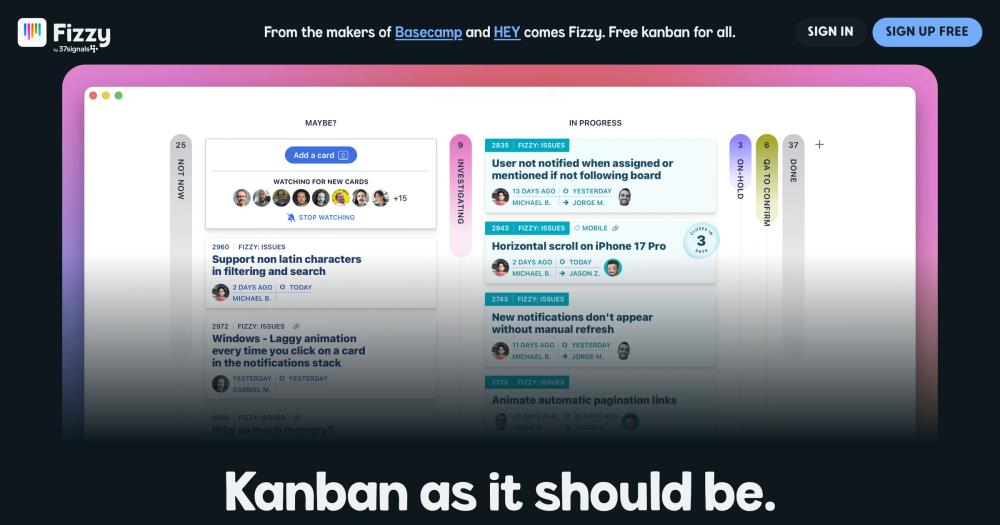
Track bugs, ideas, and small projects on a free open source kanban board by 37signals, with a self-hosting option.

Visit websiteGitHub8.3K starsDeploy on Hostinger
image of Fizzy
TL;DR

Fizzy is a free, open source kanban board from 37signals for tracking bugs, ideas, and small projects. It replaces paid project management tools like Trello, Jira, Asana, and Linear with a focused card-and-column interface that avoids the feature accumulation those products went through over years. The O'Saasy License permits self-hosting for personal and commercial team use; the hosted version at fizzy.do is entirely free, subsidized by Basecamp and HEY. Best for individuals and small teams whose kanban needs are simple and who want to avoid enterprise project management overhead.

Read the full breakdownHide the full breakdownWho it is for, how it works, trade-offs, the quick start and the FAQ
who it's for

Who Fizzy is for#

Solo developers tracking side project backlogs

Fizzy gives individual developers a free, low-maintenance board for feature ideas, bug lists, and release planning without the overhead of a full project management tool. The hosted version requires no infrastructure and no payment.

Skip if:

If you need to track work across multiple interconnected projects with dependencies, sprints, and velocity metrics, a tool like Linear or Jira is a better fit.

Small product teams managing bug and feature backlogs

Teams tracking ten to fifty active issues get a faster interface than Jira or Asana with no onboarding overhead. Webhooks feed new cards and completions to Slack channels, and stamps keep attribution visible without digging through activity logs.

Skip if:

If your team needs sprint planning, burndown charts, Gantt views, or tight GitHub and GitLab integration, Fizzy does not cover those workflows.

Teams wanting self-hosted project tracking with data ownership

The ONCE installer deploys a fully functional Fizzy instance on a single machine with automatic updates. Teams that want project data on their own infrastructure rather than stored in a third-party service have a supported path without the complexity of a full project management deployment.

Skip if:

If you are migrating from Trello, Jira, or Asana and need to bring card history along, Fizzy has no import tool and you would start fresh.

the problem

The problem it solves#

Most project tracking tools start simple and grow into enterprise software. Trello added Power-Ups and pricing tiers. Jira became a configuration layer most teams only partially understand. Asana expanded into goal-setting and workload management designed for large organizations. By the time teams notice the bloat, they're paying for features they never use and learning interfaces that assume a dedicated project manager.

The specific pain is a loss of speed. Setting up a kanban board to track ten bugs or thirty ideas should take minutes. Instead, it takes invitations, permission models, integrations, and onboarding flows that assume everyone is building enterprise workflows. Free-tier limits eventually push you toward a paid plan, and paid plans push you toward using the full feature set to justify the cost. A fast, focused board without the cruft became genuinely difficult to find in this category.

how Fizzy solves it

How it solves it#

Webhook notifications for Slack and Campfire

Fizzy sends webhooks on card events (new card created, assigned, completed) to Slack channels, Campfire rooms, or any endpoint that accepts HTTP POST. No dedicated integration app is required. Paste a webhook URL in board settings and choose which events to forward.

Auto-close for idle cards

The auto-close feature prunes cards that have sat idle past a configured threshold, keeping boards from accumulating abandoned items over time. Teams that track ideas alongside active bugs benefit from this without needing to schedule manual cleanup.

Public board sharing

Any board can be made public so external stakeholders, customers, or the public can follow progress without creating an account. This is useful for open source projects or teams that report status to outside audiences.

Stamps for card attribution

Stamps record who filed a card and when, providing a lightweight audit trail without a full activity log. Teams tracking bugs or feature requests can see attribution on every card without searching through notification histories.

API for custom integrations

Fizzy exposes an API for custom integrations beyond the built-in webhook support. Teams that need to connect Fizzy to internal tooling, CI pipelines, or custom dashboards can use the API as the integration layer.

strengths · trade-offs

Strengths and trade-offs#

Strengths

  • Made and maintained by 37signals37signals (the team behind Basecamp) shipped Fizzy and continues to maintain it. The repository had 8,283 stars and its last push was November 2026. 37signals has a track record of maintaining opinionated tools for the long term.
  • Self-hosting via ONCE or DockerFizzy ships a ONCE installer that sets up a fully functional single-machine deployment and keeps it up to date automatically. A Docker deployment guide is in the repository for teams that want containerized infrastructure. Teams that want to run Fizzy on their own hardware have a supported, documented path.
  • No freemium pricing tricksThe hosted version is entirely free with no paid tier, no feature gates, and no upsell path. 37signals funds it through Basecamp and HEY revenue. The only limit is a 1 GB file storage cap; there is no time limit, no seat limit, and no automation limit.
  • Open codebase on GitHubThe full Ruby on Rails codebase is on GitHub with 1,211 forks. Teams that want to customize the interface, add integrations, or modify board behavior can fork and modify within the O'Saasy License terms, which permit internal commercial use.

Trade-offs

  • -No data import from other servicesFizzy has no way to import cards, boards, or project history from Trello, Jira, GitHub Issues, Basecamp, or other tools. Switching means starting a new board from scratch. The team noted in the FAQ that import is on the roadmap, but it is not part of the current release.
  • -O'Saasy License restricts managed service useThe O'Saasy License permits self-hosting, modification, and internal commercial use. It does not permit running Fizzy as a hosted or managed service offered to third parties where Fizzy's functionality is the primary value. Organizations building a Fizzy-based SaaS or managed hosting service are outside the license terms.
  • -Young ecosystem with limited integrationsFizzy has 10 open issues as of November 2026. The integration catalog that Trello and Jira built over years does not exist yet. Teams that need deep integrations with GitHub, GitLab, Confluence, or time-tracking tools will find only webhooks and an API available.
versus alternatives

Fizzy vs alternatives#

Fizzy vs Trello

Both tools use a kanban-style card-and-column layout as their primary model. The practical differences are in direction and pricing. Trello grew from a simple kanban board into a tool with Power-Ups, Butler automation, Atlassian integration, and paid tiers that unlock higher limits on automations, attachments, and board counts.

FeatureFizzyTrello
LicenseO'Saasy (fair-code)Proprietary
HostingHosted free + self-hostableCloud only
PricingFree (no paid tier)Freemium; paid tiers from $5/user/mo
AutomationsNoYes (limited on free tier)
Data importNoYes
File storage1 GB (hosted)10 MB per file (free tier)

Fizzy is the better choice for teams that use Trello for basic kanban and have no need for the Power-Up ecosystem. Its hosted version is unrestricted beyond the 1 GB file cap, while Trello's free tier limits workspace members and automations. Trello remains the stronger choice when you need Power-Up integrations with Jira, GitHub, or Salesforce, or when you need to import an existing Trello board.

Fizzy vs Jira

Jira and Fizzy serve overlapping but different team sizes. Jira is a full issue-tracking and project management suite with sprints, backlogs, epics, velocity charts, and deep Atlassian ecosystem integrations. Fizzy tracks cards on columns with no sprint framework, no epics, and no reporting.

FeatureFizzyJira
LicenseO'Saasy (fair-code)Proprietary
PricingFreePaid from $8.48/user/mo (Standard)
Sprint and backlog managementNoYes
Workflow automationNoYes
Reporting and analyticsNoYes
Self-hostingYes (ONCE, Docker)Yes (Data Center, expensive)

Fizzy is the better choice for small teams and solo developers who are using Jira only for a kanban board and are paying for features they never open. Jira is the better choice when sprint planning, velocity tracking, epics, or Atlassian ecosystem integrations are real requirements.

Fizzy vs Linear and Asana

Linear focuses on software development workflows with cycle-based planning, priority scoring, and GitHub and GitLab integration. Asana spans project management, goal tracking, timeline views, and resource management across teams. Both tools are more fully featured than Fizzy in their respective areas. Teams that need Linear's development-centric workflow integrations or Asana's cross-functional project management will find Fizzy too narrow. Fizzy is the better fit when neither tool's scope matches what the team actually needs: a fast, free kanban board with no enterprise overhead.

install · quick start

Quick start#

bash
Self-hosting uses the ONCE installer for single-machine deployment and automatic updates.
```sh
curl https://get.once.com/fizzy | sh
```
tech stack · detected from GitHub

What it's built on#

Languages
JavaScriptRuby
Frameworks
Rails
Databases
MySQLSQLite
frequently asked

FAQ#

Is Fizzy really free with no paid plan?

Yes. The hosted version at fizzy.do is entirely free with no paid tier. File storage is capped at 1 GB, but beyond that there are no feature limits, seat limits, or time-based restrictions. 37signals subsidizes Fizzy through its Basecamp and HEY revenue, so there is no business model that depends on converting free users to paid.

Can I self-host Fizzy on my own server?

Yes. The easiest path is the ONCE installer, which runs with one curl command and handles initial setup and automatic updates. Docker deployment is also documented in the repository for containerized infrastructure. Kamal deployment is available for teams that want to modify the codebase and deploy their own version. All three paths are documented in the GitHub repository.

Can I import data from Trello, Jira, or GitHub Issues into Fizzy?

No. As of the current release, Fizzy has no import tool for migrating cards, boards, or project history from other services. The team noted this is on the roadmap but not part of the current release. Teams switching to Fizzy start fresh with a new board.

What does the O'Saasy License allow and restrict?

The O'Saasy License permits self-hosting, modification, distribution, and internal commercial and team use. What it does not permit is offering Fizzy to third parties as a hosted or managed service where Fizzy's functionality is the primary value of that service. Running Fizzy for your own team is within the license terms. Offering a managed Fizzy hosting service to paying customers is not.

Does Fizzy have AI features?

No. Fizzy explicitly has no AI features. The team describes this as a design choice: they removed unnecessary complexity from typical kanban implementations rather than adding AI. For teams that need AI-based issue triage, sprint prediction, or workflow automation, Fizzy does not cover those workflows. Webhooks and an API are available for custom integrations with external tools if needed.

Looking for more

Other ways to replace Trello, Linear, Jira and Asana#

GitLab

#1 in the Linear guide

Teams on GitLab for code hosting

24,549 GitHub stars

OpenProject

#2 in the Linear guide

Teams needing Scrum boards, Gantt charts, and time tracking

16,986 GitHub stars

Taiga

#3 in the Linear guide

Agile teams wanting Scrum sprints without enterprise overhead

385 GitHub stars

Gitea

#4 in the Linear guide

Small teams wanting lightweight git hosting and issue tracking

58,885 GitHub stars
All 18 Linear alternatives8 open source Linear alternatives, ranked
by category

Open source tools in these categories#

117

Product & Project Management

freeCodeCamp, agency-agents, Gstack
263

Business & Productivity

OpenClaw, Excalidraw, RustDesk
Hostinger

Self-host Fizzy on a Hostinger VPS

Keep it running 24/7, even when your laptop is off. A Hostinger VPS gives it a server of its own.

  1. 01

    Choose a plan

    Starts from $6.49/mo

  2. 02

    Apply

    Extra 10% off yearly plans

  3. 03

    Install Fizzy

    On a server that stays on

  4. 04

    Start building

    Focus on the app, not the server

Deploy on Hostinger

Sponsors

Inbox Zero

Alternative toSuperhuman

AI email assistant that drafts replies and clears your inbox

  • 12,889 GitHub stars
  • AGPL-3.0Licence AGPL-3.0
  • #Email

rakazo

Alternative toGrok Bot

AI teammates you own: your keys, your model, your machine.

  • 7,028 GitHub stars
  • Apache-2.0Licence Apache-2.0
  • #AI Agents

SnitchFeed

Live monitoring on LinkedIn, X, Reddit & more. Agentic social listening for startups.

Marketing & Growth

Advertise your product

New open source projects by email

The projects we add and every new guide. Free, unsubscribe any time.

Find open source alternatives to paid software

/
  • Claude Code to OpenCode
  • Jira to Windshift
  • Notion to AppFlowy
  • Slack to Mattermost
  • Linear to GitLab
  • Wispr Flow to Handy
  • Arc to Zen Browser
  • CapCut to Concat
  • Grok Bot to rakazo
  • Superhuman to Inbox Zero
  • Airtable to AITable
  • Muse to OpenClaw
  • Railway to Coolify
  • GitHub Copilot to Cline
  • Datadog to Netdata
  • Confluence to Wiki.js
  • Microsoft Teams to Rocket.Chat
  • Firebase to Supabase
  • Pinecone to Qdrant
  • Zapier to n8n
  • 1Password to KeePassXC
  • Devin AI to OpenHands
  • Asana to Leantime
  • Contentful to Strapi