Open Source Alternatives
  • Alternatives
  • Categories
    Categories by size1,064 projects
    • Developer Tools540
    • AI & Machine Learning468
    • Business & Productivity250
    • Web Development205
    • Security & Monitoring161
    • Communication & Collaboration143
    • IT Management140
    • Cloud & Hosting123
    • LLMOps & AI Tooling122
    • Data & Analytics115
    Browse all 21 categoriesProduct & Project Management, Design & Creative and 9 more
  • Blog
  • Advertise
SearchNotion, Slack, password manager.../
Submit
Open Source Alternatives
  • Alternatives
    • Developer Tools540
    • AI & Machine Learning468
    • Business & Productivity250
    • Web Development205
    • Security & Monitoring161
    • Communication & Collaboration143
    • Browse all 21 categories
  • Blog
  • Advertise
Submit your project

New open source projects by email

The projects we add and every new guide. Free, unsubscribe any time.

Open Source Alternatives LogoOpen Source Alternatives

Handpicked Open Source Alternatives to Paid Softwares

Product

  • Categories
  • Tag
  • Advertise

Resources

  • Blog
  • Collection
  • Submit

Company

  • Privacy Policy
  • Terms of Service
  • Refund Policy
  • Sitemap

Alternatives

  • Claude Code
  • Jira
  • Notion
  • Slack
  • Linear
  • Wispr Flow
  • All alternatives
© 2026 Open Source Alternatives. All rights reserved.
Open SourceAlternatives
Home/Categories/No-Code & Low-Code/Grist
icon of Grist Core

Grist

Open source alternative to Airtable and Smartsheet

  • 12K stars
  • Apache-2.0
  • Active this week
  • Last commit today

Last verified Nov 5, 2026

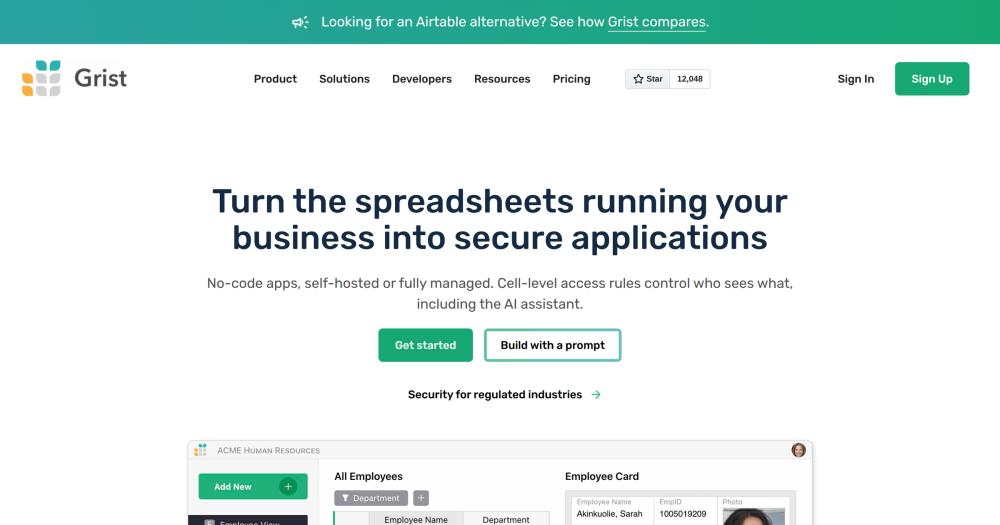
Manage structured data in a relational spreadsheet-database with Python formulas, granular access rules, and self-hosting on SQLite.

Visit websiteGitHub12K starsDeploy on Hostinger
image of Grist Core
TL;DR

Grist is a relational spreadsheet-database that combines Python formulas, typed columns, and granular access controls in a SQLite-backed format you can self-host. It replaces Airtable and Smartsheet for teams that need relational data modeling on their own infrastructure rather than a cloud-hosted proprietary service. Apache-2.0 licensed; grist-core runs on Docker and stores every document as a portable SQLite file. Best for operations teams and analysts who have outgrown plain spreadsheets but are not ready for a traditional database.

Read the full breakdownHide the full breakdownWho it is for, how it works, trade-offs, the quick start and the FAQ
who it's for

Who Grist is for#

Operations teams managing recurring workflows in spreadsheets

Grist replaces the ad-hoc spreadsheet stack that operations teams accumulate when their data needs relational references, form-based input, and access rules. A single Grist document can hold multiple related tables, a form for data entry, and filtered views that show each team member only their relevant rows.

Skip if:

If the team's primary need is project tracking (Gantt charts, task dependencies, sprint boards) rather than structured record management, Grist is not the right fit.

Regulated-industry teams requiring on-premise data storage

Healthcare, government, and financial services teams that cannot send data to a third-party cloud can run Grist on their own servers with no outbound data transfer. Row-level access rules and cell-value-based permissions support compliance requirements without a custom application build.

Skip if:

If your compliance review allows SaaS tools and your team lacks capacity to maintain a Docker deployment, starting with the hosted getgrist.com tier lets you evaluate Grist before committing to self-hosting.

Developers building internal tools for non-technical teammates

Grist provides a grid UI backed by a relational schema, so non-technical users can query and edit records without a custom admin interface. The REST API and webhook support let developers wire Grist documents into existing pipelines, while the Python formula layer keeps business logic close to the data.

Skip if:

If the data model is simple enough for a standard CRUD app and the team has resources for a proper backend, a dedicated database with a frontend framework gives more programmatic control than Grist's grid UI.

Data analysts needing Python formulas in a spreadsheet-style interface

Grist lets analysts write Python directly in column formulas, with access to the full standard library and Excel-compatible functions. Cross-table lookups work by reference column rather than by cell address, so formulas remain readable as the dataset grows. The AI formula assistant can explain and generate formulas from plain-language descriptions.

Skip if:

If the analysis requires a full computational environment (Jupyter notebooks, pandas workflows, multi-dataset joins in memory), Grist's Python is column-scoped, not a free-form notebook. Use a proper data science environment for that work.

the problem

The problem it solves#

Spreadsheets are the default tool for structured data in most organizations, but they break down in predictable ways: no cross-table references without formula gymnastics, no per-row or per-column access control, no typed columns, and files that become unmanageable once multiple people edit them. The result is duplicated data spread across dozens of sheets, broken lookups, and no audit trail.

Databases fix the structural problems but require SQL knowledge and a developer to build any user-facing interface. Most teams end up stuck between the two: too much data for a spreadsheet, not enough engineering support for a traditional database. Grist closes this gap by giving teams a typed, relational data model inside a grid UI they already know how to use.

how Grist solves it

How it solves it#

Python formulas with the full standard library

Every column in a Grist table can hold a Python formula with access to Python's full standard library, plus a set of Excel-compatible functions. An AI formula assistant (configurable to work with OpenAI, Llama, or any OpenAI-compatible endpoint via OpenRouter) can generate and explain formulas in plain language. A formula timer helps identify which calculations are slowing down large documents.

Row, column, and table access rules

Access rules control what each user can see and edit, down to individual rows and columns. Rules can be based on cell values and user attributes, so the same document can show different views to different collaborators. Partial views can be shared with third parties without exposing the underlying schema.

SQLite-backed portable document format

Every Grist document is stored as a standard SQLite file on the server. Any tool that can read SQLite can read the numeric and text data from a Grist file, so you are never dependent on a proprietary export format for access to your own data. The format also makes backups straightforward: a copy of the file is a complete, restorable backup.

Linked widget dashboards with chart and card views

Grist documents can hold multiple linked widgets on a single page: grid tables, card views, charts, pivot tables, calendar views, and summary tables. Widgets can be linked so that selecting a row in one widget filters the content of another, enabling data exploration without writing any code. Custom widgets can be built externally and embedded in the layout.

REST API, webhooks, and SCIM provisioning

The Grist REST API has an interactive console and covers documents, tables, records, and attachments. Configurable outgoing webhooks support column-specific triggers and formula conditions so external systems can react to data changes. SCIM support enables standard user and group provisioning, contributed by the French government's DINUM agency.

strengths · trade-offs

Strengths and trade-offs#

Strengths

  • Apache-2.0 license with no per-seat pricingGrist-core is Apache-2.0 licensed and free to self-host with no per-seat fees. Unlike Airtable and Smartsheet, which are cloud-only proprietary services, a self-hosted Grist deployment has one cost: the server. Teams of any size can use grist-core without a licensing conversation.
  • Python formulas instead of a proprietary formula languageAirtable uses its own custom formula language with a limited function set. Grist gives full Python in every column, including the standard library, so complex lookups, string manipulation, date arithmetic, and custom business logic stay in the spreadsheet rather than in a separate script.
  • Data portability through the SQLite formatEvery document is a standard SQLite file on disk. Any SQLite reader can open it and access the data directly, without an export step or a Grist installation. This means you can migrate between hosting providers, open documents locally with a SQLite GUI, or write scripts against the data format without depending on the Grist API.
  • Active development with government-level contributionsThe French government's ANCT and DINUM agencies have contributed heavily to grist-core, adding SCIM user provisioning, S3-compatible external attachment storage, HTTP long polling for restrictive networks, accessibility features meeting WCAG AA, and localization into 20+ languages. The project has 12,048 GitHub stars and was last updated on 2026-11-04.

Trade-offs

  • -Several enterprise features are only in the paid editionGrist-core does not include audit log streaming, SSO via OIDC or SAML, advanced admin controls for large installations, the broader Grist Assistant AI (beyond formula help), automations, the built-in MCP server, or OAuth app registration. Organizations that need any of these will need to self-host the full Grist edition (free for teams under $1M total annual funding) or use the hosted service.
  • -641 open issues in the grist-core trackerThe grist-core issue tracker carries 641 open issues, which reflects active use and ongoing feedback but also indicates a backlog. Users running production workloads should review the open issues for bugs relevant to their use case before committing to self-hosting. The project is actively maintained (last pushed 2026-11-04) but issue resolution can lag behind user-reported bugs.
  • -First-run setup requires a boot key from container logsNew Docker installs redirect to a Quick Setup screen before the site is usable. Getting past the first screen requires copying a generated boot key from the container's startup log. The setup is well-documented in the first-run guide, but it adds a step compared to tools that start in a fully open state by default.
versus alternatives

Grist vs alternatives#

Grist vs Airtable

Airtable and Grist give non-technical teams a grid interface for structured data, with cross-table references and no SQL required. The key distinction is deployment: Airtable is a cloud-only proprietary service, while Grist can run on your own infrastructure.

FeatureGristAirtable
LicenseApache-2.0Proprietary
Self-hostingYes (Docker)No
FormulasFull PythonCustom formula language
Data formatSQLite (portable)Proprietary cloud
Free self-hostedYesNo

Grist is the better choice when self-hosting is required for privacy or compliance, when Python formulas are needed for complex calculations, when data portability through a standard file format matters, or when a cloud-only subscription model is not acceptable. The Apache-2.0 grist-core edition is free to self-host with no seat count limits.

Airtable is worth considering when ease of setup is the priority, when the team needs Airtable's native automation and integration marketplace, or when a fully managed service with no infrastructure to maintain fits better.

Grist vs Smartsheet

Smartsheet is a work management service built around project planning, Gantt charts, and approval workflows. Grist is built around relational data modeling and structured record management, not project timelines.

FeatureGristSmartsheet
LicenseApache-2.0Proprietary
Self-hostingYesNo
Primary use caseRelational data and recordsProject and work management
FormulasPython + Excel functionsSpreadsheet functions
Free self-hostedYesNo

Grist is the better fit when the core need is structured data with relational references and row-level permissions rather than Gantt-style project views or approval workflows. For teams whose main challenge is that their spreadsheets have too much relational structure to work in a flat grid, Grist fits better.

Smartsheet remains the better choice when project management features such as Gantt charts, resource management dashboards, or multi-step approval workflows are the primary requirement. Grist does not replicate Smartsheet's project planning surface.

install · quick start

Quick start#

bash
Self-hosting Grist requires Docker; mount a local directory at /persist to keep data between container restarts.

```bash
docker pull gristlabs/grist
docker run -p 8484:8484 -v $PWD/persist:/persist -it gristlabs/grist
```
tech stack · detected from GitHub

What it's built on#

Languages
JavaScriptPythonTypeScript
Frameworks
Express
Databases
PostgreSQL
Cache
Redis
Tooling
Webpack
frequently asked

FAQ#

Is grist-core free to use?

Yes. Grist-core is Apache-2.0 licensed and free to self-host with no seat count limits or usage fees. The hosted service at getgrist.com offers a free tier for individuals and small organizations. The commercial full edition (which adds audit streaming, SSO, automations, and other enterprise features) is also free for teams with less than $1 million in total annual funding when self-hosting.

How does Grist compare to Airtable?

The main differences are deployment model, formula language, and data portability. Grist can be self-hosted on your own infrastructure under Apache-2.0; Airtable is cloud-only. Grist uses full Python formulas; Airtable uses a custom formula language. Grist stores documents as portable SQLite files; Airtable's data is in Airtable's cloud. Grist also supports direct import from Airtable to ease migration.

Can I import data from Airtable into Grist?

Yes. Grist has a built-in import path specifically for Airtable. It reads your Airtable bases and converts them to Grist documents, preserving table structure and field types. The import is documented in the official Grist support site. After import, you can self-host the documents or continue on the hosted service.

Which features require the paid Grist edition and are not in grist-core?

Audit log streaming, SSO via OIDC or SAML, advanced admin controls for large installations, the full Grist Assistant AI (beyond the formula-only assistant), automations (trigger-based email and webhook workflows), the built-in MCP server, OAuth app registration, invite notifications, and document change and comment notifications. These are not in grist-core but are available in the full Grist edition, which is free for teams under $1M in total annual funding.

What is the difference between grist-core and the hosted getgrist.com service?

Grist-core is the open source edition you self-host under Apache-2.0. The hosted service at getgrist.com runs the full Grist edition, which includes the enterprise features listed above. The hosted service has a free tier and paid plans. If you self-host grist-core, you run on your own infrastructure at no cost; if you upgrade to the full self-hosted edition, you get the enterprise features and can apply for a free activation key if your organization qualifies.

Looking for more

Other ways to replace Airtable and Smartsheet#

AITable

#1 in the Airtable guide

Direct Airtable replacement for teams migrating grid databases

15,658 GitHub stars

Budibase

#2 in the Airtable guide

Build internal apps and forms on structured data

28,382 GitHub stars

ToolJet

#3 in the Airtable guide

Build internal tools with 50+ data source connectors

41,178 GitHub stars

Appsmith

#4 in the Airtable guide

Git-versioned internal tools for engineering teams

41,157 GitHub stars
All 9 Airtable alternatives7 open source Airtable alternatives, ranked
by category

Open source tools in these categories#

36

No-Code & Low-Code

n8n, dify, Langflow
70

Databases & Storage

Immich, Supabase, Redis
250

Business & Productivity

OpenClaw, Excalidraw, RustDesk
115

Data & Analytics

Firecrawl, ragflow, Worldmonitor
Hostinger

Self-host Grist on a Hostinger VPS

Keep it running 24/7, even when your laptop is off. A Hostinger VPS gives it a server of its own.

  1. 01

    Choose a plan

    Starts from $6.49/mo

  2. 02

    Apply

    Extra 10% off yearly plans

  3. 03

    Install Grist

    On a server that stays on

  4. 04

    Start building

    Focus on the app, not the server

Deploy on Hostinger

Sponsors

Inbox Zero

Alternative toSuperhuman

AI email assistant that drafts replies and clears your inbox

  • 12,889 GitHub stars
  • AGPL-3.0Licence AGPL-3.0
  • #Email

rakazo

Alternative toGrok Bot

AI teammates you own: your keys, your model, your machine.

  • 6,568 GitHub stars
  • Apache-2.0Licence Apache-2.0
  • #AI Agents

SnitchFeed

Live monitoring on LinkedIn, X, Reddit & more. Agentic social listening for startups.

Marketing & Growth

Advertise your product

New open source projects by email

The projects we add and every new guide. Free, unsubscribe any time.

Find open source alternatives to paid software

/
  • Claude Code to OpenCode
  • Jira to Windshift
  • Notion to AppFlowy
  • Slack to Mattermost
  • Linear to GitLab
  • Wispr Flow to Handy
  • Arc to Zen Browser
  • CapCut to Concat
  • Grok Bot to rakazo
  • Superhuman to Inbox Zero
  • Airtable to AITable
  • Muse to OpenClaw
  • Railway to Coolify
  • GitHub Copilot to Cline
  • Datadog to Netdata
  • Confluence to Wiki.js
  • Microsoft Teams to Rocket.Chat
  • Pinecone to Qdrant
  • Zapier to n8n
  • 1Password to KeePassXC
  • Devin AI to OpenHands
  • Firebase to Supabase
  • Contentful to Strapi
  • Adobe Premiere Pro to Shotcut