Open Source Alternatives
  • Alternatives
  • Categories
    Categories by size1,075 projects
    • Developer Tools544
    • AI & Machine Learning470
    • Business & Productivity251
    • Web Development205
    • Security & Monitoring166
    • Communication & Collaboration145
    • IT Management143
    • Cloud & Hosting126
    • LLMOps & AI Tooling122
    • Data & Analytics116
    Browse all 21 categoriesProduct & Project Management, Design & Creative and 9 more
  • Blog
  • Advertise
SearchNotion, Slack, password manager.../
Submit
Open Source Alternatives
  • Alternatives
    • Developer Tools544
    • AI & Machine Learning470
    • Business & Productivity251
    • Web Development205
    • Security & Monitoring166
    • Communication & Collaboration145
    • Browse all 21 categories
  • Blog
  • Advertise
Submit your project

New open source projects by email

The projects we add and every new guide. Free, unsubscribe any time.

Open Source Alternatives LogoOpen Source Alternatives

Handpicked Open Source Alternatives to Paid Softwares

Product

  • Categories
  • Tag
  • Advertise

Resources

  • Blog
  • Collection
  • Submit

Company

  • Privacy Policy
  • Terms of Service
  • Refund Policy
  • Sitemap

Alternatives

  • Claude Code
  • Jira
  • Notion
  • Slack
  • Linear
  • Wispr Flow
  • All alternatives
© 2026 Open Source Alternatives. All rights reserved.
Open SourceAlternatives
Home/Categories/AI & Machine Learning/LibreTranslate
icon of LibreTranslate

LibreTranslate

Open source alternative to DeepL Pro, Google Cloud Translation, Microsoft Azure AI Translator, Amazon Translate and ModernMT

  • 17.3K stars
  • AGPL-3.0
  • Active this month
  • Last commit 9 days ago

Last verified Nov 5, 2026

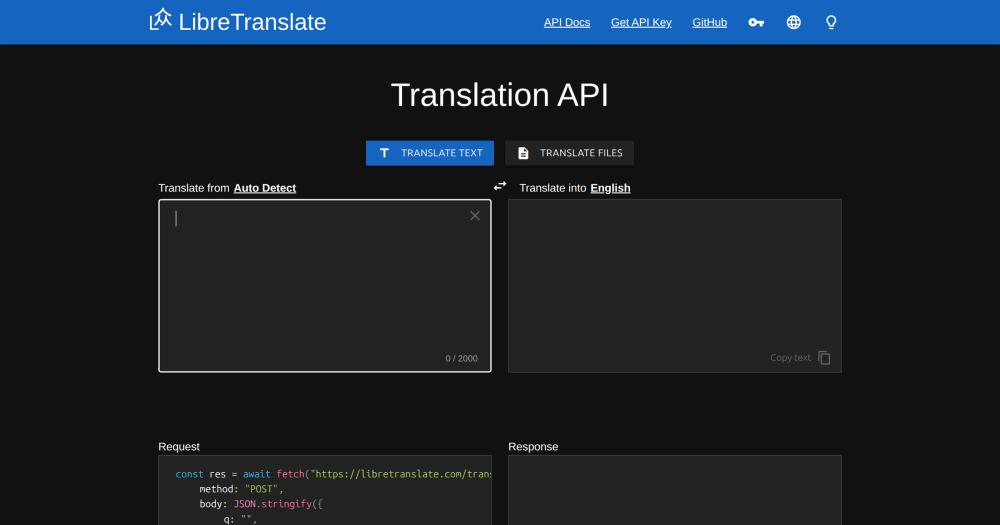
Run a self-hosted machine translation API powered by Argos Translate, with no dependency on Google, Azure, or any proprietary service.

Visit websiteGitHub17.3K starsDeploy on Hostinger
image of LibreTranslate
TL;DR

LibreTranslate is a self-hosted machine translation API that replaces paid services like DeepL Pro and Google Cloud Translation, keeping all translation requests on your own infrastructure. It is powered by Argos Translate, an open source translation library, and exposes a REST API compatible with standard HTTP clients. Licensed under AGPL-3.0, it runs offline once language models are downloaded. Best for developers building privacy-sensitive multilingual applications or teams managing high translation volumes without per-character billing.

Read the full breakdownHide the full breakdownWho it is for, how it works, trade-offs, the quick start and the FAQ
who it's for

Who LibreTranslate is for#

Developers building privacy-sensitive multilingual apps

Teams handling medical, legal, or financial documents who need translation functionality without routing text through third-party APIs. LibreTranslate provides a local endpoint that keeps all content on the application's own infrastructure, meeting data residency requirements that cloud APIs cannot satisfy.

Skip if:

Your app handles general-purpose consumer content and accuracy is the primary concern. Commercial APIs like DeepL or Google Translate produce measurably better output for most language pairs; the data-sovereignty benefit only matters when it is a hard requirement.

Teams running high-volume batch translation

Organizations that translate large document volumes regularly and want to avoid per-character fees accumulating at scale. A self-hosted instance converts the variable API cost into a fixed server cost, which becomes favorable above a threshold that depends on your server costs.

Skip if:

Your translation volumes are low and translation quality directly affects user experience. At low volume, the cost savings do not justify the operational overhead, and a managed API delivers better accuracy.

Self-hosters building offline-capable tools

Developers building applications for environments with no or limited internet access, such as local government systems, enterprise intranets, or field tools. LibreTranslate runs fully offline once models are downloaded and starts with a single command.

Skip if:

Your deployment target has reliable internet access and the offline requirement is not a constraint. Offline capability adds setup overhead that managed APIs avoid.

the problem

The problem it solves#

Machine translation for production use means choosing between accuracy and control. Commercial APIs from Google, Microsoft, Amazon, and DeepL produce high-quality output, but every piece of text you translate leaves your infrastructure, is processed on third-party servers, and may be subject to logging and data retention policies you cannot control. For teams handling medical records, legal documents, internal communications, or any sensitive data, this is a hard constraint.

The per-character billing model creates a second problem. A team translating large volumes regularly accumulates API costs with no ceiling unless they negotiate enterprise contracts. Developers who need a translation endpoint for a small app or a one-off data pipeline cannot easily run on managed APIs for free beyond minimal trial tiers.

how LibreTranslate solves it

How it solves it#

REST API for text and file translation

LibreTranslate exposes a standard HTTP REST API for translating both plain text and files across supported language pairs. Requests follow a simple JSON structure compatible with most HTTP clients and can be called from any programming language. File translation is available through a separate endpoint.

Offline-capable operation

Once language model packages are downloaded for the required language pairs, the server translates without any internet connection. This makes it suitable for air-gapped environments, secure networks, and deployments where outbound traffic must be restricted.

Argos Translate open source engine

The translation models are sourced from Argos Translate, an open source machine translation library. This means the entire stack from API to model weights is open source, with no proprietary dependency at any layer. No vendor lock-in applies to the underlying models.

Per-language-pair model installs

Language support is modular: install only the language pairs you need rather than loading a monolithic model. Models are downloaded as packages and loaded on demand, keeping server memory usage proportional to the language pairs you actually use.

No usage caps or rate limits from upstream

Running on your own server means no per-character billing, no rate limits from an upstream provider, and no account required. Translation throughput is bounded only by your hardware, making high-volume batch translation economical once the server is running.

strengths · trade-offs

Strengths and trade-offs#

Strengths

  • No data leaves your infrastructureEvery translation request stays on your server. Unlike DeepL Pro, Google Cloud Translation, or Amazon Translate, there is no network call to a third-party endpoint. For regulated industries or teams with data residency requirements, this removes a compliance blocker that cloud APIs cannot address.
  • 17,000+ stars with active developmentThe project has over 17,000 GitHub stars and 1,795 forks, with a last push to the repository in October 2026. Active maintenance means bug fixes and language model updates continue; the project is not stagnant or abandoned.
  • Zero per-request cost once deployedCommercial translation APIs charge per character, with costs accumulating quickly at high volumes. LibreTranslate has no per-request cost once deployed: total cost is the server you already operate, making it favorable for high-volume or ongoing translation workloads.

Trade-offs

  • -Translation quality below commercial leadersArgos Translate models produce lower accuracy than Google Translate, DeepL, or Microsoft Azure Translator for most language pairs, particularly for less common languages. Teams that need production-grade translation quality for customer-facing content or regulated document workflows will find the gap meaningful.
  • -132 open issuesThe project carries 132 open GitHub issues. For a critical production API deployment, reviewing the issue tracker before choosing LibreTranslate for specific language pairs or accuracy requirements is advisable, particularly for less common languages that may have fewer available models.
  • -AGPL-3.0 restricts building a managed service on topAGPL-3.0 requires that if you run a modified version of LibreTranslate as a service accessible to others over a network, you must publish the source of your modifications. Teams running it internally for their own use are not affected, but those building a managed translation product on top of it need to review this obligation before deploying.
versus alternatives

LibreTranslate vs alternatives#

LibreTranslate vs DeepL Pro

Both provide machine translation APIs for text and document translation. DeepL Pro is a managed cloud service with high-accuracy neural translation; LibreTranslate is a self-hosted open source alternative that runs on your own server.

FeatureLibreTranslateDeepL Pro
LicenseAGPL-3.0Proprietary
Self-hostingYesNo
Offline capableYesNo
Translation engineArgos Translate (open source)Proprietary neural MT
Cost modelServer costs onlyPer-character billing
Data residencyYour infrastructureDeepL's servers

LibreTranslate is the better choice when data sovereignty is a hard requirement: regulated industries, air-gapped environments, or applications where routing text to a third-party API is not permitted. The AGPL-3.0 license means you can run it internally without restriction. DeepL Pro is worth considering when translation accuracy is the primary concern, particularly for European languages where DeepL's models produce strong output, and when you do not want the operational overhead of running your own server.

LibreTranslate vs Google Cloud Translation

Google Cloud Translation is a fully managed API with broad language support and high output accuracy; LibreTranslate provides a self-hosted path for teams that need translation without cloud dependency.

FeatureLibreTranslateGoogle Cloud Translation
LicenseAGPL-3.0Proprietary
Self-hostingYesNo
Offline capableYesNo
Cost modelServer costs onlyPer-character billing
Data residencyYour infrastructureGoogle's servers

Google Cloud Translation covers more languages and delivers consistently higher output quality, making it the better choice for applications where translation accuracy determines user experience and internet access is reliable. LibreTranslate is the better fit when internet access is restricted, data must stay on-premise, or per-character costs at high volume make the managed API prohibitive.

install · quick start

Quick start#

bash
Install LibreTranslate via pip on your own server.
```bash
pip install libretranslate
```
tech stack · detected from GitHub

What it's built on#

Languages
Python
Frameworks
Flask
Cache
Redis
frequently asked

FAQ#

Is LibreTranslate free to use?

Yes. LibreTranslate is AGPL-3.0 licensed and free to run on your own server. There are no API keys, usage limits, or fees when self-hosted. A public demo instance at libretranslate.com is also available, with rate limits applied to prevent abuse. The pip package and source code are available on GitHub.

How does LibreTranslate compare to DeepL and Google Translate in accuracy?

Commercial APIs like DeepL and Google Translate produce higher accuracy output for most language pairs, particularly for nuanced or less common languages. LibreTranslate's Argos Translate models are competitive for common language pairs but the gap is noticeable for specialized or technical content. The tradeoff is data sovereignty and zero per-request cost versus best-in-class accuracy from managed cloud services.

Can LibreTranslate run offline?

Yes. Once language model packages are downloaded for the required language pairs, the server translates without any internet connection. This is one of the core advantages over cloud-only commercial APIs and makes LibreTranslate suitable for air-gapped environments or deployments where outbound traffic is restricted.

Does the AGPL-3.0 license affect how I can use LibreTranslate?

Internal use is unrestricted: you can run LibreTranslate on your own servers for your team or application without any licensing obligation toward others. The AGPL clause activates only if you modify the source code and make that modified version available to others over a network; in that case you must publish your modifications under the same license.

What languages does LibreTranslate support?

LibreTranslate supports a range of language pairs through Argos Translate model packages, which are downloaded separately for each language pair. The specific list depends on available Argos Translate models. Check the documentation at docs.libretranslate.com for the current supported language matrix, as the list grows as new Argos Translate models are released.

also worth a look

Similar open-source tools#

Agent Reach

Featured

Alternative toFirecrawl

Give any AI agent internet access, free and local

  • 108,787 GitHub stars
  • MITLicence MIT

Pyannote Audio

Alternative toAssemblyAI

Speaker diarization library for Python, pretrained PyTorch pipelines.

  • 10,752 GitHub stars
  • MITLicence MIT

Pomerado

Alternative toSkyvern

Build website MCP integrations from natural language, no API required.

  • 1,552 GitHub stars
  • MITLicence MIT

Openspline

Alternative toHeyGen LiveAvatar

Talking-avatar SDK for voice AI agents, MIT-licensed, Python and Node.

  • 334 GitHub stars
  • MITLicence MIT

Marker

Alternative toUnstructured.io

Convert documents to clean markdown and JSON with open source AI.

  • 40,748 GitHub stars
  • Apache-2.0Licence Apache-2.0

Bifrost

Alternative toPortkey

Open-source AI gateway with 23+ providers, failover, and MCP support.

  • 9,291 GitHub stars
  • Apache-2.0Licence Apache-2.0
by category

Open source tools in these categories#

470

AI & Machine Learning

freeCodeCamp, REA (Reverse Engineer Anything), OpenClaw
85

APIs & Integration

n8n, Firecrawl, iptv
544

Developer Tools

REA (Reverse Engineer Anything), Skills for Real Engineers, superpowers
Hostinger

Self-host LibreTranslate on a Hostinger VPS

Keep it running 24/7, even when your laptop is off. A Hostinger VPS gives it a server of its own.

  1. 01

    Choose a plan

    Starts from $6.49/mo

  2. 02

    Apply

    Extra 10% off yearly plans

  3. 03

    Install LibreTranslate

    On a server that stays on

  4. 04

    Start building

    Focus on the app, not the server

Deploy on Hostinger

Sponsors

Inbox Zero

Alternative toSuperhuman

AI email assistant that drafts replies and clears your inbox

  • 12,889 GitHub stars
  • AGPL-3.0Licence AGPL-3.0
  • #Email

rakazo

Alternative toGrok Bot

AI teammates you own: your keys, your model, your machine.

  • 6,568 GitHub stars
  • Apache-2.0Licence Apache-2.0
  • #AI Agents

SnitchFeed

Live monitoring on LinkedIn, X, Reddit & more. Agentic social listening for startups.

Marketing & Growth

Advertise your product

New open source projects by email

The projects we add and every new guide. Free, unsubscribe any time.

Find open source alternatives to paid software

/
  • Claude Code to OpenCode
  • Jira to Windshift
  • Notion to AppFlowy
  • Slack to Mattermost
  • Linear to GitLab
  • Wispr Flow to Handy
  • Arc to Zen Browser
  • CapCut to Concat
  • Grok Bot to rakazo
  • Superhuman to Inbox Zero
  • Airtable to AITable
  • Muse to OpenClaw
  • Railway to Coolify
  • GitHub Copilot to Cline
  • Datadog to Netdata
  • Confluence to Wiki.js
  • Microsoft Teams to Rocket.Chat
  • Pinecone to Qdrant
  • Zapier to n8n
  • 1Password to KeePassXC
  • Devin AI to OpenHands
  • Firebase to Supabase
  • Contentful to Strapi
  • Adobe Premiere Pro to Shotcut