Open Source Alternatives
  • Alternatives
  • Categories
    Categories by size1,196 projects
    • Developer Tools617
    • AI & Machine Learning520
    • Business & Productivity290
    • Web Development215
    • Security & Monitoring180
    • Communication & Collaboration159
    • IT Management151
    • LLMOps & AI Tooling132
    • Cloud & Hosting129
    • Product & Project Management126
    Browse all 21 categoriesDesign & Creative, DevOps & CI/CD and 9 more
  • Blog
  • Advertise
SearchNotion, Slack, password manager.../
Submit
Open Source Alternatives
  • Alternatives
    • Developer Tools617
    • AI & Machine Learning520
    • Business & Productivity290
    • Web Development215
    • Security & Monitoring180
    • Communication & Collaboration159
    • Browse all 21 categories
  • Blog
  • Advertise
Submit your project

New open source projects by email

The projects we add and every new guide. Free, unsubscribe any time.

Open Source Alternatives LogoOpen Source Alternatives

Handpicked Open Source Alternatives to Paid Softwares

Add Open Source Alternatives as a preferred source on Google

Product

  • Categories
  • Tag
  • Advertise

Resources

  • Blog
  • Collection
  • Submit

Company

  • Privacy Policy
  • Terms of Service
  • Refund Policy
  • Sitemap

Alternatives

  • Claude Code
  • Jira
  • Notion
  • Slack
  • Linear
  • Wispr Flow
  • All alternatives
© 2026 Open Source Alternatives. All rights reserved.
Open SourceAlternatives
Home/Categories/Developer Tools/LiveReview
icon of LiveReview

LiveReview

Open source alternative to CodeRabbit and Qodo

  • 128 stars
  • Sustainable Use License (fair-code, modified)
  • Active this week
  • Last commit 3 days ago

Last verified Nov 10, 2026

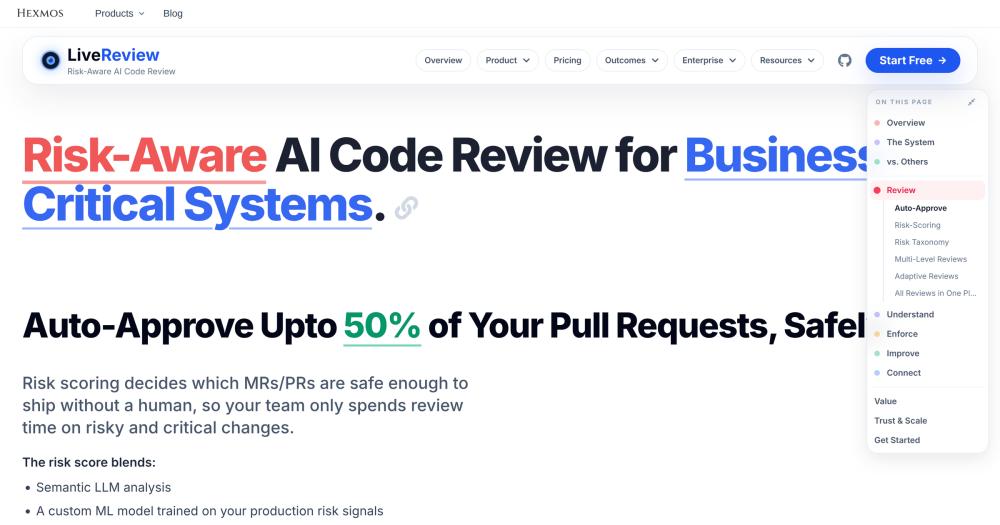
Monitor code changes with a self-hosted, risk-aware AI code reviewer that auto-approves low-risk PRs and scores every diff by blast radius.

Visit websiteGitHub128 starsDeploy on Hostinger
image of LiveReview
TL;DR

LiveReview is a self-hosted AI code review tool that auto-approves the lowest-risk 30-50% of pull requests and scores every remaining diff hunk by blast radius. It is an alternative to paid services like CodeRabbit, adding a production feedback loop that learns from your team's incidents and rollbacks to refine its approval policies. Source-available under a Sustainable Use License and deployable on Docker, it is best for engineering teams using AI coding assistants where production stability is a business concern.

Read the full breakdownHide the full breakdownWho it is for, how it works, trade-offs, the quick start and the FAQ
who it's for

Who LiveReview is for#

Engineering teams using AI coding assistants at scale

Teams where engineers routinely accept AI-generated code from Copilot, Cursor, or Claude Code gain a systematic inspection layer without slowing the writing process. LiveReview runs at every commit and PR, catching what the AI generated without requiring engineers to manually trace every diff.

Skip if:

If your team writes most code by hand without AI assistance, the auto-approve ratio and blast-radius scoring give less return on the operational overhead of running a self-hosted review server.

Platform teams managing high-blast-radius codebases

Teams maintaining shared platform code, payment processing, auth, or core infrastructure see the highest value from blast-radius prioritization. A 3-line change to a function used by 40 other services will surface immediately, while a large isolated refactor gets auto-approved without queue pressure.

Skip if:

If your team maintains mostly isolated services with clear ownership boundaries and low cross-service coupling, the blast-radius ranking adds less value than it does in a tightly coupled monorepo or shared platform codebase.

Security and compliance teams with regulated codebases

Teams in fintech, healthcare, or other regulated industries that need an auditable inspection layer for every code change can use LiveReview's air-gap mode and audit trail. Every auto-approved change is logged, every deliberate skip is recorded in git, and the CI/CD gate can block deploys on a failed review.

Skip if:

If your compliance requirement demands human sign-off on every code change with no automated approvals, LiveReview's auto-approve is not appropriate for the core compliance gate, though the risk scoring and annotations can still feed a human reviewer's workflow.

Cost-conscious teams paying for hosted AI code review

Teams currently paying per-seat or per-review for a hosted AI code review service can self-host LiveReview under its free tier (up to 30,000 lines of code reviewed per month) and eliminate that spend. For teams above that limit, paid plans scale by reviewed LOC, not by number of users.

Skip if:

If your team has no one who can run a Docker deployment and manage a reverse proxy for production, the self-hosted option requires at minimum one person comfortable with basic server administration.

the problem

The problem it solves#

AI coding tools like Copilot, Cursor, and Claude Code can generate code faster than any team can review it by hand. The result is a growing backlog of unreviewed changes, and a risk that bad code ships quietly between the cracks of a process built for human-speed output.

The harder part is that not all diffs are equal. A 3-line change to a function called by 40 other files, one that also writes to a database, carries far more production risk than a 300-line UI refactor in a fully-covered, isolated component. Standard review processes treat these diffs as equals and assign them to humans in the same queue at the same depth. That gap is where outages, security incidents, and regressions hide.

how LiveReview solves it

How it solves it#

Blast Radius and Review Priority Scoring

Every hunk in a diff gets two scores: blast radius (how many files and callers a change can reach, whether it writes to persistent storage, whether those callers span multiple subsystems) and review priority (cyclomatic complexity, loop depth, test coverage). LiveReview combines them into a single rank for the entire diff, so reviewers start where the risk is highest, not where the diff viewer starts.

Auto-Approve Up to 50% of PRs

Risk scoring identifies the lowest-risk 30-50% of changes and approves them automatically, without a human reviewer. The policy runs in three modes: conservative, balanced, or aggressive. Every auto-approved change stays in the audit trail; deliberate skips are logged in git. The system tracks false approvals, overrides, and production incidents, using that data to adjust the policy over time.

10-Category Risk Taxonomy

Every commit is scanned against 100+ failure patterns across 10 categories: reliability, correctness, performance, scalability, security, and five more. Each category tracks specific failure modes, from unhandled errors and race conditions to database query inefficiency and horizontal scaling bottlenecks. The taxonomy surfaces on every commit, not only when a reviewer happens to notice.

Five Review Checkpoints from Commit to CI/CD

LiveReview enforces reviews at five stages: commit (before the commit lands), before push (last chance before code leaves the machine), MR/PR (posted as inline comments), CI/CD (gates on every push via webhook), and scheduled (periodic sweeps for drift in untouched code). Teams mix and match per repository, turning on more checkpoints where failure is expensive and fewer where shipping speed matters.

Adaptive Reviews with Leader and Helper Model Architecture

Instead of running one expensive model for everything, Adaptive Reviews uses a high-capability Leader Model for issue detection and a cost-efficient Helper Model for writing explanations. The result is 40-50% lower AI inference costs with no degradation in review accuracy, since the Leader still drives every finding. Teams can review up to 2x the code on the same budget.

MCP Server, CLI, and IDE Extensions

LiveReview integrates through a git-native CLI (git-lrc), a Claude Code integration (claude-lrc), IDE extensions for in-editor review, and an MCP server for connecting from Claude, Cursor, or Windsurf. A REST API covers CI/CD pipelines, scripts, and bots. Teams adopt the path that fits their existing toolchain without being forced into a single integration point.

strengths · trade-offs

Strengths and trade-offs#

Strengths

  • Production Incident Feedback LoopLiveReview is the only tool in its category that learns from production outcomes. Teams log incidents and rollbacks against specific commits; the system feeds that data into its ML model and tightens or loosens approval policies based on what actually failed. CodeRabbit and Qodo review code in isolation from production, so their models never know which predictions turned out to be right.
  • Air-Gap and Self-Hosting ReadinessThe entire review system runs on-premises with no external data transmission required. Teams with compliance requirements, restricted network environments, or data privacy policies can run LiveReview fully air-gapped. Source code and diff data stay on the team's own infrastructure, not sent to a third-party review service.
  • Transparent Scoring ModelThe scoring model is fully explained: every factor that feeds the blast radius and review priority score is documented and visible in the diff viewer. Teams can inspect exactly why a change scored high or low. This is not a black-box ML score; it is a documented combination of call-graph traversal, storage write detection, and cyclomatic complexity.
  • Broad Git Platform SupportLiveReview works across GitHub, GitLab, Bitbucket, Gitea, and Azure DevOps with step-by-step integration docs for each. This covers the full range from large enterprise GitLab installations to small team Gitea deployments, without requiring teams to migrate their version control to a supported provider.

Trade-offs

  • -Fair-Code License Restricts Resale and Managed HostingLiveReview is source-available under a Sustainable Use License, not an OSI-approved open source license. Teams can self-host, modify, and run it for internal use at no charge, including commercial and team use. The restriction is resale: offering LiveReview as a hosted or managed service to other organizations, or distributing modified versions commercially, requires a separate commercial license. Enterprise Edition features require an Enterprise License.
  • -Docker and Linux/macOS Only for Self-HostingThe official self-hosted install requires Docker, bash, and either Ubuntu or macOS. Windows Server and Windows Desktop are not officially supported hosting environments. Teams running Windows-only infrastructure will need WSL2 or a separate Linux host. The bash-only requirement also means zsh and fish users must run the setup script in a bash environment.
  • -Early-Stage Project with 128 StarsLiveReview was created in August 2025 and had 128 GitHub stars and 16 open issues as of November 2026. It is an actively maintained project with recent commits, but it does not have the ecosystem depth or community breadth of more established tools. Teams adopting it early accept a tradeoff: more influence over direction, less accumulated community knowledge and third-party integrations.
  • -Production ML Model Requires Incident HistoryThe adaptive ML model that learns from production incidents is only as good as the incident data you feed it. New deployments start without a trained model: the system uses LLM analysis and static graph scoring from day one, but the approval policy feedback loop improves only as teams log real incidents and rollbacks. Teams without systematic incident tracking will not get the full benefit of the production learning feature.
versus alternatives

LiveReview vs alternatives#

LiveReview vs CodeRabbit

CodeRabbit and LiveReview both provide AI-powered code review comments on pull requests and support multiple Git platforms. The core difference is deployment model and production learning.

FeatureLiveReviewCodeRabbit
DeploymentSelf-hosted or cloud (bring-your-own-key)Cloud-hosted SaaS
LicenseSustainable Use (source-available)Proprietary
Auto-approveYes, with configurable risk policyYes
Production outcome learningYes, tracks incidents and rollbacksNo
Blast-radius scoringYesNo
Air-gap supportYesNo
PricingFree up to 30k LOC/month; $32/month for 100k LOCPer-seat or per-repository

LiveReview is the stronger choice when data privacy, air-gap requirements, or production feedback loops are the deciding factors. Teams processing code on-premises for compliance reasons cannot use CodeRabbit's cloud service; LiveReview's self-hosted path covers that case. The production incident learning feature is unique to LiveReview: auto-approve policies improve as the system observes which predicted low-risk changes actually caused production problems.

CodeRabbit is worth considering for teams that do not need self-hosting and want a fully managed service with no server administration overhead. If running a Docker deployment on a server is not something your team has capacity for, CodeRabbit's cloud-first model is simpler to start.

LiveReview vs Qodo

Qodo takes a broader approach than LiveReview. Its product spans IDE integration, PR review, and standardized code quality tooling, while LiveReview focuses specifically on the risk-scoring and auto-approval problem.

FeatureLiveReviewQodo
DeploymentSelf-hostedCloud/IDE extension
Risk scoringYes, blast-radius basedNo
Auto-approve workflowYesNo
IDE integrationExtension availableCore product
Production learningYesNo
Air-gapYesNo

Qodo is a better fit when the goal is standardizing code quality practices in the IDE as engineers write, rather than inspecting code at review time. Its integration into the developer's writing workflow catches style and correctness issues earlier in the process.

LiveReview is the better choice when the goal is a post-write inspection layer: catching what AI coding tools generate, ranking review attention by business risk, and automating approvals for safe changes. The two tools address different points in the workflow and can run alongside each other without conflict.

install · quick start

Quick start#

bash
Self-hosting LiveReview uses Docker and runs on Ubuntu or macOS with jq installed.
```bash
curl -fsSL https://raw.githubusercontent.com/HexmosTech/LiveReview/master/lrops.sh | sudo bash -s setup-demo
```
tech stack · detected from GitHub

What it's built on#

Languages
GoJavaScriptPythonTypeScript
Frameworks
React
Tooling
esbuildWebpack
frequently asked

FAQ#

Is LiveReview free to use?

The self-hosted tier is free for up to 30,000 lines of code reviewed per month, with unlimited users on that plan. Paid plans start at $32/month for 100,000 LOC and scale by reviewed lines, not by seat count. The source code is available on GitHub under a Sustainable Use License, so teams can audit the code, run security scans, and maintain full data privacy with an air-gapped deployment.

What license does LiveReview use?

LiveReview uses a Sustainable Use License, a fair-code license that is source-available but not OSI-approved open source. Self-hosting for internal use, including internal commercial and team use, is permitted at no charge. Teams may not resell LiveReview, offer it as a managed or hosted service to others, or distribute modified versions commercially without a separate commercial license. Enterprise Edition features require an Enterprise License. The full terms are in the repository.

Which Git platforms does LiveReview support?

LiveReview supports GitHub, GitLab, Bitbucket, Gitea, and Azure DevOps for MR/PR review comments. The CLI-based commit and push-time reviews work with any Git repository regardless of the hosting platform. Step-by-step integration guides are available for each supported provider in the official documentation.

How does the auto-approve feature decide which PRs are safe?

Risk scoring blends three signals: LLM semantic analysis of the diff, a custom ML model trained on your team's production incidents and rollbacks, and static call-graph analysis of your codebase. Each diff hunk gets a blast-radius score (how far the change can propagate) and a review-priority score (complexity and test coverage). The lowest-scoring 30-50% of changes, depending on your selected policy (conservative, balanced, or aggressive), are auto-approved without a human reviewer.

Can LiveReview run in an air-gapped environment?

Yes. The self-hosted deployment has no required external connections: AI inference runs against your own API keys and models, and all code and diff data stays on your infrastructure. The setup script pulls Docker images during initial install, so an internet connection is needed at setup time. Ongoing operation does not require external access. The official productionization guide covers air-gap deployment in detail.

also worth a look

Similar open-source tools#

Pr Agent

Alternative toCodeRabbit

Open source AI PR reviewer for GitHub, GitLab, Bitbucket, and more

  • 15,457 GitHub stars
  • MITLicence MIT

no_human

Alternative toConductor

From ticket to reviewed pull request, on your machine.

  • 320 GitHub stars
  • MITLicence MIT

Grit

Alternative toModerne

Automate code migrations at scale using a pattern-matching DSL

  • 4,623 GitHub stars
  • MITLicence MIT

Code Server

Alternative toGitHub Codespaces

VS Code in the browser, self-hosted, with no per-seat pricing.

  • 79,785 GitHub stars
  • MITLicence MIT

Bifrost

Alternative toPortkey

Open-source AI gateway with 23+ providers, failover, and MCP support.

  • 9,431 GitHub stars
  • Apache-2.0Licence Apache-2.0

Nuphos

Featured

Alternative toConductor

Agent workspace for teams running Claude Code or Codex

  • 372 GitHub stars
  • Apache-2.0Licence Apache-2.0
by category

Open source tools in these categories#

617

Developer Tools

REA (Reverse Engineer Anything), Skills for Real Engineers, superpowers
123

DevOps & CI/CD

Nvm, Uptime Kuma, Netdata
180

Security & Monitoring

RustDesk, REA (Reverse Engineer Anything), Sherlock
520

AI & Machine Learning

freeCodeCamp, REA (Reverse Engineer Anything), OpenClaw
Hostinger

Self-host LiveReview on a Hostinger VPS

Keep it running 24/7, even when your laptop is off. A Hostinger VPS gives it a server of its own.

  1. 01

    Choose a plan

    Starts from $6.49/mo

  2. 02

    Apply

    Extra 10% off yearly plans

  3. 03

    Install LiveReview

    On a server that stays on

  4. 04

    Start building

    Focus on the app, not the server

Deploy on Hostinger

Sponsors

Inbox Zero

Alternative toSuperhuman

AI email assistant that drafts replies and clears your inbox

  • 12,942 GitHub stars
  • AGPL-3.0Licence AGPL-3.0
  • #Email

rakazo

Alternative toGrok Bot

AI teammates you own: your keys, your model, your machine.

  • 7,478 GitHub stars
  • Apache-2.0Licence Apache-2.0
  • #AI Agents

SnitchFeed

Live monitoring on LinkedIn, X, Reddit & more. Agentic social listening for startups.

Marketing & Growth

Advertise your product

New open source projects by email

The projects we add and every new guide. Free, unsubscribe any time.

Find open source alternatives to paid software

/
  • Claude Code to OpenCode
  • Jira to Windshift
  • Notion to AppFlowy
  • Slack to Mattermost
  • Linear to GitLab
  • Wispr Flow to Handy
  • Arc to Zen Browser
  • CapCut to Concat
  • Grok Bot to rakazo
  • Superhuman to Inbox Zero
  • Airtable to AITable
  • Muse to OpenClaw
  • Railway to Coolify
  • GitHub Copilot to Cline
  • Datadog to Netdata
  • Confluence to Wiki.js
  • Microsoft Teams to Rocket.Chat
  • 1Password to KeePassXC
  • Firebase to Supabase
  • Pinecone to Qdrant
  • Zapier to n8n
  • Devin AI to OpenHands
  • Asana to Leantime
  • Contentful to Strapi